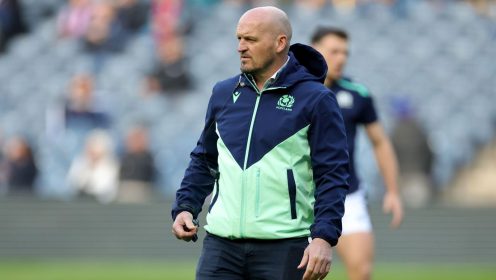
Italy v Scotland prediction: Gregor Townsend’s ‘gambles’ pay off to avoid ‘humiliating’ Six Nations repeat

Saturday’s Stadio Olimpico encounter carries weight beyond Round One of this year’s Six Nations as Italy arrive in front of their Rome faithful having established something near to competitive respectability under Gonzalo Quesada but, as is always the case, still searching for silverware.
Scotland pitch up wounded after November’s collapses against New Zealand and Argentina, with Gregor Townsend’s job security looking shakier by the week.
Townsend’s ruthless team selection speaks volumes about the pressure he’s facing as he looks to turn around the failures of the autumn. He’s done something akin to the unthinkable, with Blair Kinghorn dropped entirely and Duhan van der Merwe omitted from the 23 and Darcy Graham benched.
Tom Jordan starts at full-back with Jamie Dobie on the wing, suggesting these are more than minor tweaks, smacking somewhat of a coach throwing the dice to get a blend of teamship over individual promise. The contrast in recent trajectories is sharp.
Quesada’s Italy have spent three years building an identity – attacking ambition balanced with defensive organisation – and accepting that results lag behind performance when you’re competing against sides with superior resources. November’s win over Australia validated that approach and many believe that was no fluke and that Italy are building something real.
Scotland’s story reads differently. Townsend inherited mediocrity in 2017, rebuilt them into genuine contenders, then watched progress plateau into frustrating near-misses and painful late collapses. The depth is genuine – this squad might be Scotland’s strongest in the professional era – but talent without mental resilience just produces sophisticated disappointment and time is running out for the former British and Irish Lion fly-half.
The scrutiny on Townsend has intensified since November. Scottish journalists asked pointed questions about his future during the autumn and, unusually for Toony, his answers felt defensive, lacking the conviction you’d expect from a coach confident in his position. The Scottish Rugby Union backed him publicly but backing a coach in February doesn’t prevent sacking him in March. Townsend knows this opener matters beyond points on the board.
You feel this is make-or-break territory for both coaches, especially with strong rumours abounding that the great Sergio Parisse is primed to take over the leadership and forward coaching of the Azzurri. Quesada needs to show that competitive performances can translate into wins against stronger opponents whilst Townsend needs to prove eight years hasn’t ossified into stagnation, that his side can close out tight matches when pressure mounts.
In summary, we’re at the intriguing point where one side believes they’re building something, whilst the other wonders if the foundations are crumbling.
Where the game will be won
Scotland hold clear advantages in the two areas that define modern Test rugby: breakdown effectiveness and aerial dominance.
The evidence comes from Europe. When Glasgow dismantled Toulouse and Saracens at Scotstoun, when Edinburgh beat RC Toulon, the pattern was identical – relentless breakdown pressure creating turnovers, then suffocating territory through intelligent kicking and there’s little doubt Scotland can replicate this at international level through players who execute these systems weekly for their clubs.
Gregor Brown’s bench impact has been transformative in Europe’s pool stages, often used off the bench for impact, a role he’ll relish on Saturday. His introduction typically coincided with opposition fitness degrading, creating windows where his fresh power overwhelms fatigued resistance.
Rory Darge remains one of the competition’s most effective poachers whilst the great captain and now Lion Sione Tuipulotu adds carrier quality and organisational leadership that Italy will struggle to contain across 80 minutes.
The aerial battle presents Scotland’s clearest route to control. Finn Russell’s kicking game has reached exquisite levels over the past 18 months and he identifies defensive vulnerabilities, kicks into spaces that exploit them, then watches his chase line arrive with pinpoint timing. Italy will compete through committed chase work but competing and controlling are different propositions and you’d feel that the Scots hold the aerial aces.
Scotland’s plan will be straightforward. Kick Italy into positions where mistakes occur through pressure and physicality – poor clearances under pressure, mistimed jumps, handling errors – then capitalise through power and precision. The question isn’t whether Scotland possess these advantages but whether they execute with sufficient ruthlessness to get the right side of the scoreboard.
Exclusive: World Rugby clear up red card ‘confusion’ ahead of 2026 Six Nations
Last time they met
What they said
Quesada acknowledged that facing Scotland first presents complications. “I don’t know if it’s the ideal game because Scotland lost a couple of games they shouldn’t lose,” he noted.
“They played amazing rugby against the All Blacks and Argentina, but they finish losing.”
The Italian coach understands wounded opponents arrive dangerous, particularly when their coach faces mounting pressure, but Quesada’s mission extends beyond individual results, and as is often the case in Italian rugby, his focus remains on building an identity rather than chasing scoreboard validation.
“We cannot only have results as the goal because we know that it would be frustrating and not realistic when we see the level of other teams,” he explained.
“It’s more about consistency. A good set piece, a big crowd, organised defence, providing a lot of passion, and we never stop proposing exciting, attacking rugby; that must be part of our DNA.”
Townsend described this championship as “open” whilst acknowledging his squad represents “arguably the best depth they’ve had in recent memory.”
The depth matters less than execution under pressure – precisely where Scotland have failed repeatedly under his tenure.
The media scrutiny hasn’t relented since November’s collapses. When asked pointedly during the Autumn if his position should be questioned, Townsend offered no pushback and the silence spoke volumes. This Six Nations feels like last-chance territory for a coach who’s delivered progress without silverware, improvement without breakthrough, and worst of all, turned promising situations into crushing defeats.
Players to watch
Danilo Fischetti continues establishing himself as one of Europe’s most destructive scrummaging looseheads. He generates scrum penalties that shift momentum, as evidenced against South Africa where he toasted both Springbok tightheads, and against a Scottish scrum missing some regular starters, he’ll fancy his chances of causing problems.
Manuel Zuliani brings abrasive carrying and pinpoint breakdown from the back-row – the sort of direct running that forces defensive systems to commit extra numbers and creates space elsewhere.
Captain Michele Lamaro approaches his 50th cap and provides the organisational leadership Italy require when matches turn attritional and deep experience of closing tight games out.
Italy arrive weakened by injuries – Ange Capuozzo out, Sebastian Negri unavailable, Tommaso Allan doubtful – but these three remain essential long-term propositions and will all be sorely missed.
For the Scots, Ben White arrives as the most improved scrum-half in world rugby, and admitted to Planet Rugby recently that honing his trade alongside Baptiste Serin at Toulon has transformed his game – the service speed, the decision-making under pressure, the tempo management- White’s become the conductor Scotland lacked for years and adds real class inside Russell.
Tom Jordan gets the nod at full-back ahead of dropped Kinghorn – a selection call that shows Townsend responding to pressure with boldness rather than conservatism- but the flip side of that is Jordan’s Bristol form, way ahead of that shown by Kinghorn for Toulouse so far this year.
George Horne provides the alternative off the bench, and his club form has seen lightning pace and real spike when Glasgow need quick ball exploited. He’s become Warriors’ heartbeat in Europe, injecting tempo perfect for his bench role. The contrast between White’s control and Horne’s chaos gives Scotland genuine tactical flexibility.
Rory Darge’s breakdown work needs no introduction, whilst the criminally underrated Scott Cummings continues delivering the lineout security and defensive grunt that allows teammates surety of possession and quick ball. Gregor Brown’s bench impact deserves a mention too – his introduction typically coincides with opposition legs tiring and Scottish intensity increasing and that combination he’s already shown has proved decisive repeatedly in European competition and translates directly to Test rugby.
Main head-to-head
Nacho Brex versus Huw Jones presents the encounter’s most intriguing tactical battle. Both players swap positions during phase play, often moving between 10, 12 and 13, making this less a straight individual matchup and more a chess match of positioning and exploitation.
Brex operates predominantly at outside centre but drifts into first receiver when Italy require his distribution skills. He’s the glue holding Italy’s backline structure together when possession changes hands rapidly and his game centres on intelligent distribution and defensive organisation – reading attacking shapes, communicating line speed, and keeping defensive systems compressed.
Jones brings something entirely different- offering devastating pace off first-phase ball and the ability to exploit marginal defensive gaps that disappear once defences reset. He’s evolved beyond simple pace merchant though and his positioning has improved dramatically, reading space before it materialises and hitting those angles at maximum velocity, almost ghosting into killer support lines that sees him scoring a lot of tries for club and country.
The match-up will determine whether Scotland’s defensive system can handle Brex’s distribution and threaten their outside channels. If Jones receives early ball on Brex’s outside shoulder, Italy’s defensive system faces problems it cannot solve without committing extra defenders covering and drifting around the moderated push defence they employ. If Brex controls tempo and keeps Russell defending rather than attacking, Scotland’s threat diminishes significantly.
Whoever controls the critical 50-70 minute window – when Test matches are typically decided – will likely determine the outcome. Brex needs to maintain defensive organisation as Italian legs tire but there’s little doubt that Jones will look to exploit the space that fatigue creates.
Prediction
Scotland’s record in Rome matters. Last time these sides met at the Stadio Olimpico, Italy won – seismic for Quesada’s project but humiliating for Townsend’s. Scotland know this venue doesn’t suit them especially first with a hostile crowd generating an atmosphere that unsettles visiting sides. Rome has become a graveyard for Scottish ambitions and that will play on their mind.
Italy will start well – they always do at home against Scotland, feeding off crowd energy and early defensive intensity. Four years ago, in Round One they led France deep into the match before Les Bleus’ power told in the final quarter and Galthie’s men sneaked over the line.
The opening exchanges will feel tight; Italian crowds create doubt in visiting sides, magnify small errors into psychological crises and worryingly, Townsend’s Scotland have proved vulnerable to exactly this environmental pressure throughout his tenure.
Townsend’s selection gambles add another variable and whilst dropping Kinghorn and van der Merwe could energise a squad tired of near misses, equally it could create positional fragility and unfamiliarity when structure and relationship matters most. Jordan and Dobie have huge talent but lack Test experience in these positions; one early mistake and the crowd pounces and their confidence, playing outside their optimal position, may crumble.
But Scotland possess two decisive advantages that become overwhelming as matches progress; superior power across the pack and bench depth that Italian conditioning cannot match over 80 minutes, particularly with Italy missing Capuozzo, Ross Vintcent and Negri.
When Brown, Horne and Scotland’s replacement forwards arrive around the hour mark, we’ll see the outcome framed as fresh legs against fatigued defenders and power against weakening resistance, which should prove enough to take Townsend’s side across the line.
Glasgow and Edinburgh’s European success comes from exactly this – identifying the moment when opposition fitness degrades, then exploiting that window ruthlessly through superior replacement quality and Scotland, critically, will replicate that pattern through personnel depth Italy cannot match.
Italy should compete for 50-55 minutes, possibly lead briefly, but we reckon that Scotland pull away late for a bonus-point win, although Italy will make them work considerably harder than the final score suggests. But who knows what might happen in the cauldron of Rome as Italy look to benchmark their improvement. Scotland by 14.
Previous results
2025: Scotland won 31-19 at Murrayfield
2024: Italy won 31-29 in Rome
2023: Scotland won 25-13 at Murrayfield
2023: Scotland won 26-14 at Murrayfield
2022: Scotland won 33-22 in Rome
2021: Scotland won 52-10 at Murrayfield
2020: Scotland won 28-17 in Florence
2020: Scotland won 17-0 in Rome
2019: Scotland won 33-20 at Murrayfield
The teams
Scotland: 15 Tom Jordan, 14 Kyle Steyn, 13 Huw Jones, 12 Sione Tuipulotu (c), 11 Jamie Dobie, 10 Finn Russell, 9 Ben White, 8 Jack Dempsey, 7 Rory Darge, 6 Matt Fagerson, 5 Grant Gilchrist, 4 Scott Cummings, 3 Zander Fagerson, 2 Ewan Ashman, 1 Pierre Schoeman
Replacements: 16 George Turner, 17 Nathan McBeth, 18 Elliot Millar Mills, 19 Max Williamson, 20 Gregor Brown, 21 George Horne, 22 Adam Hastings, 23 Darcy Graham
Italy: 15 Leonardo Marin, 14 Louis Lynagh, 13 Juan Ignacio Brex, 12 Tommaso Menoncello, 11 Monty Ioane, 10 Paolo Garbisi, 9 Alessandro Fusco, 8 Lorenzo Cannone, 7 Manuel Zuliani, 6 Michele Lamaro (c), 5 Andrea Zambonin, 4 Niccolò Cannone, 3 Simone Ferrari, 2 Giacomo Nicotera, 1 Danilo Fischetti
Replacements: 16 Tommaso di Bartolomeo, 17 Mirco Spagnolo, 18 Muhamed Hasa, 19 Federico Ruzza, 20 Riccardo Favretto, 21 Alessandro Garbisi, 22 Giacomo Da Re, 23 Lorenzo Pani
Date: Saturday, February 7
Venue: Stadio Olimpico, Rome
Kick-off: 15:10 local (14:10 GMT)
Referee: Ben O’Keeffe (NZR)
Assistant referees: James Doleman (NZR), Katsuki Furuse (JRFU)
TMO: Richard Kelly (NZR)
FPRO: Marius van der Westhuizen (SARU)
READ MORE: 2026 Six Nations: Comprehensive TV broadcast guide, how to watch the action anywhere in the world