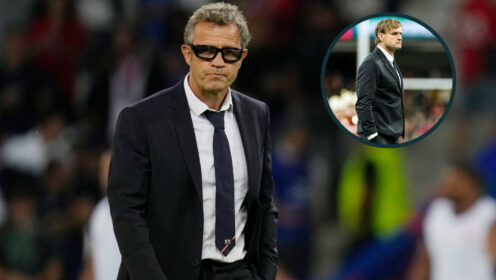
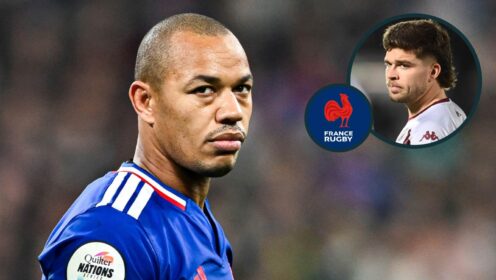
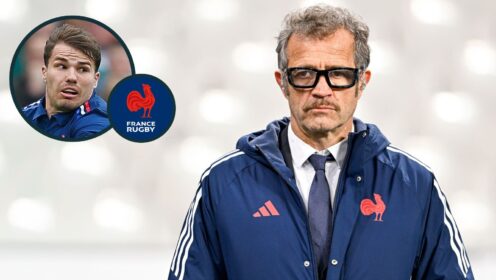
Six Nations prediction: Fabien Galthie’s ‘calculated gamble’ to pay off as France claim consecutive titles
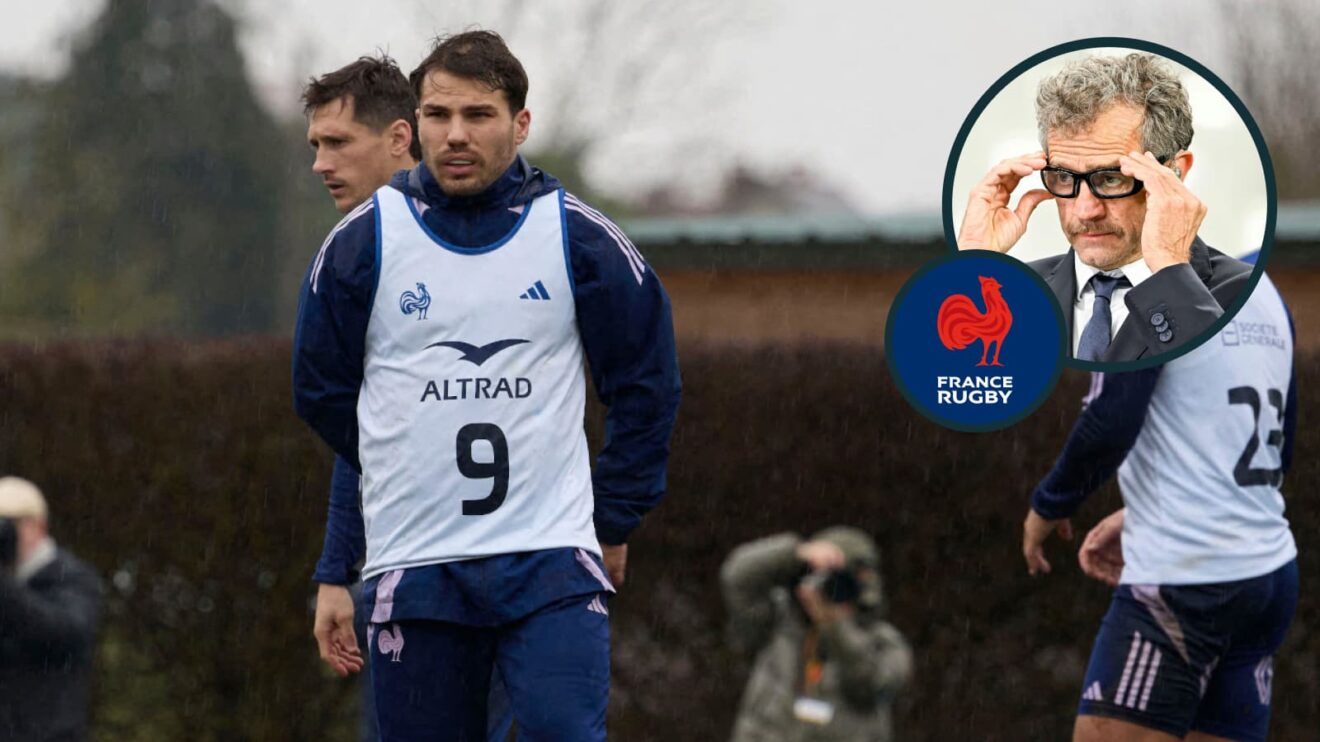
Can Antoine Dupont and Fabien Galthie lead France to Six Nations glory?
Last up in our set of previews ahead of the 2026 Six Nations, we examine the prospects of last year’s champions, Fabien Galthié’s France.
France begin their title defence on Thursday against Ireland in Paris carrying the burden of tragedy alongside Galthié’s most ruthless selection decisions in six years as national coach. France’s preparation has been shaped by disruption and difficult calls, not all of them purely rugby related.
The heart attack that forced Uini Atonio into immediate retirement last week casts a shadow over preparations that were already complicated by the coach’s brutal cull of Grégory Alldritt, Damian Penaud and Gaël Fickou, three players who, between them, have accumulated 215 caps and represent the institutional memory of France‘s recent success.
Galthié‘s gamble extends beyond personnel into philosophy. On his watch, France has essentially been Stade Toulousain with additions, the Rouge et Noir spine of Antoine Dupont, Romain Ntamack, Julien Marchand and Thibaud Flament providing the framework around which Les Bleus were constructed.
Toulouse won European Cups in 2021 and 2024, dominated Top 14 rugby, and Galthié sensibly built his Test side around what was working at the highest level of club rugby. Now it’s Union Bordeaux-Bègles’ turn.
UBB won the 2025 Investec Champions Cup final against Northampton Saints playing rugby that felt less like a tactical system and more like organised chaos rendered beautiful through precision, and Galthié has loaded his squad with Bordeaux influence: Louis Bielle-Biarrey, Nicolas Depoortère, Yoram Moefana, Matthieu Jalibert, Romain Buros, Cameron Woki and Maxime Lamothe all selected in the squad.
The shift from Toulouse’s systematic excellence to Bordeaux’s controlled chaos creates tactical questions that Thursday night will expose. Can Dupont, returning from the ACL rupture that ended his 2025 Six Nations in the 42-27 demolition of Ireland in Dublin, bridge the transition from one club’s dominance to another, or will the shift create dissonance that Andy Farrell’s injury-ravaged but tactically sophisticated Irish side will exploit?
Ntamack’s injury forces Jalibert into the number 10 shirt for the tournament opener, pairing him with Thomas Ramos in a 10/15 combination that carries tactical uncertainty despite previous Test starts together, adding further questions to an already volatile selection.
Atonio’s absence removes scrummaging ballast and leadership from a pack that was already reconfigured by Galthié’s decision to drop Alldritt, the physical enforcer whose 4×4 carrying ability has been central to France’s forward play since 2019. In normal circumstances, this would be a purely rugby debate.
It won’t be this time. Régis Montagne, the 25-year-old Clermont tighthead who was playing in Pro D2 two seasons ago, inherits Atonio’s role against an Irish pack that will target France’s scrum with predatory focus, whilst the back-row loses both Alldritt’s grunt work and the insurance policy his presence provided when matches turned attritional.
The gamble is calculated but significant. Galthié is backing talent over experience, evolution over consolidation, and club form over Test pedigree in positions where international rugby traditionally rewards the opposite qualities.
Whether this represents visionary selection or hubristic overreach will be settled over the next eight weeks, beginning with a Thursday night fixture in Paris that carries the emotional weight of Atonio’s tribute alongside the tactical intrigue of France’s selection revolution.
Last year
France claimed the 2025 Six Nations title despite losing to England in Round Two, their 42-27 destruction of Ireland in Dublin effectively deciding the Championship before the final weekend arrived. Bielle-Biarrey’s eight tries set a new Six Nations record, whilst Dupont’s leadership reached exceptional levels until the ACL rupture against Ireland ended his involvement.
The Ireland performance represented French rugby at its most clinical, dismantling Grand Slam winners with forward dominance and backline precision. The 26-25 defeat to England at Twickenham exposed defensive vulnerabilities and breakdown discipline issues that would resurface in autumn’s 32-17 loss to South Africa, suggesting Galthié’s attacking philosophy occasionally compromises defensive structure.
Autumn victories over Fiji (34-21) and Australia (48-33) weren’t illuminating. The Springboks defeat highlighted ongoing issues with game management in tight finishes and defensive organisation against sides capable of exploiting transition opportunities, the same weaknesses England had exposed nine months earlier.
Dupont’s injury fundamentally altered France’s year – and a sidebar is that France are still furious about the clear-out that led to it, caused by Irish forwards.
His absence through autumn removed the organising intelligence that allows France’s attacking ambition to function coherently, and whilst Nolann Le Garrec and Maxime Lucu provided competent cover, neither possessed his ability to read defensive structures and exploit space before it closed.
This year
France’s fixture list begins with the Championship’s most difficult assignment and concludes with its most anticipated. The Thursday night opener against Ireland in Paris represents the tournament’s defining fixture, a repeat of last year’s Dublin showdown between defending champions and a side desperate to reclaim the title.
Ireland arrive carrying an injury crisis that has removed Andrew Porter, Robbie Henshaw, Mack Hansen, Paddy McCarthy, Jack Boyle and Hugo Keenan, but Farrell’s sides consistently absorb personnel losses without compromising tactical coherence.
Wales in Cardiff on February 15 presents the second fixture, where France have historically struggled but where the Welsh rebuild has yet to generate convincing results. Scotland at Murrayfield on March 7 follows Italy in Lille on February 22, both matches France will expect to win, before the tournament concludes with England at the Stade de France on March 14 in what could become a title decider.
The target sequence is straightforward: beat Ireland to establish momentum, secure four wins from the remaining fixtures to claim the title. Losing to Ireland creates pressure that accumulates through subsequent rounds, particularly if England maintain form and the final fixture in Paris becomes a Championship eliminator rather than a coronation.
England team: Steve Borthwick benches Maro Itoje as Tommy Freeman gets centre nod
The trickiest assignment is unquestionably Ireland. Not because the other fixtures are guaranteed victories but because losing in Paris to an injury-ravaged side would represent tactical failure and a psychological blow that France might struggle to recover from. The Six Nations will be won or lost on February 5.
Key players
Antoine Dupont returns from the ACL rupture that ended his 2025 campaign, his presence immediately restoring the organising intelligence France lacked through autumn. Dupont’s value extends beyond exceptional passing and defensive work rate into game management and tactical decision-making under pressure, his ability to read defensive structures making him the world’s most influential scrum-half.
The complication is whether he can survive 80 Test minutes having played just 458 minutes of competitive club rugby since March 2025, and whether he can bridge the shift from Toulouse’s systematic excellence to Bordeaux’s instinctive patterns whilst integrating players he’s never previously partnered at Test level.
François Cros represents France’s most significant fitness concern. The Toulouse flanker, operating as le gratteur on the left channel in France’s vertical back-row system, has made just three club appearances this season, and whilst he remains the fittest player in French rugby by conditioning metrics, match sharpness cannot be replicated in training.
Cros functions as connective tissue between France’s aggressive defence and counter-attacking game, his ruck work creating the turnover platform that allows Bielle-Biarrey and Depoortère to operate in transition. Without him, France’s system fractures. The concern is whether he can sustain 80 minutes against Ireland’s multi-phase attack without his fitness betraying him in the critical 50 to 65-minute window.
Louis Bielle-Biarrey‘s eight tries in 2025 established him as the Six Nations’ most dangerous attacking weapon, his combination of raw pace and intelligent running lines making him almost impossible to defend in transition.
The 22-year-old Bordeaux wing exploits half-gaps other players don’t recognise, his ability to read defensive shoulders and accelerate through closing windows providing France with a try-scoring threat from anywhere inside opposition territory. Ireland will structure their defensive system specifically to prevent Bielle-Biarrey receiving quick ball in space, making the opening 20 minutes critical.
The Matthieu Jalibert–Thomas Ramos combination at 10-15 represents the tournament’s most intriguing tactical variable. Jalibert’s club form for Bordeaux has been exceptional, his instinctive decision-making aligning with UBB’s attacking philosophy, but his Test career has been characterised by inconsistency and friction with Galthié around game management.
They have started together previously, most recently in the 2025 Six Nations against England, but that partnership operated within a different tactical framework, and whether they can develop the control required to dominate territory against Ireland’s defensive system will determine whether France’s backline functions coherently.
Players to watch
Régis Montagne inherits Atonio’s tighthead role, carrying the dual burden of replacing an irreplaceable figure whilst proving his rapid development from Pro D2 to Test rugby wasn’t premature.
The 132kg Clermont prop started all three November Tests, demonstrating quality set-piece work whilst occasionally struggling against Springbok scrummaging power. His performance against Ireland’s scrum will effectively decide whether France maintain parity or surrender territorial advantage.
Théo Attissogbé is sure to replace Penaud on the right wing despite missing November through injury, his selection ahead of France’s all-time leading try scorer representing Galthié’s most controversial decision beyond the Alldritt omission.
The 21-year-old Pau flyer possesses searing pace and has impressed for a Pau side currently second in the Top 14, but asking him to perform against Ireland’s defensive system and aerial maturity represents significant pressure.
Nicolas Depoortère’s expected inclusion alongside Yoram Moefana imports Bordeaux’s centre partnership directly into Test rugby, the 23-year-old outside centre bringing offloading skills and dynamic fend work whilst possessing defensive solidity that modern international rugby demands.
His combination with Moefana provides a genuine X-factor in the 12-13 channel; their understanding developed through club rugby potentially offering decision-making advantages.
Prospects
France enter as defending champions with attacking firepower to destroy any side in the competition and defensive vulnerabilities that allow competent attacking sides to score tries against them.
The Grand Slam remains achievable if they navigate Ireland successfully and maintain performance consistency, and if the squad remains fit through five matches, France possess the quality to claim consecutive titles.
Best case sees France winning all five through Dupont’s organisational brilliance, Bielle-Biarrey’s attacking menace and the forward dominance that their reconfigured pack can deliver. The Bordeaux influence integrates seamlessly, Jalibert’s instinctive game management complements Ramos’ tactical kicking, and Galthié’s selection gambles are vindicated.
Want more from Planet Rugby? Add us as a preferred source on Google to your favourites list for world-class coverage you can trust.
Worst case involves losing to Ireland through scrum weakness, Cros’s diminished effectiveness through match fitness issues, and the Jalibert-Ramos combination failing to control territory. Subsequent fixtures become increasingly pressurised, defensive vulnerabilities reappear, and France finish third or fourth.
Realistic assessment suggests France can claim the Championship. Their opening match turns on one thing: France’s ability to hold scrum parity. The emotional tribute to Atonio provides fuel that Ireland, for all their tactical sophistication, cannot match on a Thursday night in Paris.
France can edge a five-point game through superior attacking quality and home advantage, with Montagne’s scrummaging just adequate enough to prevent Ireland from establishing territorial dominance. The subsequent four fixtures offer no serious threat if France maintain fitness and form. First.
Fixtures
Thursday, February 5 v Ireland (Stade de France, Paris)
Sunday, February 15 v Wales (Principality Stadium, Cardiff)
Sunday, February 22 v Italy (Stade Pierre Mauroy, Lille)
Saturday, March 7 v Scotland (Scottish Gas Murrayfield, Edinburgh)
Saturday, March 14 v England (Stade de France, Paris)