Law discussion: Junior Springbok leaves Warrick Gelant red-faced, but did the referee make the right call?
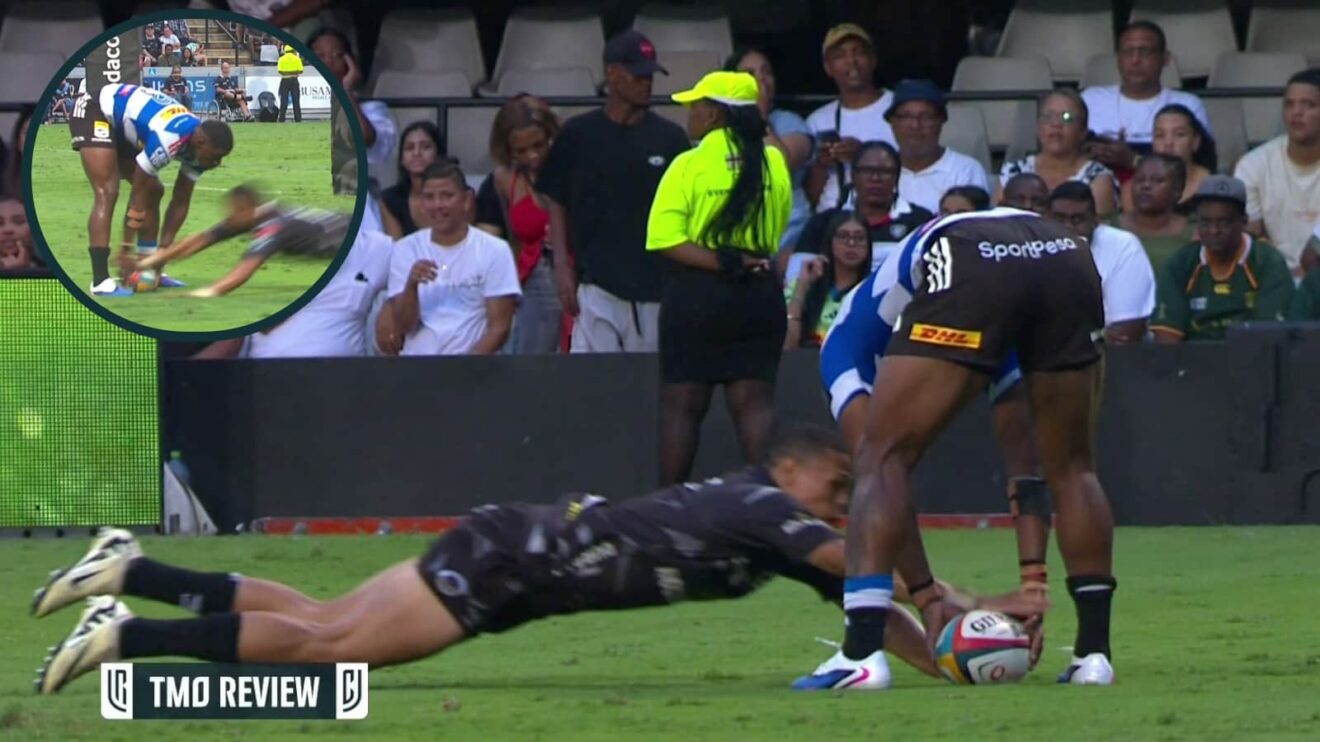
Jaco Williams and Warrick Gelant during the URC match between the Sharks and Stormers. (Screenshots from URCtv)
Saturday’s United Rugby Championship clash between the Sharks and Stormers was dominated by Warrick Gelant’s clanger, but did the officials get the decision right?
After going eight games unbeaten in the URC, the Stormers tasted defeat for the first time in round nine to their coastal rivals in Cape Town and were eager to get revenge in the return fixture in Durban.
However, it was not to be as John Dobson’s men suffered back-to-back defeats at the hands of the Sharks, who have enjoyed a resurgence under the tutelage of interim head coach JP Pietersen.
The Sharks outscored the Capetonians five tries to two at Kings Park to secure an emphatic 36-24 come-from-behind victory with rising star Jaco Williams grabbing a brace, leaving Springbok full-back Gelant red-faced with the second of his scores.
A clanger from the Springboks’ full-back
That try has proved to be somewhat controversial, with fans left perplexed by Christopher Allison’s decision to award the try. So let’s break it down.
In the 70th minute, the Stormers had an attacking lineout just inside the Sharks’ 22 with Sacha Feinberg-Mngomezulu opting for a high bomb after his side secured possession at the set-piece. Aphelele Fassi managed to pick the ball out of the skies before Jaden Hendrikse sent it high for Edwill van der Merwe to chase.
The Stormers managed to deal with the threat with Feinberg-Mngomezulu chancing his arm with a speculative cross-kick that didn’t come off and landed in the path of Williams.
The World Rugby U20 Championship winner, who earned just his second start for the Sharks on Saturday, opted to kick low and hard downfield and went tearing after the ball.
Stormers full-back Gelant casually jogged back as the ball crossed the try line and, not realising the true threat that Williams posed, slowly bent down to the ball. This delay allowed the Sharks winger to dive across the surface and get his hand onto the ball.
“Play silly games, win silly prizes,” SuperSport’s lead commentator for the match screamed as referee Allison called upon his TMO Quinton Immelman to review the decision. “I’m not sure who grounded that ball first, so the question will be ‘Try yes or no’?” Allison said to Immelman.
The referee needed just two close-up replays of the incident to make his decision. “There is no downward pressure from the Stormers player; the Sharks’ player grounds the ball, so that’s a try,” he explained before awarding the five-pointer to Williams.
Try of the weekend! 🙌🏉
Jaco Williams with an UNBELIEVABLE try for @SharksRugby.
Hollywoodbets @SharksRugby
DHL @THESTORMERS @Vodacom #URC#SHAvSTO #CoastalDerby |#EXTRAAYourSummer | #ExtraordinaryLeague pic.twitter.com/Zw1e2tv358— vodacomrugby (@VodacomRugga) January 31, 2026
The law book
Many fans were left perplexed by the decision, insisting that the officials had got the call incorrect, but as per World Rugby’s laws around the in-goal and grounding the ball, Allison got the call spot on.
Law 21.1 reads, “The ball can be grounded in in-goal:
a. By holding it and touching the ground with it; or
b. By pressing down on it with a hand or hands, arm or arms, or the front of the player’s body from waist to neck.”
21.2 adds: “Picking up a ball is not grounding it. A player may pick up the ball in in-goal and ground it elsewhere in in-goal.”
The latter of which is crucial in this case, as the manner in which Gelant bends down and the positioning of his hands when doing so points towards him picking up the ball instead of grounding it.
Allison adjudged that Gelandt did not put any ‘downward pressure’ on the ball, which is in reference to law 21.1b ‘pressing down’. Instead, it was Williams who pressed the ball down first, with law 21.3 stating: “An attacking player grounding the ball in in-goal scores a try.”
Whilst many will argue that Gelant’s hands touch the ball while it’s in contact with the ground, that does not mean that he has grounded the ball. The laws around rucks provide a comparable reasoning for this, with 15.9 stating, “The ruck ends and play continues when the ball leaves the ruck or when the ball in the ruck is on or over the try line.”
When a ball is out the back of the ruck in-goal, and a scrum-half simply places their hands on the ball first in process to kick or pass, the fact that they place their hands on the ball, while it is in contact with the ground on the goal line or in-goal, doesn’t mean its grounded. Much like Gelant, the scrum-half would be lifting the ball instead of grounding it and would not be applying downward pressure.
Gelant joins Poitrenaud’ed list
Ultimately, it was a real clanger and a rookie error from Gelant who made the same error as former Toulouse star Clement Poitrenaud in the 2004 Champions Cup final.
The Frenchman also attempted to allow the ball to cross the try line before dotting it down, and did not identify the threat that Wasps’ scrum-half Rob Howley posed as the Welsh number nine dived at the ball and dotted down to score a pivotal try. France number eight Gregory Alldritt fell foul of a similar incident last year as Damian Penaud dived to steal a try for Bordeaux in the Top 14 meeting.
Unfortunately for Gelant, his error sealed the result for the Sharks as the converted try opened up a 36-24 lead in the final 10 minutes of the encounter, an advantage they held until the final whistle.
Planet Rugby reached out to a current elite professional match official to ensure that the technicalities and law interpretations expressed in this article were accurate, and they confirmed that they are.
Want more from Planet Rugby? Add us as a preferred source on Google to your favourites list for world-class coverage you can trust.
READ MORE: Willie le Roux hits back at Springboks critics who have been ‘cooking me since 2015’