France v Ireland: Winners and losers as Les Bleus exploit Sam Prendergast’s ‘frailties’ while Fabian Galthie is ‘vindicated’
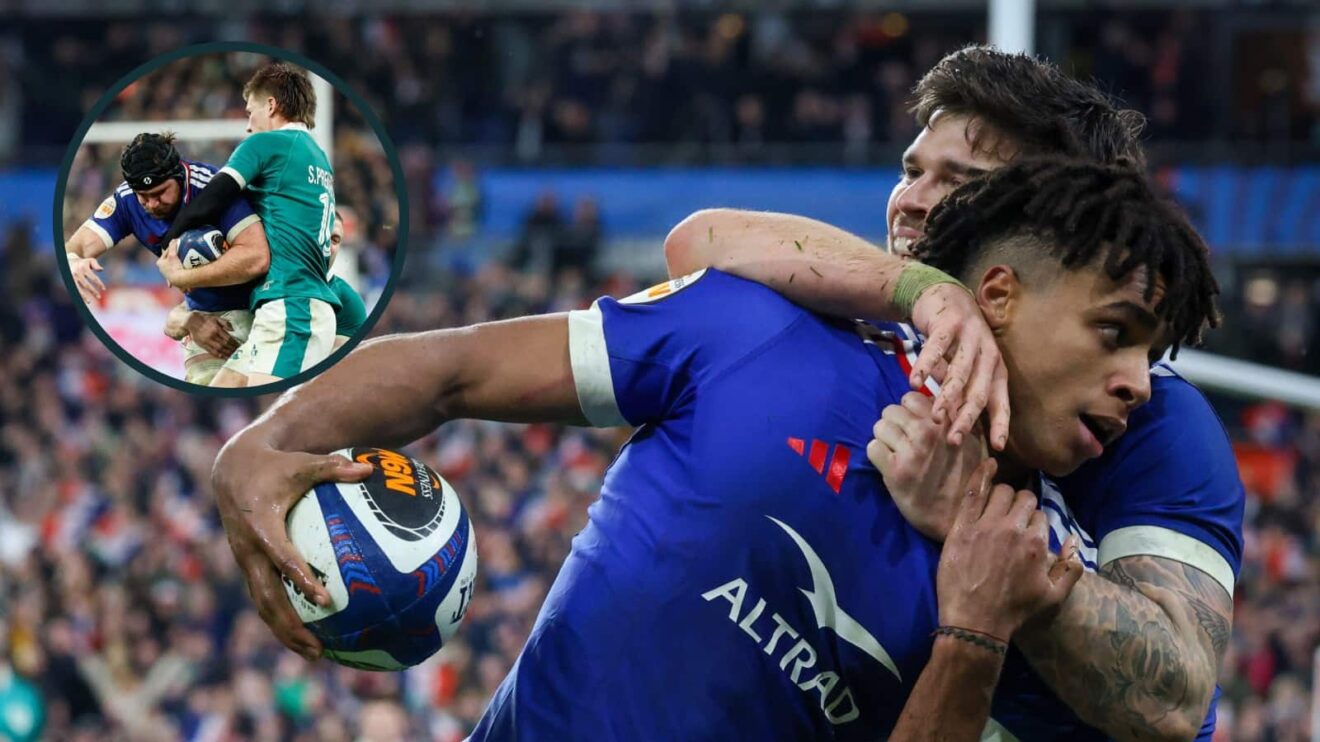
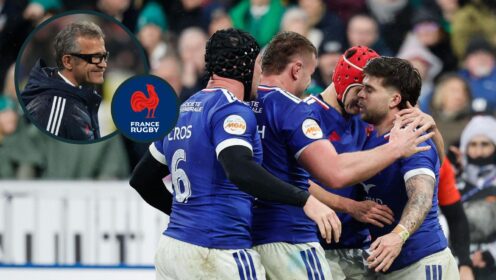
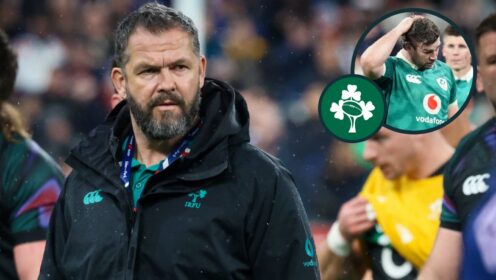
Theo Attissogbe celebrates with Matthieu Jalibert and an inset of Sam Prendergast tackling Lenni Nouchi.
Following France’s 36-14 victory over Ireland in the opening game of the 2026 Six Nations, we pick out our winners and losers from the clash at the Stade de France.
Les Bleus cruised to their win on Thursday evening with Louis Bielle-Biarrey crossing for two tries whilst Matthieu Jalibert, Charles Ollivon and Theo Attissogbe chipping in with scores of their own.
Ireland’s Six Nations campaign got off to a sluggish start as Andy Farrell’s men were pointless in the first half, but threatened a comeback later on in the match as replacement forwards Nick Timoney and Michael Milne grabbed five pointers.
However, it was not enough as Ireland left the French capital, copping a hefty defeat and without a single league point, while Fabian Galthie’s men now turn their attentions to their trip to the Principality Stadium in round two.
But before that, here are our winners and losers from the opening game.
Winners
Irish front-row
It was a tough evening at the office overall for the Irish pack who battered on the gain-line and at the breakdown, but there was a shining light for Farrell and his assistant John Fogarty, the scrum.
Ireland are still sporting the scars that the Springboks ingrained on them in November last year as they were pulverised at the set-piece, conceding penalty after penalty, with two props visiting the sin bin in the defeat to the back-to-back world champions.
Injuries to Tadhg Furlong and Andrew Porter only heightened fears that a repeat in Paris was very much on the cards, but did not prove to be the case.
While Fogarty certainly deserves his flowers, Jeremy Loughman and Tom Clarkson thoroughly deserve praise for their efforts. During their time on the park, the scrums were hardly a factor against a far more fancied French pack. On a night that not much went right for the Irish, the efforts of the starting front-row to gain parity and avoid being dominated certainly went a long way in ensuring it wasn’t an absolute blood bath.
The replacements
Staying with the positives for Ireland, more on their shortfalls later as there were plenty of those, and Farrell can afford a small smile for the performances he saw from the bench.
Milne carried with a real savagery that was absent from Ireland’s performances prior to his injection into the game, and he was not alone in raising the intensity and accuracy in the latter stages of the match.
James Ryan left it a bit too late to really get stuck in, but he was certainly fired up after his hammering hit on Jalibert and laid into the French pack, who were battered in the second half.
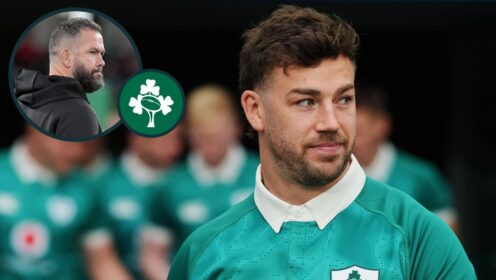
Jack Conan’s shift from the pine left England great Chris Robshaw questioning why he wasn’t in the starting XV, “Irish fans: why does Conan not start for Ireland? He makes impacts every time he’s on the pitch,” the ex-Quins skipper remarked on X. Timoney was similarly brilliant and was rewarded with a try too.
Meanwhile, Jack Crowley gave the Irish attack direction and energy, which Sam Prendergast simply failed to do prior to the Munsterman’s arrival.
France’s back-five forwards
But all those efforts were in vain and mostly due to the utter brilliance of France’s second and back-row, who bossed the gain-line and the breakdown with their sheer brutality and accuracy in the first half.
Man of the match Mickael Guillard led the charge for the French with a sterling shift in the second-row. His club claims that he is just shy of 6ft5 and weighs in at 113 kgs, but on Thursday evening, he looked a foot taller and 20kgs heavier as he repeatedly shunted Irish defenders backwards, occasionally offloading the ball but always making a telling contribution.
Guillard has been utilised in the back-row by France recently, usurping Gregory Alldritt as the first-choice number eight, and while he packed down alongside the brilliant Ollivon in the locks come scrum time, Les Bleus certainly deployed him in a more loose forward-esque role in open play.
He was not alone, though, as Ollivon caused all kinds of havoc for Ireland through his incredible work-rate and could have ended the game with a brace if it weren’t for a rare moment of butter fingers with the try-line begging. Francois Cros has been lacking match minutes of late, but that wasn’t evident in Paris, while Oscar Jegou and Anthony Jelonch threw their weight around brilliantly to obliterate the Irish up front.
Matthieu Jalibert
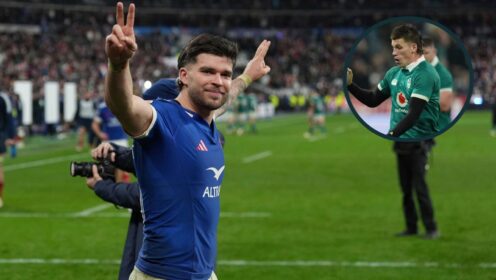
Concerns over the cohesion of the partnership of Antoine Dupont and Jalibert were quickly put to bed as the pair combined stunningly to not only conduct an emphatic win but do so in style.
The distance the duo were able to get on their clearance kicks was a thing of beauty, Thomas Ramos’ too, but the pair made the right decision more often than not as France rampaged into an emphatic lead and ultimately a win.
Outside of a failed Sexton-esque loop – you’ve got to run that at pace and not against Ireland for that to work Matthieu – Jalibert was on song all night, not overplaying his hand as he has been guilty of doing when donning blue previously. The 27-year-old’s Test career has been hit and miss in recent times with falling outs with Galthie and a refusal to bench for Les Blues, but on Thursday night, there were signs that perhaps things are starting to fall into place for the brilliant Bordeaux back and that only be beneficial for him and France going forward.
Theo Attissogbe and Louis Bielle-Biarrey
There was a lot that went right for France at their iconic stadium, with Yoram Moefana and Nicolas Depoortere firing in the centres, Kalvin Gourgues doing the same later, while everything that Ramos touched turned to gold.
Bielle-Biarrey, along with Guillard, stole the spotlight as the former scored two scintillating tries, but much of France’s success is owed to sensational Attissogbe, who played a more understated role in the win.
Much was made of Damian Penaud’s omission from the Six Nations squad, but the man tasked with filling his boots emphatically stepped up to the plate and shone where France’s all-time leading try scorer has struggled in recent times.
The removal of the escorts has emphasised the need for wingers to be proficient under the high ball, whether that’d be receiving opposition’s punts or chasing high bombs from your scrum-half or fly-half. This is where Attissogbe shone.
France retained possession five times out of the six contestable kicks that Dupont hoisted into the Paris night sky while Ireland only managed the same number from Jamison Gibson-Park and Prendergast’s combined tally of 13 contestable kicks. Much of that was due to the sensational athleticism and aerial prowess of Attissogbe, who got the better of Jacob Stockdale in the air and consistently wreaked havoc on the Irish catchers.
While Bielle-Biarrey was blistering his way to the try, Attissogbe was rocketing into the air, the duo making the most of the forward dominance Les Bleus had for much of the game – vindicating Galthie’s bold selection calls.
Losers
Damian Penaud
France’s record try-scorer looked undroppable, irreplaceable and just too good to ignore just a few short months ago, but Galthie shocked all by omitting him from the squad for their Six Nations defence, and now, Penaud has a mountain to climb to get back into the squad.
Attissogbe’s performance was a statement of intent and puts the onus on Penuad to respond. The Bordeaux speedster is a ruthless finisher and one of the best attacking flyers in the game, but the modern game moves insanely quickly, particularly at the highest level, and he wants his number 14 blue jersey back. He needs to improve on his lacklustre defence and aerial frailties.
Want more from Planet Rugby? Add us as a preferred source on Google to your favourites list for world-class coverage you can trust.
Sam Prendergast
It was plainly obvious that France targeted the Leinster pivot’s channel, with Prendergast asked to make a match-high of 20 tackles but only managed to complete just 13 of those.
Even when he did manage to make contact and bring a French attacker to ground, it was behind the gain-line and put the Irish defence on the back foot. Quite simple, he was a liability in defence and resembled a turnstile when Jalibert charged towards the try line, leaving brother Cian with far too much to do to deny the Frenchman from scoring the simplest of tries.
At 22, Prendergast is still a young, inexperienced fly-half with a lot to learn but boasts the raw talents to thrive in international rugby, highlighted by his excellence in the build-up to Timoney’s try. However, he is no Johnny Sexton or Ronan O’Gara yet, and that was clear for all to see in Paris. He lacked the drive to really put himself in the way of French attackers, even to act as a speed bump, while he stuck to type with the ball in so much so that they may as well have broadcast his attention to the Les Blues defence as to what was coming next.
He did look more comfortable in possession when Crowley entered the fray, but defence remains a major issue. Prior to paving the way for Jalibert’s try, he made a crucial error, gifting France an opportunity to attack off loose possession, and they did not pass up on the chance to make him pay.
Jalibert put in a wonderful long kick, aiming for the Irish 22 after France were pushed back into their own half. This left Prendergast with four options as he charged back to cover: Let the ball bounce out and risk Bielle-Biarrey snapping up possession, catch the ball and run into touch, or collect the ball and attempt a punt, or attempt the audacious. In the first option, if LBB did not grab the ball, Ireland would have got the lineout. In the second and third France get the throw, the third could well have resulted in France being on the attack further up the pitch, and the fourth is the route he chose.
Historically, Les Blues have thrived on loose attacking ball, and that remains true in the modern era. Prendergast’s immature decision and lack of game awareness gifted Galthie’s men the opportunity to attack in their preferred manner, with Bielle-Biarrey doing what Bielle-Biarrey does and scored the try.
His shortfalls extended beyond his lacklustre defence, he forced passes that weren’t on, wasn’t bold enough with his touchline kicks and lacked a killer edge that has fuelled Irish pivots of years gone by.
Joe McCarthy
It was a forgettable night for the Irish pack and most notably for their enforcer Joe McCarthy. The Leinster second-rower is renowned for his aggression and physicality, but all that was absent on Thursday evening as he failed to make any telling impact when carrying the ball to the line and conceded a frankly daft penalty.
Ireland needed their pack to rise to the occasion and meet the French forwards head-on, but failed miserably to do so. McCarthy, now a British and Irish Lion, should have led that charge but was largely anonymous throughout his stint.
Wales
We eagerly await to see if Steve Tandy can turn Wales into a serious threat in the Six Nations again as they visit the Allianz Stadium in round one, but on the evidence of the opening match, a battering awaits them in round two.
France are notoriously slow starters in the Six Nations, but the manner in which they hammered Ireland will strike fear into the hearts of Welsh supporters – not that they needed any more heart trauma.
Andy Farrell
Prior to the match against the Springboks last November, there were hints that Ireland were in decline, with the defeat to South Africa only adding fuel to the flames. A nervous wait for the Six Nations’ opener then ensued, with Leinster’s form this season and the mounting injury list applying further pressure.
It now all falls on Farrell to inspire the change. Perhaps more bold selections are needed to rid the squad of the complacency that was on display at the Stade de France, as a similar showing against Italy could have dire consequences.
It’s not panic stations just yet or time to sharpen the axe, but if there is no sign of improvement against the Azzurri, significant weight will be added to that case.