England’s two-card trick: the numbers behind a team that keeps sending itself off


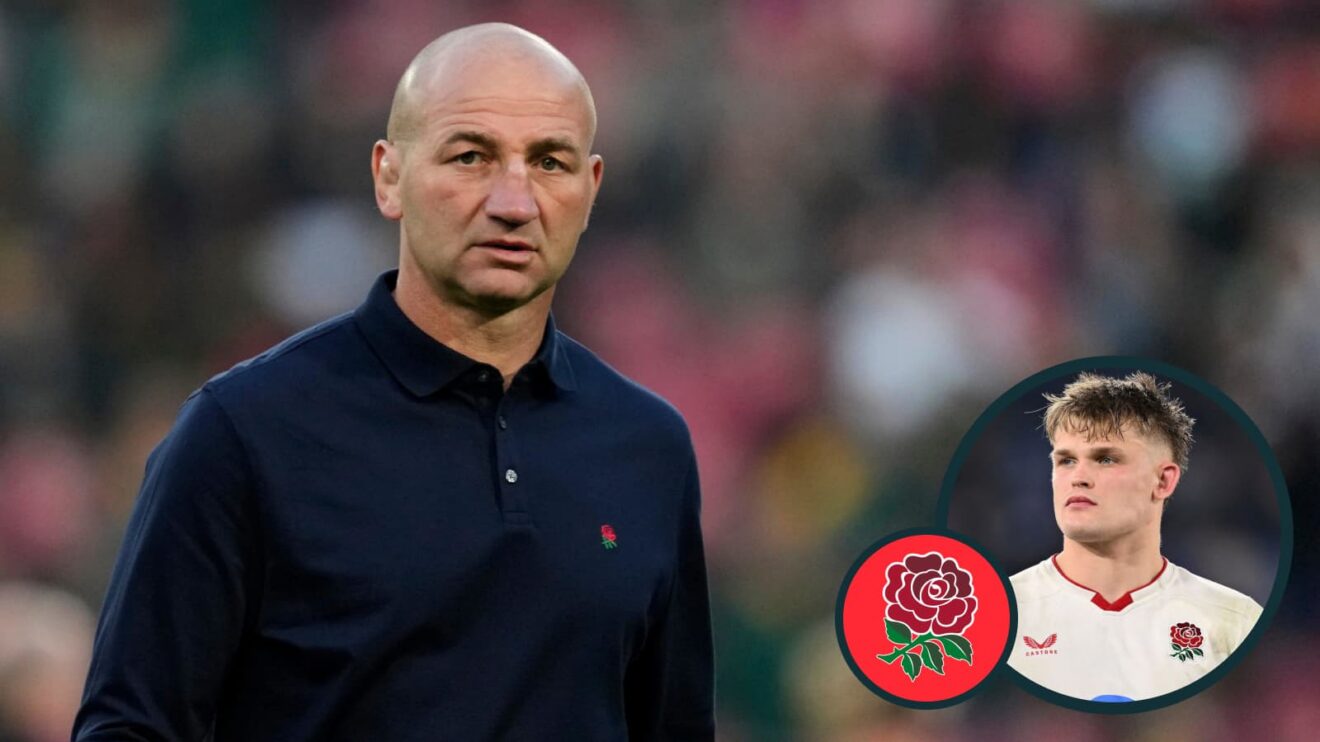
England head coach Steve Borthwick has a discipline crisis.
Steve Borthwick has a discipline crisis. Everyone can see it, but the numbers say it is a stranger and more specific crisis than the one being described on the airwaves, and until England diagnose it correctly they will keep losing Test matches they are good enough to win.
The volume myth
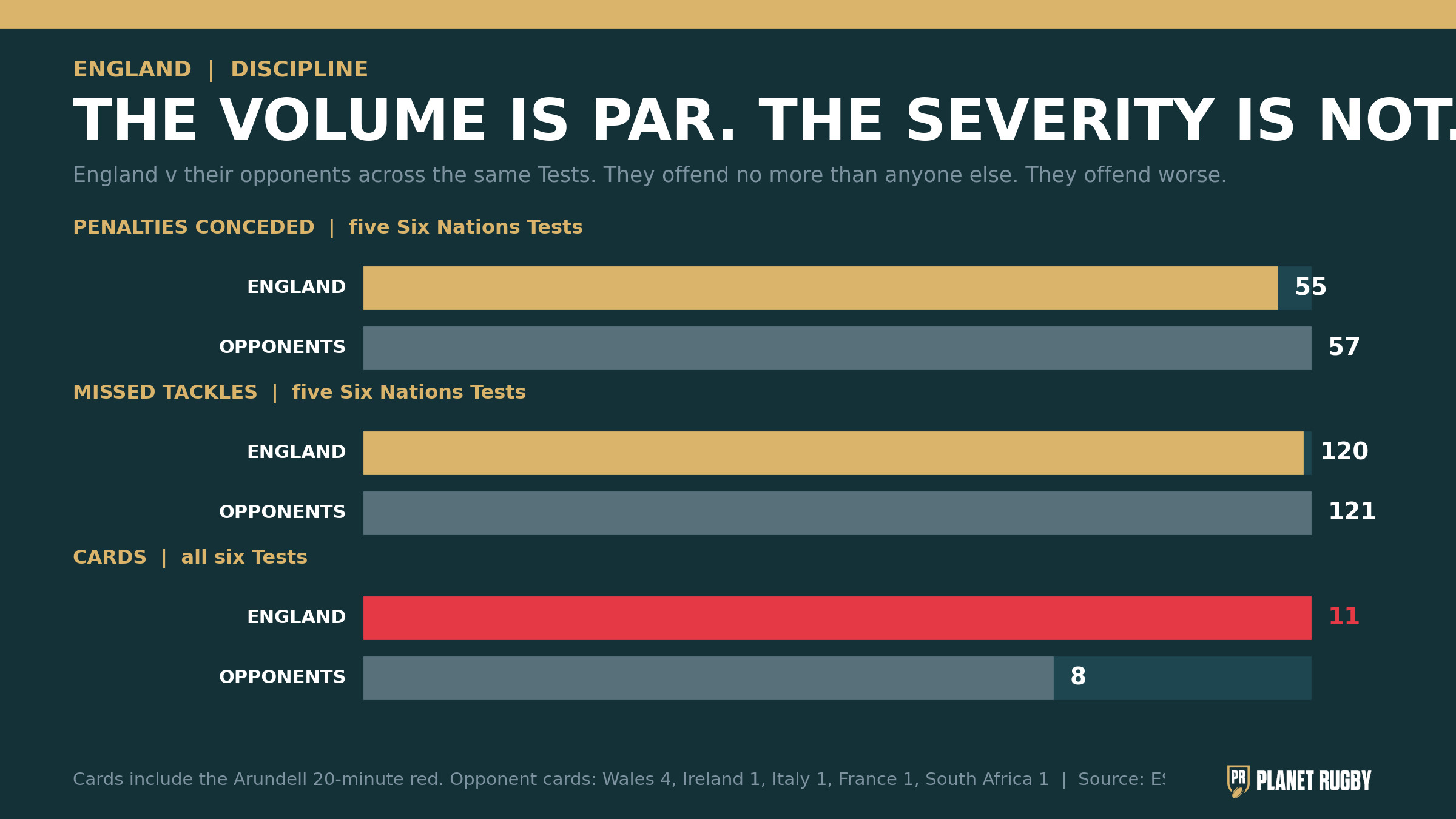
Start with the finding that surprised us when we pulled every official stat sheet from the Wales game onwards. England are not an ill-disciplined team by volume. Across the five Six Nations matches they conceded 55 penalties; their opponents conceded 57. They missed 120 tackles; their opponents missed 121. Match by match the penalty counts read 12-16 against Wales, 8-10 in Edinburgh, 14-12 against Ireland, 10-8 in Rome, 11-11 in Paris.
Only twice in five games were England the worse offenders, and never by more than two. On the raw ledgers of infringement and defensive error, this England side is exactly average.
The severity catastrophe
Now the other column. From those 55 penalties, England produced nine cards, equalling Italy’s 2002 record for a single championship, and Saturday’s two at Ellis Park make it 11 in six Tests.
Their opponents, from 57 penalties plus a full match against the Springboks, produced eight, and four of those belonged to Wales on one calamitous afternoon. England commit roughly the same number of offences as everyone else. What they commit are the wrong offences: the high shot in the aerial contest, the cynical slap-down, the maul dragged to earth a metre out, the early hit with an overlap on. Maro Itoje and Tom Curry against Wales, Henry Arundell twice in Edinburgh, the second a 20-minute red. Freddie Steward and Henry Pollock against Ireland. Sam Underhill and Itoje in Rome. Ellis Genge in Paris. Tommy Freeman and Guy Pepper in Johannesburg. Every single one of the six matches contained at least one England card, including the 48-7 win.
What the cards cost
Here the accounting turns brutal, and every figure quoted is timestamped from official records.
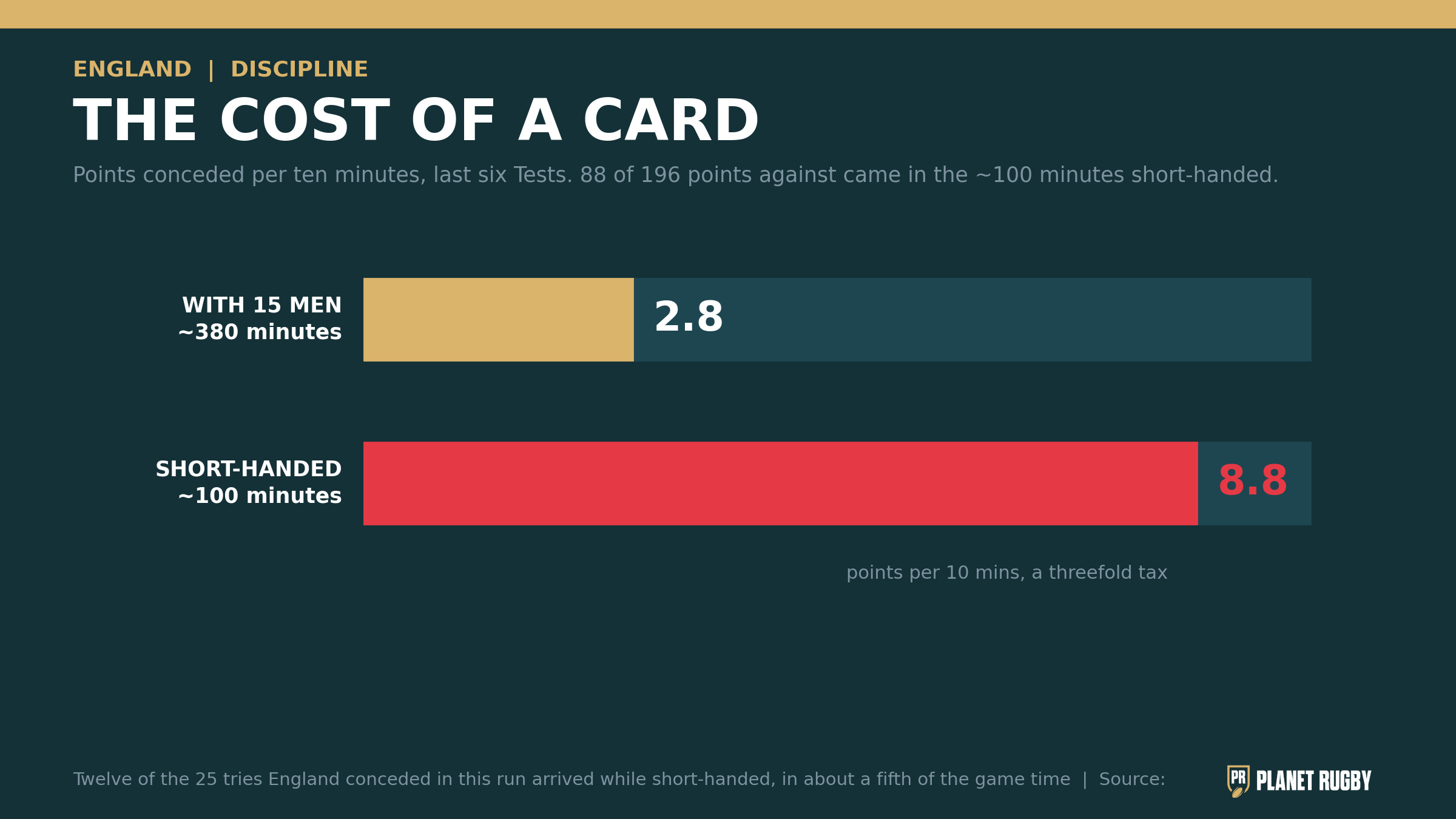
England have now spent roughly 100 minutes of their last six Tests without a full complement, more than a full match. In those minutes they conceded 88 points. In the other 380 minutes they conceded 108. That is 2.8 points per 10 minutes at full strength and 8.8 points per 10 minutes short-handed, a threefold tax paid 11 times over.
12 of the 25 tries England have conceded in this run arrived while they were down a man or two, in a fifth of the game time.
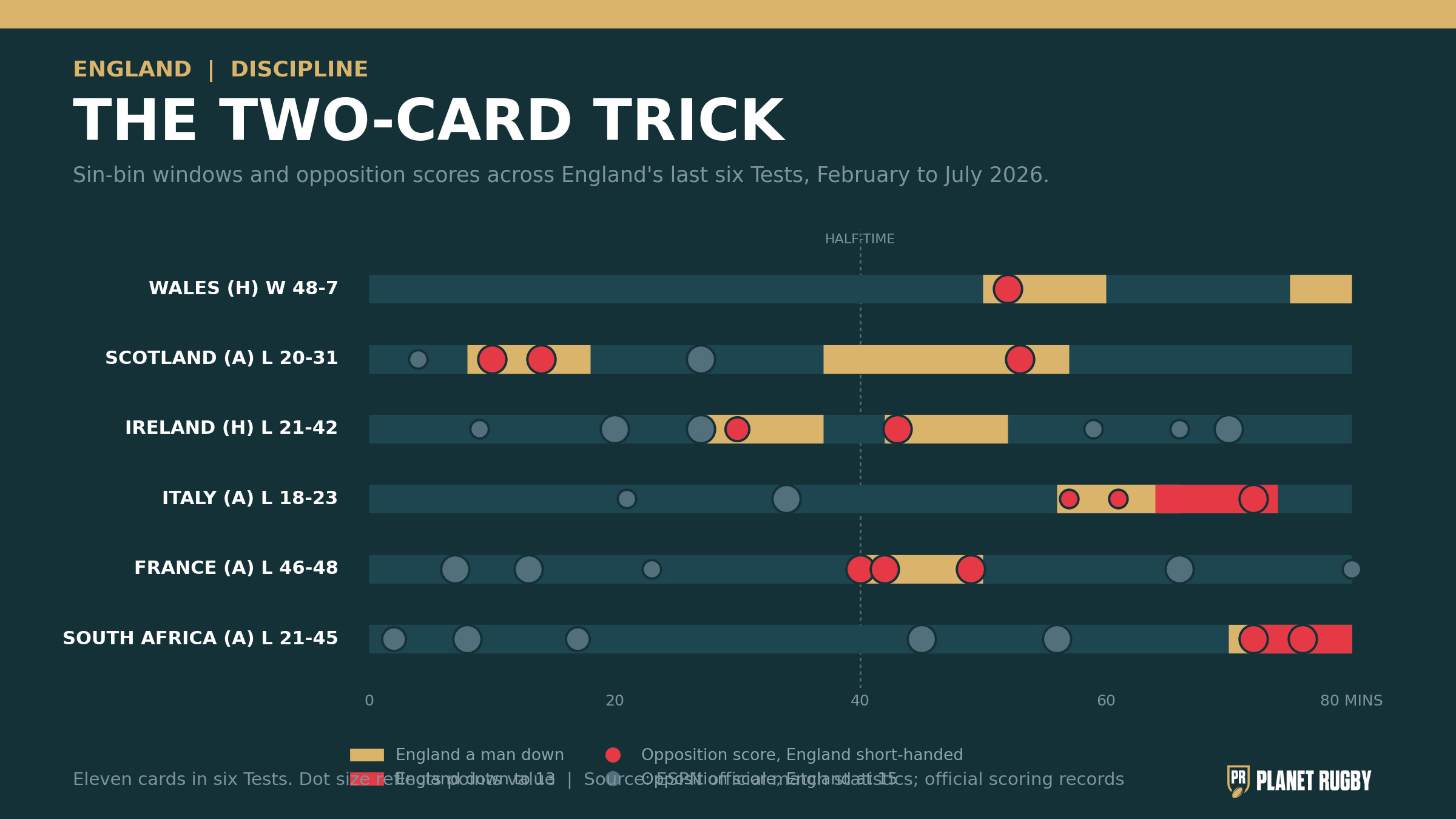
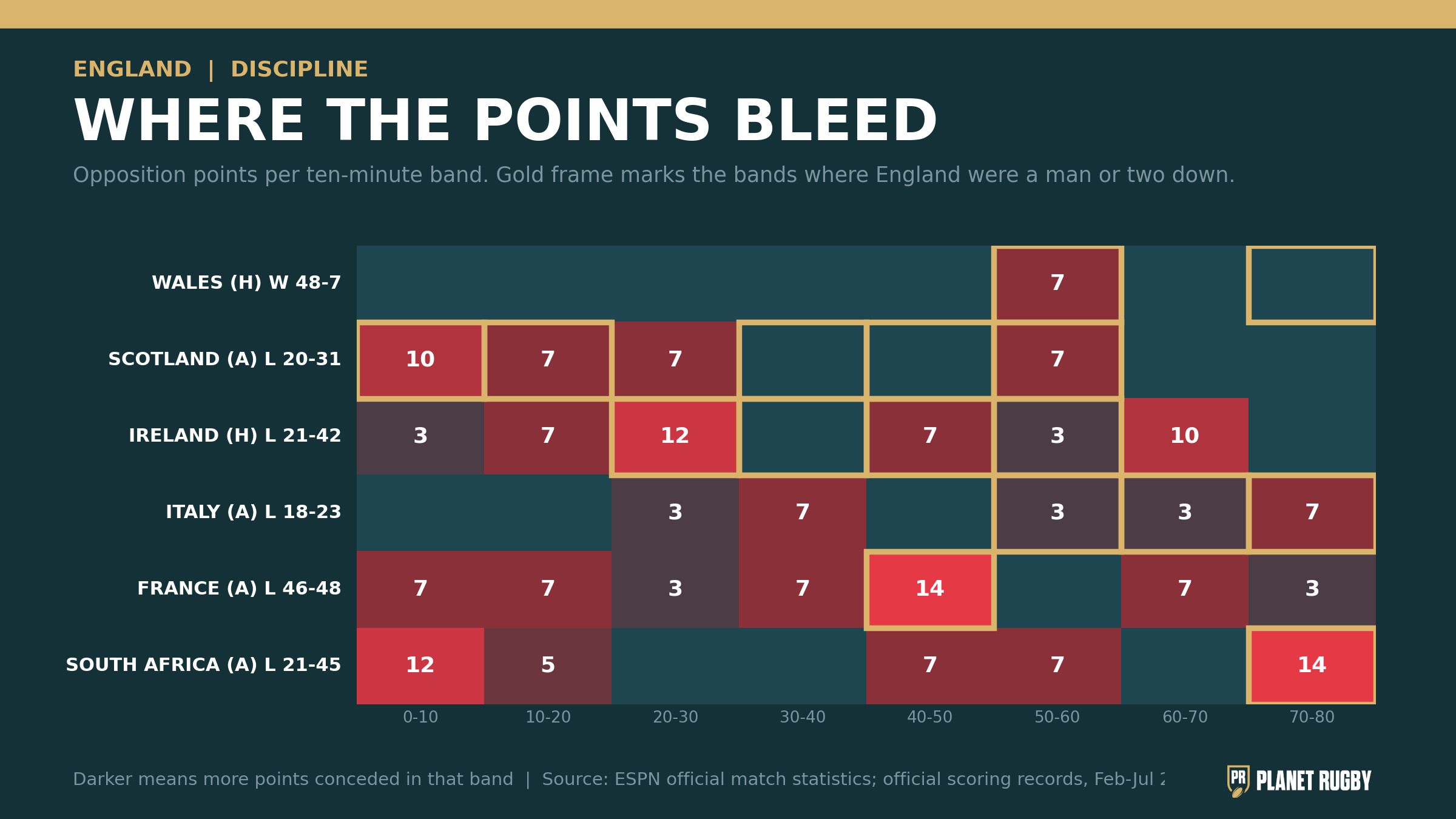
The map of the damage is unambiguous. Scotland scored 14 unanswered points during Arundell’s first bin and struck again during his red-card window. Ireland scored through Tommy O’Brien in Steward’s absence and Dan Sheehan in Pollock’s. Italy took six points off the tee during Underhill’s bin and won the match through Leonardo Marin with Itoje watching from the sideline. France converted Genge’s yellow into a 21-point window either side of half-time: penalty try, Louis Bielle-Biarrey, Theo Attissogbé, seven minutes of game time that decided a two-point championship match.
And on Saturday, Malcolm Marx and Ben-Jason Dixon fed on 13 Englishmen to turn a 10-point contest into a 24-point hiding. Even in the sole victory, Wales’s only try came during Itoje’s 10 minutes in the bin.
The trick’s second half
The pattern runs the other way too, and it is just as revealing. England’s own scoring leans heavily on opposition cards.
The Wales rout was built almost entirely against 13 and 14 men. Ollie Lawrence’s try against Ireland came during Jamie Osborne’s yellow. Freeman’s near-winner in Paris followed Demba Bamba’s late binning. Genge’s tap-and-go on Saturday arrived during Kurt-Lee Arendse’s 10 minutes.
A team that bleeds when down and feasts mainly when up is a team that cannot impose itself at 15 against 15, which is a deeper indictment than any penalty count.
Why it keeps happening
Look at when the cards fall. Freeman on 70, Pepper on 72, Itoje on 64, Curry on 75, Genge with the clock red. The majority arrive in the final quarter or at moments of maximum defensive stress, which points to the true mechanism: these are not acts of thuggery, they are failures of exhausted judgement.
A defence under sustained pressure runs out of legal options a fraction before it runs out of will, and the split-second decisions, whether to contest, where to aim a tackle, when to concede the try rather than the card, keep going wrong. Borthwick said it himself in Rome: the amount of times England have been without a player and conceded points has been a significant factor in the whole campaign. He has diagnosed the symptom.
The fix is harder, because you cannot coach composure into the 70th minute from a training paddock; you build it through squad depth that keeps legs fresher, through clarity that removes decisions, and through the kind of ruthless internal accountability that makes the card, not the try, the cardinal sin.
The bottom line
England have shipped 96 points in their last two Tests and won one of their last six. They have not had 15 men on the field for over 100 minutes in that stretch, and it has cost them 88 points, at least two Test matches, and quite possibly a championship. The cruellest part is what the full-strength numbers say: par penalties, par tackle counts, an hour of genuine parity with the world champions at Ellis Park, a 10-point lead in Paris, control for an hour in Rome.
This is not a bad England team. It is an average-discipline team with a catastrophic severity problem, and that, at least, should be fixable, but so far that hasn’t happened.
Three weeks remain of this Nations Championship window. If England finish a single match with 15 men on the field, it will be the first time since Cardiff last year, and it might just be the day the losing stops.
The Edwards elephant
One more piece of context makes England’s severity crisis impossible to ignore, because the solution may currently be sitting at home in Wigan. Shaun Edwards was pushed out by France in late May, two months after winning his seventh Six Nations title, with Fabien Galthié moving to new defence and kicking coaches despite Edwards holding a contract to 2028. He was absent from France’s July preparation camps, he has made clear he wants to return to coaching immediately, and there is no more decorated discipline-and-defence coach alive.
Edwards’s defences have always been built on precisely the qualities England lack: legal aggression, tackle-height obsession, and the composure to defend for 10 phases without offering the referee a decision. The public push to place him on Borthwick’s staff began within days of the L’Équipe reports, and every card since has strengthened it. Borthwick, meanwhile, is under pressure that has moved from tectonic to geological.
One win in six, a record nine-card championship, 11 cards across the run, 96 points shipped in a fortnight, and a fanbase that watched Ellis Park greet England with indifference rather than hostility. The RFU backed him after Rome. The data in this piece is the case he now has to answer, and the most obvious answer on the market is a 59-year-old Wigan man with seven titles and a famously low tolerance for exactly the sins England keep committing.
The next three weeks will tell us whether Borthwick reaches for him, or whether someone else eventually does the reaching.
READ MORE: The staggering pay disparity in international rugby as ‘floor drops away’ south of the equator