Springboks: The ‘blow me down’ Rassie Erasmus story that almost paid off for Nick Mallett as ex-head coach hails ‘extraordinary rugby brain’


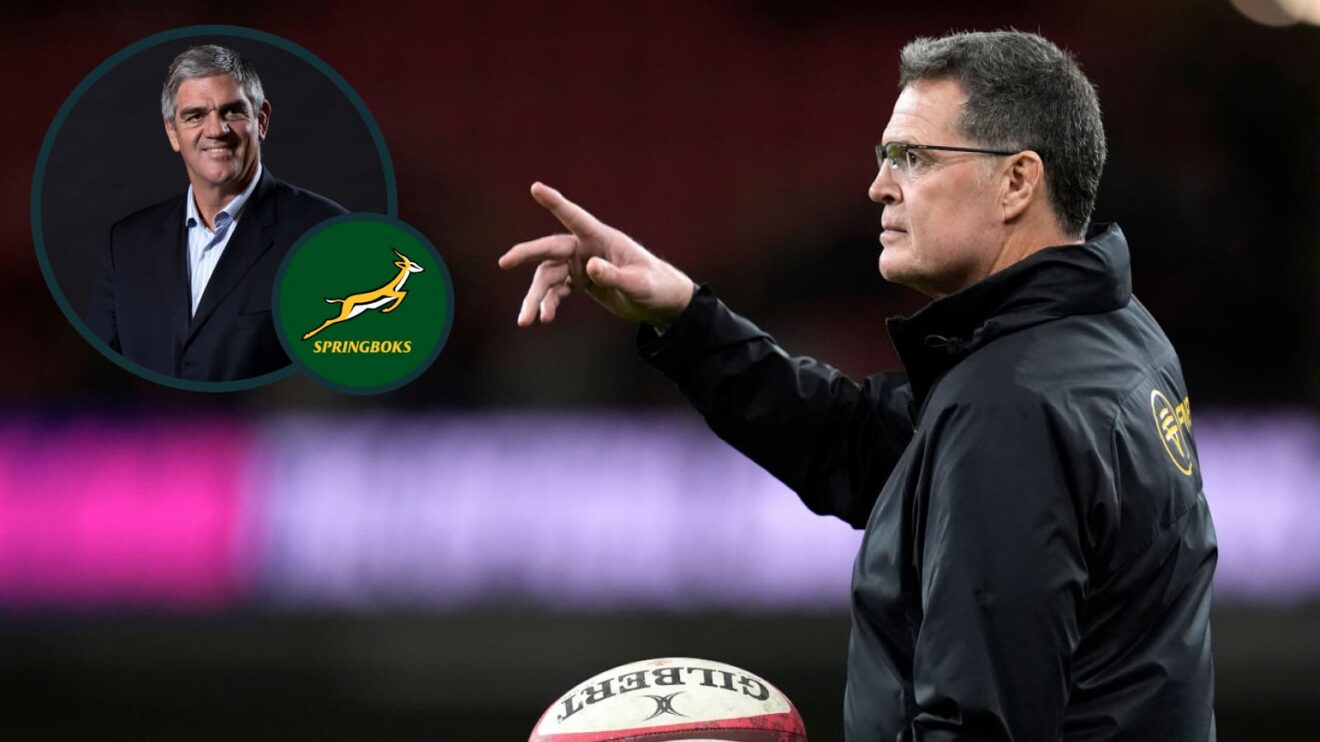
Nick Mallett praises Springboks head coach Rassie Erasmus.
Nick Mallett has offered a revealing insight into the “extraordinary rugby brain” of Rassie Erasmus as South Africa prepare to kick off their Nations Championship campaign at home to England.
Mallett is the former Springboks coach who selected Erasmus for 25 of his 36 caps and appointed him captain on the one occasion he got to lead his country.
Long before Erasmus moved into coaching and became a back-to-back World Cup winner, the English-born Mallett recalls a player who was shy yet “incredibly innovative”.
“Let me tell you a story,” he says, speaking from Cape Town. “In the very last game I coached the Springboks we played against Australia in Durban.
“The year was 2000 and Rassie was in the starting line-up. In the build-up I gave the guys an analysis of the opposition and how I thought we should play. I signed off by saying, ‘if any of you have seen anything I’ve missed, please come and tell me’.
Knock at the door
“Half an hour later, there is a knock on my door and Rassie said, ‘Coach, sorry man, can I have a word? I’ve been through their exit line-out strategy and they always seem to do the same move’.
“‘[John] Eales goes forward, plays down to [Jeremy] Paul, Paul plays to [George] Gregan and Gregan plays behind [Toutai] Kefu’s back to [Stirling] Mortlock’.
“‘Mortlock then sets up the ruck and they’ve got a left foot with [Chris] Latham and a right foot with [Stephen] Larkham. That’s how they exit’.
“I said to him, ‘I don’t see a problem there, we’ve got all defensive guys in position’.
“He came back at me with, ‘Ya, but you’ve got me tackling Kefu, and he never gets the ball. I’d like to go for the interception. Can we just get our scrum-half to move into my position, just in case he does give it?’
“I looked at Rassie, thought for a moment, and said, ‘Okay, let’s do that’.
“Blow me down, 25 minutes into the game, Australia get a lineout in their 22, Eales plays down to Paul, Paul to Gregan, Gregan behind Kefu’s back… and there’s Rassie, darting in to make the interception before taking the ball over the try line and being tackled by Latham and Larkham as he touches down.”
The reason this anecdote has not surfaced before now is what happened next. Kiwi referee Paul Honiss chalked off the score and Australia went on to win 19-18 with Mortlock’s last-gasp penalty giving the Wallabies their first Tri-Nations title.
“You won’t believe this,” Mallett continues. “That was the very first time a TMO was asked by a referee, ‘Did you see the ball grounded?’
“Clearly, you couldn’t, because Rassie had two Australians on his back. One of them actually ruffled his hair and said, ‘well done’ type of thing to him. There was no way either could have held the ball up.
“But in answer to the specific question the TMO said he couldn’t actually see the ball grounded so the try wasn’t awarded.
“After that they changed the protocol to ‘Is there any reason I can’t award a try?’ It was too late for us, we lost by one point. And too late for me, as it was my last time in charge.
“I’m not sure Rassie would have saved my career even had the try been given and we won. Unfortunately I wasn’t getting on very well with the South African Rugby Union at the time and they were quite keen to get rid of me.
“But that day he showed himself to be a player ahead of his time in the way he thought about the game. An incredible innovator.”
Another story
This weekend’s visit of England to Ellis Park reminds Mallett of another story of Erasmus the player that offers an insight into the brilliant coach he would go on to become.
“That game at Twickenham in 1997,” he says, referring to the 13-7 England victory that unexpectedly denied the Springboks a world record 18th consecutive victory.
“I wouldn’t say we were casual coming into that game but, on reflection, there were a lot of things I could have done better.
“Rassie was one of the guys that played that day and, I’ve chatted to him about it, he says he learned so much about coaching and what you need to do with a group of players from the time I coached.
“He says setting new goals every single campaign is absolutely critical. I didn’t do that.
“I thought the guys were mature enough to understand that every game was important, instead of focusing on that Northern Hemisphere tour and saying, ‘this is a chance of a grand slam and all that stuff’.
“You live and learn. I always feel the longer you coach and the more mistakes you make, the better you become in the longer run.”
That England victory, secured with a Jeremy Guscott try and eight points from the boot of stand-in goal kicker Matt Dawson, is almost 30 years old now.
Erasmus has used the time in between to develop into a world-leading rugby thinker.
“There’s a saying, imitation is the greatest form of flattery,” Mallett adds. “You’ll see that every single national coach now copies what Rassie does.
“I’m not sure how much more he can innovate, but he’s not scared of anything. Yet initially he was actually quite shy.
“He didn’t want to be up in front of the media, he didn’t want to be exposed to having to tell players ‘you’re getting dropped on Saturday’. Things that are difficult to do.”
Munster stint
Mallett believes Erasmus’ spell at Munster, initially as director of rugby, then, following the tragic death of Anthony Foley, combining the responsibilities of head coach, was “absolutely pivotal to his growth”.
“That was the start of his understanding of what you have to do as a coach,” he says. “How you have to build a culture, how you have to be straight and honest and open with your players all the time, even if there are difficult decisions to take.”
Want more from Planet Rugby? Add us as a preferred source on Google to your favourites list for world-class coverage you can trust.
How Erasmus has only once, back in 2019, been named World Rugby Coach of the Year is a mystery.
As he begins his quest to add the inaugural Nations Championship to the World Cup and Rugby Championship titles South Africa already hold, Mallett sums him up succinctly.
“An extraordinary rugby brain,” he says.