Wales v Barbarians: Five takeaways as ‘Welsh Lomu’ George North signs off in style while Steve Tandy left with a ‘mammoth task’


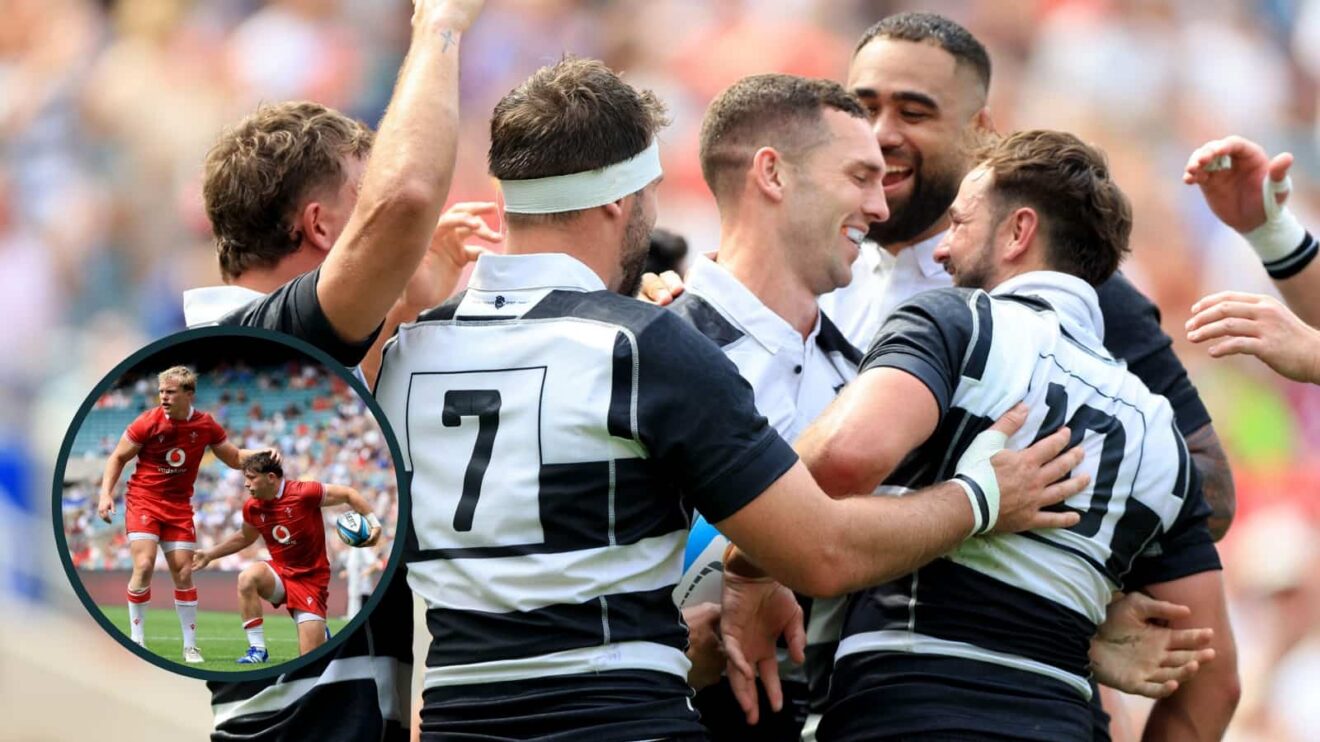
George North celebrates after scoring for the Barbarians and an inset of Wales' Dan Edwards.
Following Wales’ 33-31 victory over the Barbarians, here are our five takeaways from the clash at the Allianz Stadium in Twickenham.
Top line
This was far from a vintage showing by any means for either side as the Baa-Baas and Wales faced off to farewell a true great of the game, George North.
A 16-year-long career, over 100 international appearances and a highlights reel that will live long on social media, North bows out as one of the greatest that Welsh rugby has produced in the modern era and he signed off in style, crossing for a brace – as he did in his first appearance for his country – and adding a conversion for good measure.
In an error-ridden first half, it was Wales who had the lead heading into the sheds (14-5) courtesy of tries from Kieran Hardy and Dan Edwards, the latter converting both. Those tries were separated by Springboks prop Vincent Koch’s meat pie.
Edwards doubled his tally early in the second stanza before the biggest cheer of the day erupted with North coming off the bench, and that cheer was quickly outdone as the 34-year-old scored with his very first touch of the ball in Baa-Baas’ colours. In classic North fashion, he received the ball on the wing, stepped inside, flattened a defender and thundered the ball into the turf for five points.
Reuben Morgan-Williams delivered the reply for Wales with Alex Nankivell continuing the ding-dong battle. Ellis Mee was then rewarded with a well-deserved try in the 67th minute before North grabbed his second.
Mee thought he had a second as the clock went into the red. However, his try was disallowed and this gave the Baa-Baas one final chance to score, and score they did with a long pass from North unlocking the defence and Uruguayan scrum-half Santiago Ararata finishing off the try under the sticks, giving the retiring North the chance to add the extras and the cherry on top of a fitting sending-off for a glorious career.
Training run more than an exhibition match
Just a week ago, the Baa-Baas were in Gqeberha to tackle the Springboks in what was marketed as a ‘festival of rugby’ with South Africa A tackling Zimbabwe in the curtain-raiser. Here, it was the men’s team colliding with Wales as the warm-up for women’s fixture between the same two teams.
The contrast between the two matches couldn’t have been any starker. Last week’s game was seen as an opportunity for South Africa to brush off the cobwebs, get some minutes into players’ legs before the Nations Championship and do it against some international calibre stars.
It was always going to be tough for Wales to replicate the 80-31-esque scoreline in the 30-odd degree heat of Twickenham, but the overall vibe at the home of English Rugby was far more corporate than the festival that the Baa-Baas so often promise.
Both matches against Test-level teams were essentially warm-ups and money-makers, but one certainly felt more like it than the other. The echo of the stadium announcer in London said it all.
Wales work-ons
Most of the players selected by Steve Tandy this Saturday last played on the weekend of May 16 (a handful played a fortnight after for Cardiff) and frankly it showed. Ahead of their Tests against Fiji, Argentina and South Africa, it was plainly obvious that the Wales players needed a run-out and to get some minutes under their belts.
A Baa-Baas team thrown together at the last minute, that spent the week on the lash and had travelled from South Africa, remained competitive against a strong Welsh side. We saw in the Six Nations how the longer the squad stayed together and under Tandy’s guidance, the better they got, and there will be a hope that trend continues – or else their clash against the Springboks in Durban is going to be a tough, tough watch.
The Wales boss would not only have wanted to tick the box of getting the players playing again, but he will have wanted to see them perform in the systems and get the result too. The latter they achieved; the former is arguable.
It wasn’t all doom and gloom for the squad. They won a match, a confidence boost for a squad that doesn’t have many Ws in their bank over the past few seasons. Their lineout ran accurately for the most part, and they managed to regularly enter the Baa-Baas’ 22.
Unfortunately, there were more negatives than positives. Their penalty (14) and turnover conceded (16) counts were both higher than the Baa-Baas; their scrum was pummelled in the first half with Koch, Gia Kharaishvili and Welshman Elliot Dee clearly having the upper hand over Gareth Thomas, Dewi Lake and Dillon Lewis.
While their 22 entry rate was respectable, their ruthlessness was not as they averaged just 2.33 points per entry in the first 40 minutes and it didn’t get much better in the second stanza either.
Tandy’s mammoth task
While Warren Gatland revelled in the abundance of talent in Welsh rugby during his first tenure at the helm of Wales, Tandy has adopted a team lacking experience and confidence. That was certainly evident in London, but what has also made his task all the more difficult is the performances of the Welsh regions, with only Cardiff progressing to the knockout stages of the United Rugby Championship.
That allowed many of the players the opportunity to get some good rest in before linking up with the Wales squad, but it has also left them lacking crucial game time heading into the Nations Championship, and they don’t have easy match-ups.
Fiji have proven recently that they are more than capable of knocking over tier one nations, with Wales and England on the checklist in recent times. The Welsh will have home-ground advantage for that fixture in Cardiff, but following that they head to South America to face a confident Los Pumas team before jetting to Durban to face the Springboks.
To avoid a cricket score, they simply cannot replicate their error rate produced against the Barbarians, which is a task in itself considering the slippery and humid conditions in Durban even in July.
Simply, Tandy not only has to get his squad up to a Test standard before facing the Pacific Islanders next weekend but will need to be wary of over-working his squad with two gruelling away Test matches ahead of them.
Farewell George, the ‘Welsh Lomu’
Of course he scored with his first action in the black and white jersey. It just had to be. It was perfectly scripted that he grabbed a second and a conversion to celebrate his final game with 12 points.
Not everyone gets their Richie McCaw retiring moment; hell, few even get to decide when their final game will be. North deserves something akin to the former, but at the very least he got the latter and a rather special one, as he got the opportunity to play against the team he represented so proudly 121 times, scoring 47 times.
Shane Williams will breathe a sigh of relief as he remains Welsh rugby’s all-time leading try scorer in international rugby for a little longer, but that should not distract from the fact that one of Wales’ greatest-ever players in the modern era has hung up his boots.
North is perhaps the last of the golden generation of Welsh rugby players to hang up his boots, following the likes of Sam Warburton, Liam Williams, Alun Wyn Jones, Dan Biggar, Leigh Halfpenny and so many others.
A juggernaut of a player, North made his debut at the age of 18, standing at 6ft 4in and weighing 105kgs under Gatland, and was quickly dubbed the ‘Welsh Lomu’.
Unlike so many that have been likened to the late, great All Blacks legend Jonah, North was not a flash in the pan or an eye-catching headline. No, he was the real deal. Sure, he never hit the global icon status that Lomu did; few ever will, but for Wales and the British and Irish Lions, he will comfortably fall under the legends category.
Want more from Planet Rugby? Add us as a preferred source on Google to your favourites list for world-class coverage you can trust.
He burst onto the international scene on November 13, 2010, becoming the joint-third youngest player to represent Wales and quickly made his mark, crossing twice against the Springboks – becoming his country’s youngest-ever try scorer. That set the tone for his Test career as the impressive accolades and milestones just kept on coming.
He represented Wales at the 2011 Rugby World Cup and two years later earned his first selection for the British and Irish Lions, where his stardom hit new heights, famously lifting Israel Folau over his shoulder and running with him – a truly iconic moment – while he also scored a glorious try as the famous touring side claimed a 2-1 series victory.
At just 22 years and 320 days old, he became the youngest-ever player to notch up 50 Test caps, and he would go on to represent Wales twice more at Rugby World Cups, go on another Lions tour and was denied the opportunity for a third through injury.
What separates North from the others likened to Lomu is not that he wasn’t a flash in the pan but also just how many times he showed his reliance and determination to come back and come back better. His career was littered with long-term injuries, cruel setbacks and a troublesome spate of concussions. The injuries started to take their toll, particularly on his pace, but North reinvented himself and became a classy centre.
Saturday was a far cry from McCaw hoisting the William Webb Ellis Cup above his head at this very stadium in 2015, but when it comes to Welsh rugby, North is every bit a legend as the aforementioned All Blacks greats. Farewell, George; enjoy retirement.
READ MORE: George North: A look back at his career as he prepares to face Wales in his final match