Loose Pass: Fly-half ‘fates decided’ as Springboks and All Blacks stars ‘drop stinkers’ while ‘one-sided’ World Cup games loom


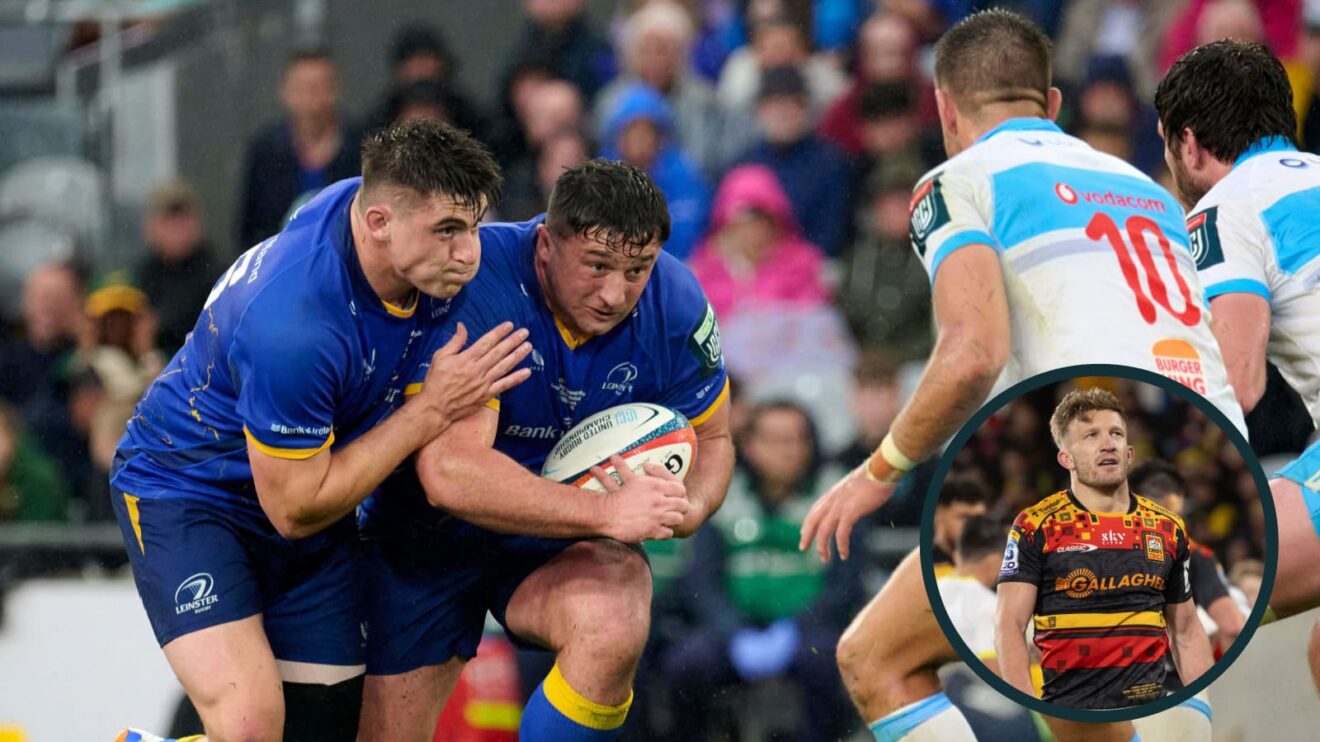
Leinster cruised to the URC title on a weekend of one-sided games.

This week we will mostly be concerning ourselves with one-sided big games, accidental yellows and a weekend of pivotal interest…
A new level?
The book ‘The Numbers Game’ by Chris Anderson and David Sally might be about soccer, but as always with elite sport, a review can contain signposts for other sports to look in a particular direction.
Specifically, a section of the book – a handful of pages, not a whole chapter – remarked upon the way that many of the more recent so-called ‘best of the best’ clashes (think Liverpool v Manchester City, or Barcelona v Real Madrid) were churning out results more suited to a sort of Liverpool v Thurrock, or Barcelona v Tresviso sort of scenario. Germany’s dismantling of Brazil in the 2014 World Cup would be another example.
But the section posited that it was not necessarily that one team was so vastly superior per se, rather that the top-most teams had become so well-trained and elite that on their day, when it all clicks as it should, even other best teams can barely lay a finger. Not about collapses, more about the sport in general seeing more and longer spells of near-perfection.
Are we reaching that zenith in rugby now? The stats even from this past weekend alone paint that sort of picture. Teams should not be running 70 points past others in semi-finals, but Toulouse did that to Racing 92 on Friday. Leinster looked unstoppable in the first half against the Bulls. Most indicatively, the Chiefs, the self-same Chiefs who ran the Crusaders ragged not one week ago, were shredded by the Hurricanes. Look a little further into the past and there’s Bordeaux’s dismantling of Leinster in the first half of the Investec Champions Cup Final. In fact, the number of breathtakingly one-sided ‘big’ games this season has almost outnumbered tight ones – such as Northampton’s hard-fought win over Exeter.
There have been collapses under pressure in the past, but in none of the above-mentioned games, with perhaps the exception of Racing’s limp surrender in Toulouse, would the narrative be reasonably about the losing team being awful. Much more prevalent is the number of team performances this season which have been benchmark for both the season and at times, for the sport.
And which is really the only conclusion worth drawing; but certainly a counter-argument to anybody disappointed with the one-sided nature of some of the Finals and play-offs we’ve had over the past couple of months. There’s been a perceptible improvement in quality at the sub-international level for much of this season in both hemispheres, while the recent Six Nations was also evidence that the uptick in general levels of skill, fitness and decision-making at the top level is better than ever.
Assuming the trend continues, what a World Cup we might be set for in 15 months’ time! As long as those pesky defence coaches don’t become too belligerent of course…
The yellow streak
At one card each, it didn’t entirely matter, but the two yellow cards dished out in the Prem Final on Saturday both were incredibly harsh.
Both involved players dipping before the tackle. Both times the ball-carrier dipped down towards the contact also. Both times the tacklers were immobile and absorbing the contact.
And both times referee Matthew Carley explained all this, virtually exonerating the tackler both times, but then sending them to the bin anyway?
He has his protocols, but at what point does the necessity of protecting heads transcend the boundaries of common sense? On both occasions, the tacklers concerned would have been putting their own heads in somewhat disproportionately risky positions in order to comply with the protocols; the skew towards the ball-carrier, who in both cases went aggressively to the contact point rather than evading, has become something that almost encourages players to go for contact rather than looking for evasion.
Common sense fortunately prevailed when Henry Pollock charged in for a loose ball later, and happily, the two yellow cards rather cancelled each other out, but we’re still too close to the edge when it comes to sending players off for unavoidable collisions.
The weekend of the 10s
A weekend of stories for fly-halves. Redemption for Sam Prendergast ahead of a tough tour for Ireland, during the exact same 80 minutes Handre Pollard dropped a stinker ahead of South Africa’s clash with England.
It can’t have escaped Dave Rennie’s attention how good Ruben Love was against Damian McKenzie either, with the latter rendered almost hologrammatic at times by both the former’s brilliance and the Hurricanes’ general attacking play.
Want more from Planet Rugby? Add us as a preferred source on Google to your favourites list for world-class coverage you can trust.
And then there’s France, where Six Nations orchestrator-in-chief Matthieu Jalibert has had a couple of weeks to cool his boots after Bordeaux’s failure to qualify for the Top 14 play-offs, but who can’t have failed to notice how Romain Ntamack is playing, even if the latter is not going to join the France squad until Toulouse have finished the business in the Top 14. What happens there might be the most interesting fly-half story of the first round of Nations Championship matches.
With quite a few fly-half questions flying around ahead of the July Tests, this felt at times a weekend where fates were decided, not just trophies.