Six Nations prediction: Ireland face ‘fascinating test’ of Andy Farrell’s coaching as ‘brutal schedule’ designed to see them ‘limping into March’
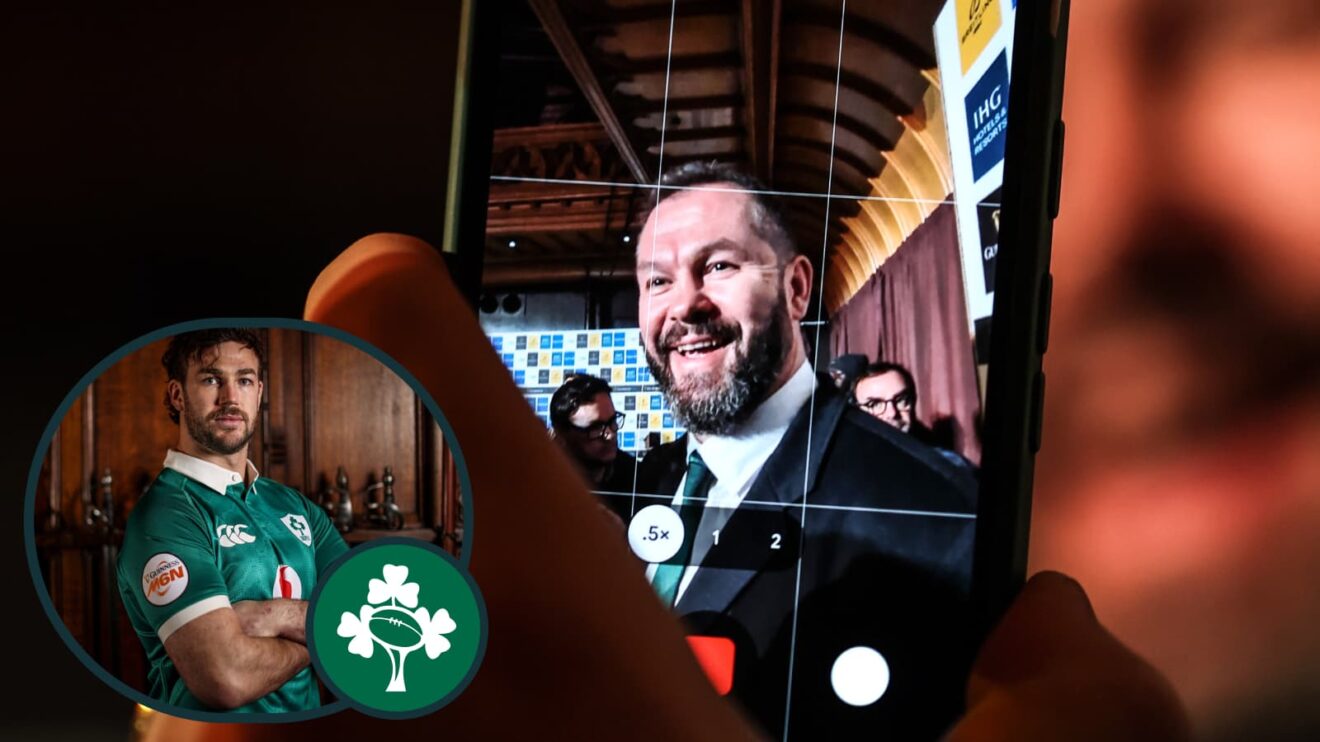
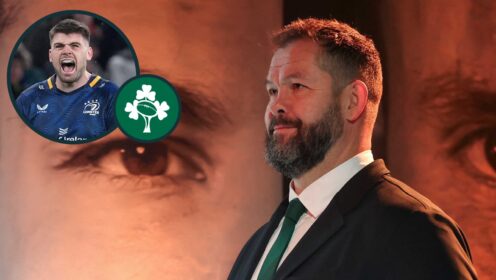
Andy Farrell being filmed at the Six Nations launch and, inset, Ireland skipper Caelan Doris (INPHO)
Next up in our set of previews ahead of the 2026 Six Nations, we examine the prospects of last year’s third-placed finishers, Andy Farrell’s Ireland.
After a disappointing Autumn Nations Series, uncertainty is stalking the injury-hit Irish while preparing for the Championship at their Quinta do Lago warm-weather base in Portugal.
Aside from their dismissal of Joe Schmidt’s Australia, it was a ropey November that featured unsettling losses to New Zealand and South Africa, while the handbrake remained on in the victory over Japan.
In short, it wasn’t the uplifting return to the helm that was hoped for with Farrell returning from his British and Irish Lions coaching sabbatical. His Ireland side isn’t terrible, but their game hasn’t progressed in quite a while now and it arguably makes them the hardest team to call heading into this tournament.
Last year
With Farrell busy with the Lions, defence coach Simon Easterby became interim head coach for the Six Nations and dreams of a third successive title win spectacularly collapsed with eventual champions France coming to Dublin and demolishing them with a 42-27 Round Four ambush.
Other than the impressive 30-minute post-interval power surge that neutralised England in their tournament opener (a 10-5 half-time deficit was transformed into a decisive 27-10 advantage), Ireland had little to cheer in a low-frills February that featured wins over Scotland and Wales.
Those performances in Edinburgh and Cardiff were largely huff and puff, and the latter against the supposedly hapless Welsh was not helped by Garry Ringrose’s 20-minute red card, which meant it wasn’t until the 67th minute that Easterby’s side finally got back into the lead.
Those results secured them the Triple Crown, but that was ultimately no consolation for what came to pass in March, especially the dubious misadventure of getting blown away in the second half by the French.
Ireland had moved 13-8 ahead shortly after the restart in Dublin, but they then inexplicably fell apart. That five-point lead brutally morphed into a 13-42 deficit coming down the finishing straight before a couple of late tries gave the final score a flattering complexion.
They had been battered, and the negativity carried into their final match as they only narrowly defeated the Italians by five points in Rome.
With Easterby double-jobbing, defensive leaks severely undermined their campaign. Whereas the Irish finished their 2024 title win conceding just 60 points and seven tries for a points difference of +84, they conceded 117 points, 14 tries and had a points difference of just +18 in 2025. That hurt.
This year
Opening the tournament away to France was the perfect fixture for Ireland in 2024. The French were still reeling from their 2023 Rugby World Cup failure, and the title-defending Irish, despite similarly exiting at the quarter-final stage, were keen to show who was still the Six Nations boss.
Two years on, the dial has shifted with the teams set to clash on Thursday in Paris. Momentum is clearly with the French for this opener, as too many of Ireland’s leading players are either still searching for top form following their Lions involvement in Australia or are injured.
Their November finished with the destruction of their yellow-carded scrum by the Springboks and with Ireland now struggling with injuries in this area, there are fears that a bruising start is in the pipeline for Farrell and co.
Hosting Italy in Dublin after a nine-day break will offer the chance for them to draw breath after the Stade de France, but the downside of the tournament reducing from two to just a single fallow week means that there is no respite between rounds two and three and they play away to much-improved England without the usual week off.
Adding in their issues with ongoing discipline and doubts over who should play at No.10, there is a very real prospect that Ireland could be cut adrift in the title race with just one win in three matches by February 21 if they begin poorly in Paris.
You have to go back to 2021 to find the last time that this type of one-in-three situation happened. While the Irish are tipped to win their back-to-back home games in March versus Wales and Scotland, playing catch-up on the table wouldn’t be satisfactory for a team that was ranked world No.1 less than two years ago.
Key players
The fit-again Caelan Doris is the beacon of hope for this Irish team. Having cruelly missed the Lions through injury, the upside is that his winter form since his return is on an upward trajectory.
He was solid but rusty getting tossed straight into the maelstrom of Test rugby in November without a club build-up, but his efforts since then with Leinster have been increasingly excellent and he will pack a punch in the coming Ireland matches.
While there are no fears about the level he can play to, what he needs to improve is captaining the team. Ireland’s penalty count woundingly grew throughout 2025, culminating in the farce that was one red and four yellows against South Africa.
That was with an English referee in charge that evening in Dublin and with English officials set to hold the whistle in three of their upcoming Six Nations matches following a January where Leinster and Munster also had their difficulties with English refs, Doris’ diplomacy will be crucial.
Bernard Jackman: Bundee Aki outburst part of widespread Ireland referee problem
Dan Sheehan is another player Ireland will heavily lean on. His trademark sparkle hasn’t fully glistened in a while, either with his lineout accuracy or the potency of his carry.
But his post-Lions doldrum period – and that of numerous others – must now end if the Irish are to thrive with the challenge of defying the doubters that feel they are a beaten docket before a ball has been kicked.
The curiosity about Ireland’s lineout issues is that this set-piece is coached by a certain Paul O’Connell, who should be doing way better.
Sheehan’s experience will also be crucial at the scrum, given the prop casualty rate. The prospect of packing down with rookies is a situation where the hooker needs to provide leadership and ensure Ireland don’t pick up in Paris where they woundingly left off in Dublin against the Boks.
Jamison Gibson-Park is the other player Ireland are so dependent on. He, too, is another of the Lions with a muted post-tour roar, but there were signs with Leinster that he is now in better form and he needs to go all-out in the coming weeks to make Farrell’s team tick.
The speed of the No.9’s pass and his slick movement around the pitch were a core ingredient when Ireland were winning titles, and he needs to be at his best at a time when the No.10 situation is in a state of flux.
A top form JGP would result in alleviating some of the pressure that will be heaped on whoever plays fly-half and give opposition stars such as Antoine Dupont of France and England’s Alex Mitchell plenty to think about.
Players to watch
The identity of the Irish No.10 is an intriguing conundrum. Farrell gave two starts each to Jack Crowley and Sam Prendergast in November, but Harry Byrne has now re-emerged as an option.
Want more from Planet Rugby? Add us as a preferred source on Google to your favourites list for world-class coverage you can trust.
Byrne is a safer bet type of operator, your regular 7/10, but the other two have an attacking X factor capable of rating way better on their day and lighting up the Irish attack. The downside is they also can be defensively exposed, especially Prendergast whose tackling tech progress has been frighteningly disappointing.
Loosehead is another key position demanding forensic attention following the ailments that have sidelined Andrew Porter, Paddy McCarthy and Jack Boyle.
Jeremy Loughman and Michael Milne could never have imagined they would be arriving into February competing with each other for the No.1 shirt, but it’s a sharp reminder of how injuries can dictate Test rugby selection.
Joe McCarthy’s Test career is now 19 caps old and having experienced how the likes of Maro Itoje go about their business as a Lions teammate before getting injured, the time is ripe for him to take his game to a new level here now that he has shed his rookie status.
Ireland need an enforcer who can stay on the right side of the law while being a complete nuisance and it will be interesting to see if McCarthy can elevate himself, especially in the February away days in Paris and London, and not fall foul of the refs.
Becoming a Test regular at the age of 33 is something few would have felt Stuart McCloskey would get the opportunity to do after a stop-start international career.
But Farrell has belatedly developed a soft spot for the bruiser with delicate offloading skills and Ireland will want him to build on his moments of encouragement in November before injury intervened.
Beady eyes should also be on Jamie Osborne. The late-tour Lions call-up, who was excellent when breaking through away to South Africa in 2024, hasn’t played since injuring his shoulder against Japan in November, but he is poised to be thrust into the team and remind people that there is a viable alternative to the injured Hugo Keenan at full-back.
Prospects
Head coach Farrell was on the money at the tournament launch in Edinburgh when he described Ireland as hunters rather than the team that everyone else is hunting. It highlighted how much his team’s reputation has fallen in recent times and it presents a fascinating test of his coaching to come up with a fresh plan to bring about a renaissance. Farrell propelled the Irish from also-rans to serious hitters with his change-up in 2022, but the pressure is on for him to come up with an upgrade as their game plan is now prey to too many rivals. Their lack of squad depth is troubling, and the brutal schedule seems designed to leave them limping into March. Third.
Fixtures
Thursday, February 5 v France (Stade de France, Paris)
Saturday, February 14 v Italy (Aviva Stadium, Dublin)
Saturday, February 21 v England (Allianz Stadium, Twickenham)
Friday, March 6 v Wales (Aviva Stadium, Dublin)
Saturday, March 14 v Scotland (Aviva Stadium, Dublin)