All Blacks v France prediction: Dave Rennie to begin reign with victory as rivalry that ‘does not do ordinary’ adds a fresh chapter in ‘full noise’ of new house


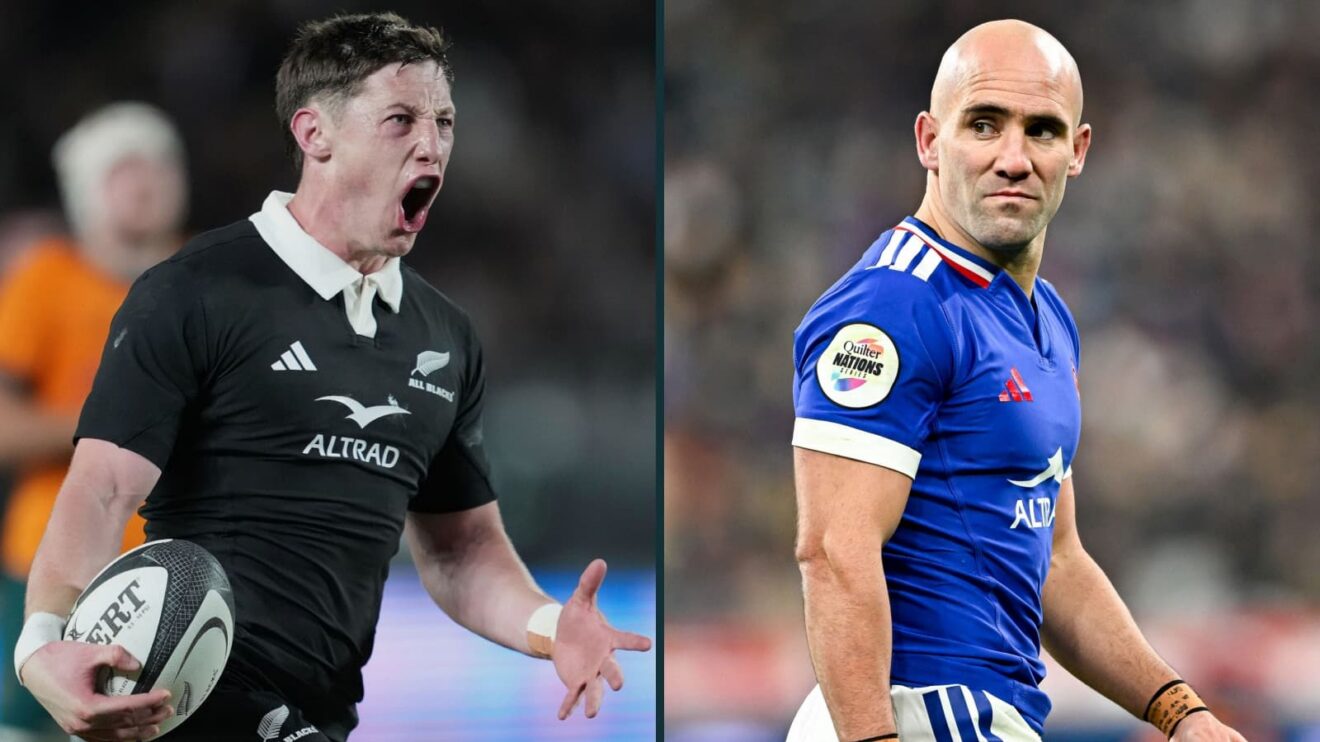
Cam Roigard and Maxime Lucu face off in the All Blacks v France clash.
New roof, new coach, one of the oldest and strangest rivalries on the All Blacks’ books. Dave Rennie starts his reign against a France side shorn of its stars and entirely unbothered by it.
Christchurch has waited 15 years for a night like this. The last All Blacks Test at a permanent Canterbury stadium came before Lancaster Park fell in the quakes, and One New Zealand Stadium opens its roof as a city’s answer to all that lost time and lost rugby. France christen it, and they do so as the very first fixture of the Nations Championship, the opening ball of a competition that has torn up the rugby calendar.
But they come without the men who made them. The Top 14 final came too late for this opener, barring every Toulouse and Montpellier player under the release deal, and Fabien Galthié has parked others, notably the world class duo of Louis Bielle-Biarrey and Charles Ollivon, after a season that ran from September and never eased.
However, what travels is still dangerous. Bordeaux-Bègles did not make the play-offs, so the spine of the double European champions is free, and Matthieu Jalibert, Maxime Lucu, Damian Penaud, Yoram Moefana, Nicolas Depoortere and Marko Gazzotti give this French side real teeth. Call it what it is; the closest a neutral will get to Union Bordeaux-Bègles against the Hurricanes, the two best clubs either side of the equator, dressed in fern and cockerel.
Reach for the word ordinary at your peril. New Zealand and France have met eight times at World Cups, more than any other pair in the game, and the ledger runs through the 1999 semi-final when France buried a side Jonah Lomu had all but sent home, the 2007 ambush in Cardiff, and the 2023 opener when Les Bleus became the first team ever to beat the All Blacks in a pool match. New Zealand have the 1987 and 2011 finals and the 62-13 mauling in 2015 to set against it. This international fixture ends tournaments and it certainly does not do ordinary.
Where the game will be won
Collision, aerial battle and set-piece; everything on Saturday runs off those three.
France’s honest weakness is the front-row, and New Zealand are built to punish it. Jefferson Poirot props at 33, out of retirement because Cyril Baille has faded and the cover behind Jean-Baptiste Gros is thin, packing down with Maxime Lamothe and Demba Bamba in a unit short on caps. Ethan de Groot and Fletcher Newell will anchor a heavy New Zealand scrum with Sam Darry and Josh Lord at lock. Hold that scrum and France have the ball players to cut anyone open. Go backwards and the platform dies, and the fast game they want never leaves the ground.
France carry a threat off the maul too. Tom Staniforth and Hugo Auradou give them lineout height, Gazzotti a jumping tail, and the drive is a weapon this pack has scored from before.
The battle in the air might be the best watch of the lot. France kick to contest and they own the drop zone, tapping the ball back to keep it alive rather than claiming it clean, turning a 50/50 into chaos and launching one of the most dangerous counters in the game off the mess. 19 of their 30 Six Nations tries came off transition, which tells you exactly where the danger lives. Theo Attissogbe, Penaud and Max Spring can punish anyone given room to run.
New Zealand play the transition game too but rather back the clean catch and the fast strike. Both sides have the boots to make it sing, Lucu and Jalibert able to shift a defence around the park and Cam Roigard’s box kick setting the chase. Whoever wins that contest earns the right to attack and this is where the fast game either catches fire or dies.
France score for fun but, in recent times, they leak almost as freely. They shipped 19 tries in the championship, the second worst in it, and were cut open for 50 points at Murrayfield and 46 by England in Paris on the very day they won the title. The friction between Galthié and defence coach Shaun Edwards sat underneath much of that, and with Edwards gone, plugging the leak is the stated focus of the new chapter. New Zealand will have circled it in red ink; Will Jordan’s finishing, Ardie Savea on the carry and a Hurricanes core that plays at 100 miles an hour are the tools to run at a soft edge. Whoever wins front-foot ball and recycles it fastest owns the speed, and the side made to chase across the turf is the one whose scrum blinked first.
What they said
Rennie has set his stall out plainly. He wants optimism and brutality in the same breath, the basics done brilliantly, selection on form with nothing owed to reputation. Jason Ryan, the one assistant he kept, calls the new environment tremendously clear, a coach who knows exactly what he wants. Codie Taylor, a centurion who has seen plenty come and go, put it simplest this week: the new man owns the room the moment he speaks – something the All Blacks sorely needed.
Savea, handed the captaincy for the year, framed it the way the black jersey always does. Leading the side is one of the great honours in sport, a united All Blacks team can unite a nation, and he wants all five million Kiwis behind a group walking towards what is coming.
Galthié made his peace with the short turnaround long ago. His staff, he says, have become masters of building a team in under a week, simple enough not to drown the players and precise enough to send them out sure of themselves. This France group has been built without deference and they see this as an opportunity to explore and consolidate depth, rather than a threat to their record.
Players to watch
Matthieu Jalibert runs France with the ease of a man who has finally made the 10 shirt his own, in the best club form of his life and he’s now trusted to conduct the lot. Yoram Moefana is the collision that wins or loses the French gainline, the physical hinge of the midfield. Marko Gazzotti was superb against the England XV and steps in at eight, the coming force of French forward play, built for this kind of Saturday. Behind them stands Theo Attissogbe, the breakout of last year’s tour, a wing whose work under the high ball kept France alive last winter and whose counter gives them a spark from deep.
New Zealand answer in kind. Ardie Savea is the heartbeat, home again after a title with Kobe under the coach now leading his country, the on-field centre of everything Rennie is building. Ruben Love gets the 10 shirt, the clearest sign of the youth turn, and how he steers a green side under French pressure and heat may quietly settle the night. Off the bench Fehi Fineanganofo will emerge uncapped and unafraid, a wing who set a single-season try record for the champion Hurricanes and earned his shot despite a signed deal to leave. Jordie Barrett gives them senior iron at 12, the man who has to win the exchange with Moefana and hold the young ones steady.
Main head-to-head
Cam Roigard is New Zealand’s first choice without argument, the tempo-setter of the Hurricanes side that swept the lot, a scrum-half who lives on the fringe and turns fast ball into carnage. Maxime Lucu leads France and matches him for class, kept from the shirt for years only by the shadow of Dupont. Roigard quickens everything, Lucu controls and squeezes, and whoever bends the game to his pace hands his pack the whip.
This tournament was sold on a Roigard against Antoine Dupont reunion, and with Dupont now withdrawn on workload grounds it is worth killing a lazy line before it comes round again. Roigard did not outplay Dupont in Paris. France won that night in November 2024, 30-29. Roigard was excellent, took a lovely intercept try off Grégory Alldritt at the scrum and had, in Scott Robertson’s own words, a good head-to-head. Dupont was excellent too, running the closing quarter moving to 10 and steering France home in only his second XVs game back after Olympic sevens gold. When your man’s side wins and he owns the last 20 minutes, outplayed is the wrong word.
The recent record sits with New Zealand, and the longer one keeps everyone honest. Three defeats in last July’s clean sweep, 29-19, 43-17 and 31-27, set against that Paris one-pointer and France 27-13 at the 2023 World Cup. France won three on the bounce before the whitewash undid the run, and they have not won on New Zealand soil since Dunedin in 2009. A first win here on Saturday would be only their fourth in the country’s history.
Prediction
France will play with the freedom of a side that has nothing to lose and plenty to prove, and for a good hour they will look every bit the equal of the hosts. The Bordeaux spine is too sharp to dismiss, Jalibert too clever, Attissogbe and Penaud too quick in the loose. Somewhere in the first half, Christchurch will hold its breath. The World Cup history is the standing warning here and Kiwi worry will be this is exactly the French profile that writes an upset, young, fearless and deaf to the aura.
The scrum is France’s glass ceiling. That French front-row is asked to last 80 minutes against a pack chosen for the fight, and when the benches empty and the set-piece tilts, the platform that lets France run finally frays. Rennie has the control, the aerial game and the home roof, and a new coach with a fresh group wants the statement of a first-night win. France will score, and score well, and keep the margin honest deep into the last quarter through sheer refusal to fold.
Want more from Planet Rugby? Add us as a preferred source on Google to your favourites list for world-class coverage you can trust.
New Zealand by 11. 37-26 to the All Blacks, three tries each, the difference sitting in the scrum squeeze and the calm of the men in black when the game asks for control rather than courage. The new house opened the only way this rivalry knows, at full noise, with France sent to Brisbane beaten and already a problem for the Wallabies.
The teams
New Zealand: 15 Damian McKenzie, 14 Will Jordan, 13 Quinn Tupaea, 12 Jordie Barrett, 11 Caleb Clarke, 10 Ruben Love, 9 Cam Roigard, 8 Ardie Savea (c), 7 Luke Jacobson, 6 Peter Lakai, 5 Sam Darry, 4 Josh Lord, 3 Fletcher Newell, 2 Codie Taylor, 1 Ethan de Groot
Replacements: 16 Asafo Aumua, 17 Xavier Numia, 18 Tyrel Lomax, 19 Patrick Tuipulotu, 20 Wallace Sititi, 21 Cortez Ratima, 22 Billy Proctor, 23 Fehi Fineanganofo
France: 15 Max Spring, 14 Damian Penaud, 13 Fabien Brau-Boirie, 12 Yoram Moefana, 11 Théo Attissogbé, 10 Matthieu Jalibert, 9 Maxime Lucu (c), 8 Marko Gazzotti, 7 Oscar Jégou, 6 Pierre Bochaton, 5 Tom Staniforth, 4 Hugo Auradou, 3 Demba Bamba, 2 Maxime Lamothe, 1 Jefferson Poirot
Replacements: 16 Barnabé Massa, 17 Reda Wardi, 18 Régis Montagne, 19 Mickaël Guillard, 20 Killian Tixeront, 21 Nolan Le Garrec, 22 Antoine Hastoy, 23 Nicolas Depoortere
Date: Saturday, 4 July, 2026
Venue: One New Zealand Stadium, Christchurch
Kick-off: 19:10 (local), 08:10 (UK), 09:10 (France), 09:10 (South Africa), 17:10 (AEST), 19:10 (New Zealand), 04:10 (Argentina), 16:10 (JST), 03:10 (EDT)
Referee: Luke Pearce (RFU)
Assistant Referees: Christophe Ridley (RFU) and Katsuki Furuse (JRFU)
TMO: Marius van der Westhuizen (SARU)
FPRO: Ben Whitehouse (WRU)
Broadcasters: ITV (United Kingdom), TF1 (France), Virgin Media Television (Republic of Ireland), Sky Italia (Italy), Wowow (Japan), Sky Sport (New Zealand), Nine Network / Stan Sport (Australia), SuperSport (South Africa)