All Blacks team: Five takeaways as ‘bold selections’ hint at Dave Rennie ‘moving with the times’ after Scott Robertson reluctance


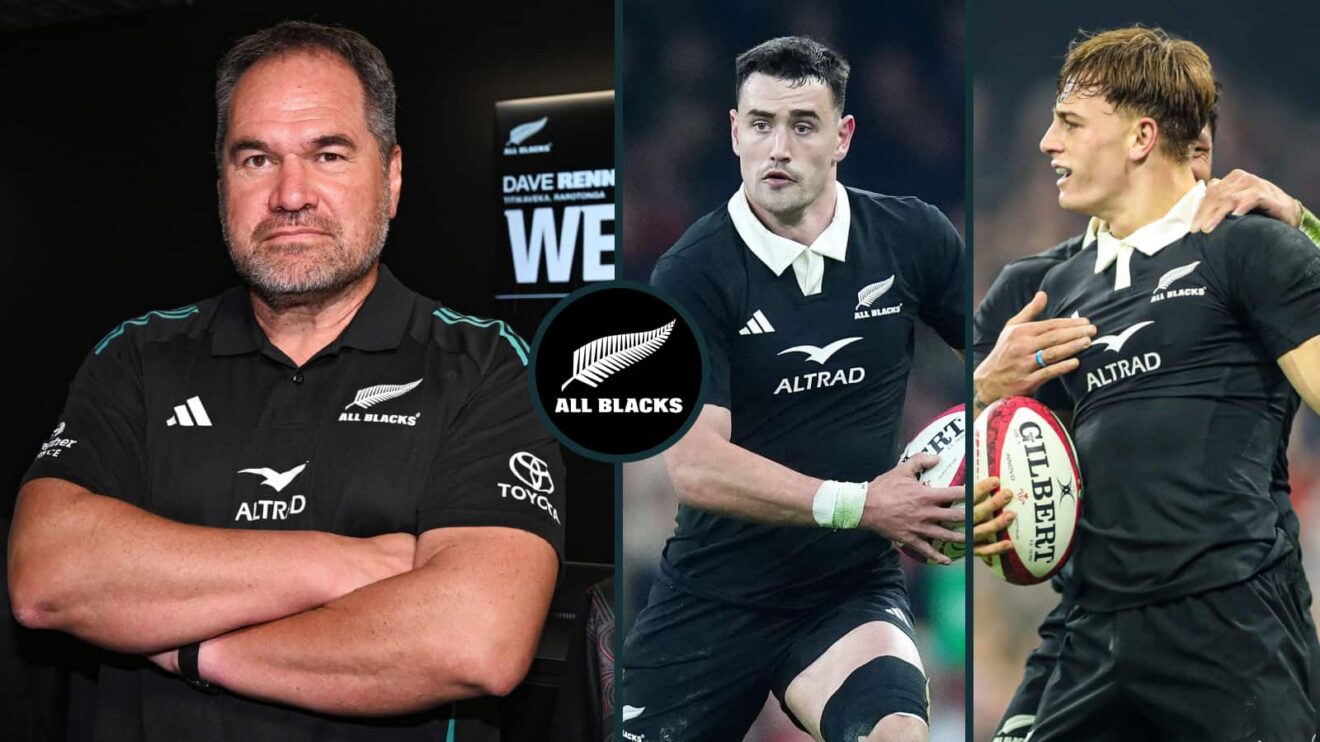
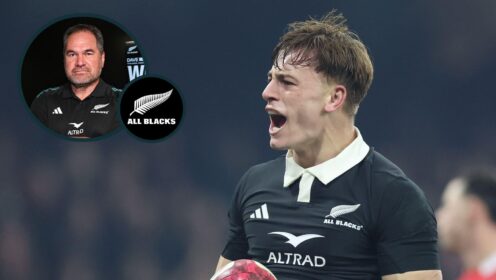
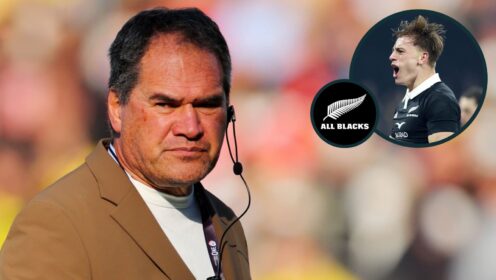
All Blacks head coach Dave Rennie and backs Will Jordan and Ruben Love.
Following the announcement of Dave Rennie’s first All Blacks team, here are our five takeaways from the matchday 23 to face France.
The top line
Rennie’s mission to get the All Blacks back on track begins at One NZ Stadium in Christchurch on Saturday evening against a strong Les Bleus outfit. Sure, Fabien Galthie doesn’t have all of his best players at his disposal, but Bordeaux’s early exit from the Top 14 means that this will be a far sterner task that the All Blacks will face than the one Scott Robertson oversaw last year.
For his debut game in charge of New Zealand, Rennie has very much rewarded Super Rugby Pacific form with nine title-winning Hurricanes scattered across the matchday 23, with six coming from the losing finalist Chiefs. The remaining players largely impressed throughout the domestic season, with Will Jordan being the standout exception due to injury, as Rennie delivers on his promise to reward form.
Jordan is named on the right wing, more on that later, with Damian McKenzie starting at full-back while Caleb Clarke completes the back-three. The most in-form centres during the 2026 season combine in the midfield with Jordie Barrett linking up with Quinn Tupaea, while Ruben Love’s brilliance this year has seen him clinch the starting fly-half jersey where he partners Cam Roigard.
Ardie Savea leads the side from the number eight jersey and is joined by Luke Jacobson and Peter Lakai – two players who have also been rewarded for their domestic form. Sam Darry and Josh Lord combine in the second-row with the All Blacks missing Scott Barrett and Fabien Holland due to injury, while Tupou Vaa’i is ruled out through concussion.
The front-row is spearheaded by hooker Codie Taylor with Ethan de Groot at loosehead and Fletcher Newell in the number three jumper. The Hurricanes scrum was pivotal in their title run, and Rennie has again recognised that with Asafo Aumua, Xavier Numia and Tyrel Lomax set to make an impact from the replacements bench.
It’s a particularly special occasion for loosehead Numia, who is one of the two uncapped players in the team along with fellow Hurricane Fehi Fineanganofo, who broke the Super Rugby record for the most tries scored in a single season along with Josh Moorby. Fineanganofo is joined by fellow Cane Billy Proctor and Chiefs number nine Cortez Ratima as the backline replacements.
Wallace Sititi has recovered from his horror injury in the Super Rugby semi-finals and is joined on the bench by Blues lock Patrick Tuipulotu.
Stark contrast to Scott Robertson conservatism
Fairly or unfairly, Robertson was accused of being conservative in his selection, more often than not backing pedigree over form, but with his first All Blacks matchday 23, there is a stark contrast with Rennie’s picks.
Most notably at fly-half, where Love gets his maiden start in the role at international level despite the presence of the vastly experienced McKenzie and Beauden Barrett as the other playmaking options, the former boasting 74 Tests, the latter north of 100.
Had he gone down the route of selecting McKenzie or Barrett in the number 10 jersey, there would have been some outcry or criticism, but the reasoning would be sound considering that France are more than likely going to be a bigger challenge than the one that awaits them next week against Italy. Starting Love against the Azzurri would allow him the opportunity to ease into the role at Test level, but instead, he has been thrown into the deep end and will sink or swim against one of the most tactically astute teams in the world.
There is a real element of risk when selecting the first team of the year as it will inevitably set the tone for the season ahead and, in Rennie’s case this year, his tenure. However, we saw hints of it when he was the Wallabies head coach; he is not shy to make a bold call or two and often gets it right; the recall for Quade Cooper being a standout example of just that.
With Love stationed at fly-half, McKenzie still finds a space in the starting line-up as he is named full-back. It’s certainly an intriguing decision from the selection team with Jordan named on the wing. It suggests that Mike Blair’s attacking structures could be reliant on dual playmakers, a concept that has been very hit and miss for the All Blacks in recent years but a discussion that will certainly resurface, particularly when Richie Mo’unga has met the absurd requirement of having played an NPC fixture before turning out for New Zealand.
Another bold selection and somewhat enforced comes in the second-row with the largely inexperienced lock pairing of Lord and Darry entrusted with the starting jerseys. With Tuipulotu fit and ready to go, one would have expected that he would make the run-on team, especially against a forward-focused team like France. But much like with the Love selection, Rennie and his staff are giving the duo the chance to impress.
Furthermore, the make-up of the back-row is eye-catching. Jacobson is very much a marmite player in New Zealand, and most would have been shocked to see his name next to the number seven. However, a hard-nosed loose forward like the Chiefs skipper is perhaps just what the All Blacks back-row requires. While Jacobson and his charges were soundly beaten in the Super Rugby Pacific Final, he was a true warrior in a frankly shocking showing, and that clearly hasn’t escaped the selectors, nor has his form leading up to the title-decider.
Traditionally, France have selected three loose forwards that would not be out of place in the second-row, so while the All Blacks trio may lack height, Rennie’s selections point towards a bigger focus on speed, power in contact and breakdown presence.
Dave Rennie owns selections, but will he bend to public pressure?
Overall, this matchday 23 is one that supporters can get excited about even if they don’t fully agree with all of them; fans never do, to be fair. Under Robertson, the team was largely predictable and even the usually accurate New Zealand Herald got several selections wrong this time around.
The unpredictability of the selections is one thing that is in stark contrast to his predecessor, but another is the fact that, unlike Robertson, Rennie very much has owned the selections.
“Two of the best full-backs in the world on the field at the same time,” Rennie remarked when asked about Jordan and McKenzie’s starting roles.
On the back-row calls, he explained: “It’s just numbers on the back for me. Sounds like some people got quite excited about the change, but all of those guys have played a little bit at eight. We like Luke. He is tough; he’ll have a real physical presence against the French, and we think that’s really important. Both Pete and Ardie give us post-tackle presence, but excellent athletes who suit our type of game. So yeah, it was probably the area we discussed most around combinations, and so those guys will start and Wallace off the bench.”
On Lakai playing at blindside, he added: “He’s packing down at six at a scrum. That’s probably the only difference. We like Ardie at eight; we could have played him at seven. So I reckon what they got is a complementary skill set.”
It was clear-cut, straightforward and transparent explanations from the new head coach. The numbers on players’ backs have been a consistent talking point in New Zealand and not just with Robertson. Savea’s constant selection at number eight has been a talking point since Kieran Read’s retirement. The same applies to Barrett and McKenzie at 10 and 15. Then there is always the outcry of ‘Will Jordan is the best full-back in the world, why is he playing on the wing?’
But Rennie stuck to his guns. Even if it doesn’t look right on paper, it’s what we want. That was effectively his message. However, the key thing will be whether he sticks to it and doesn’t succumb to the pressure of the public when things aren’t quite going right. The New Zealand public is incredibly demanding of the All Blacks, and even if they are winning, playing well is a requirement, and criticism is bound to come. It’s part of the job.
Want more from Planet Rugby? Add us as a preferred source on Google to your favourites list for world-class coverage you can trust.
What the new head coach has over his predecessor is that he has dealt with this kind of pressure with the Wallabies before and is far more experienced, having coached in other environments too. He has been in the game longer as the top dog, and it is already showing. There was a lot of excitement around Robertson, and the same applies to Rennie now, but he will know better than most that he will only be afforded so much grace and that will be halved, at the very least, by the first whistle in Christchurch.
Super Rugby Pacific quality litmus test awaits
“The Top 14 is the best competition in the world,” Rennie said after naming his team. It’s the kind of line that won’t sit well with the Super Rugby Pacific hierarchy, but factually, it’s spot on.
The French have 30 professional teams, 14 of which are in the highest division and are the most well-funded clubs in the world. It means that France head coach Fabien Galthie is never short on options of players who could be of international standards, and frankly, New Zealand simply doesn’t have the same pool to select from.
With there being so many different styles and approaches to the game in the Top 14, it means that it is an ideal breeding ground for international players, whilst Super Rugby clubs, to a degree, are guilty of playing a similar kind of game. So while Rennie has backed the form of the Chiefs and Hurricanes players in his first matchday 23 of the year, Saturday’s encounter will be a litmus test of just how well Super Rugby form translates to the highest level.
It’s a debate that has raged on since South Africa left the southern hemisphere’s premier club competition and will continue to do so going forward, particularly if the All Blacks look undercooked in Christchurch.
Love was outstanding at number 10 for the Hurricanes, Jacobson a menace for the Chiefs, Clarke was one of the best under the high ball in the competition, the ‘Canes front-row dominated the scrums, Fineanganofo scored tries for fun and Jordie Barrett was otherworldy, but can they replicate that in the black jersey? Yes is the answer, but Rennie and co. will be out to get the verdict on the others and as soon as possible.
Not a Bomb Squad but just as effective?
“I don’t like that term,” Rennie quipped after being asked if he was looking for a ‘Bomb Squad’ like impact by naming an all-Hurricanes replacement front-row on his bench. The All Blacks boss is clearly not a fan of the nickname but is certainly looking for the same kind of impact on the game from his front rowers in the latter stages of the match.
It’s no longer a case of benches becoming more influential in the modern game; it’s a fact that it’s crucial. Particularly at international level, it’s a 23-man game, with the first names and Rennie is too savvy a coach not to know that.
We see that in the eight players that he has selected, with not a single role wasted. With the front-rowers, he is looking for maximum impact and proven combinations with the Hurricanes trio.
Based on Super Rugby form, especially during the latter stages, picking between Samisoni Taukei’aho and Aumua could have been a tough task, but when adding the benefit of clubmates Numia and Lomax into the mix, Aumua comes out an easier winner. With Vaa’i sidelined, Tuipulotu is the only viable out-and-out lock available, but he is a perfect option for the second-row cover because of his experience, ability to call the lineout, and play both loosehead and tighthead lock.
The loose forwards in the All Blacks squad are of a similar ilk as they have all-round skillsets, but Sititi’s standout feature is his explosiveness not only into and through contact but in terms of speed too. While he would not be out of place in the starting line-up, his strengths make him a real weapon off the bench, something we have witnessed in the black jersey already. His ability to play all three back-row positions and be a lineout option too makes him the perfect foil for the starting three.
In a straight shootout between Ratima and Kyle Preston for Cam Roigard’s back-up, the former has got the nod. It’s an understandable selection in the sense that if changes are made in the half-backs, we are likely to see Ratima combine with McKenzie in the latter stages. Familiar combinations are a theme in the All Blacks selection, and this call follows that.
Then it comes to the final two slots, where Rennie has opted for Billy Proctor and Fineanganofo. With no need for fly-half cover on the bench, there are sufficient replacements in McKenzie and even Barrett; Rennie is able to use his final two slots to cover a worst-case scenario, ease in a newbie and have two potential game-chargers all at once.
The head coach has boldly snubbed the insurance policy that Beauden Barrett could have provided and instead stuck Proctor in there to ensure that there is cover in the midfield. Fineanganofo is not only given the luxury of easing into international rugby via the bench but is entrusted to effectively be Jordan’s cover, with the Crusaders star thrown into the starting XV having barely played this year and sustained an injury on his most recent return from the sidelines.
Clarke also doesn’t have the best injury profile, and while the pair are among the best outside backs in New Zealand, even the world, cover this time around is probably needed.
Robertson resisted the urge to deviate away from the traditional 5-3 bench split during his tenure; Ian Foster tried it once, and it backfired. While Rennie doesn’t like the term, his first bench selection suggests that a lot more focus has been put on the last eight numbers on the teamsheet and that we can expect him to be more flexible. His picks hint at the best fit for the task at hand and not just the second-best players in their respective positions. Only time will tell, but it would not be a shock to see the All Blacks move with the times.