The Springboks ‘superpower’ that sets them apart, where it comes from and their ‘refusal’ to lose – Analysis


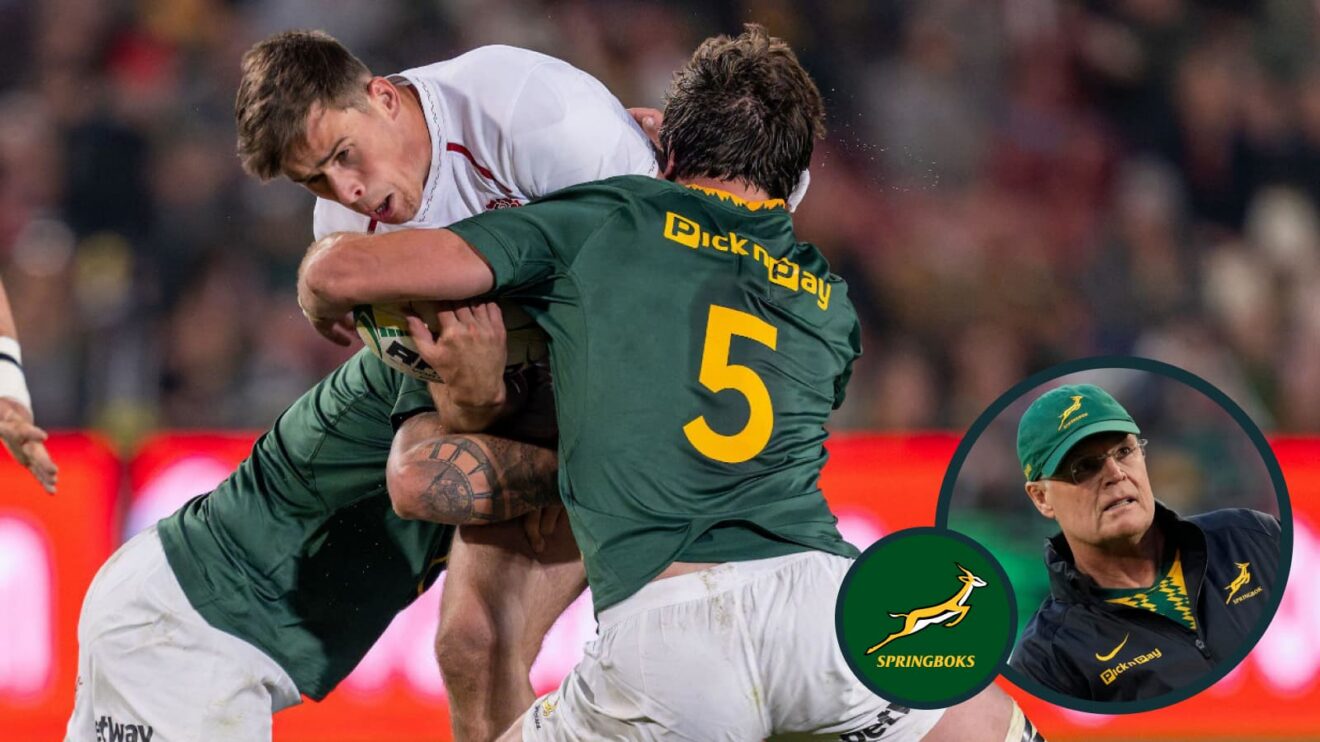
England centre Seb Atkinson tackled by Springboks duo.
Everyone wants to talk about shape, kicking maps and the Bomb Squad. They’re all missing the point. South Africa’s defining skill isn’t tactical. It’s emotional. The Springboks refuse to lose collisions, and nearly everything else flows from that.
The premise
South Africa will lose lineouts, they will lose aerial contests, and on the odd bad night they will lose Test matches. What they will not do is lose the collision. That commitment sits above the game plan, above selection, above everything, and the kicking game, the rush defence and the loaded bench all exist downstream of it. Break it and they have broken the one thing the jersey stands for, so they do not break it. Lose the shape, lose the aerial contest, lose a lineout or three, and the Springboks will live with it. Lose the collision and they have betrayed their shared identity, and that’s the value that lives before any other technical aspect in the green and gold shirt.
Paris
The proof arrived on one night in October 2023, and the numbers are still quite astonishing. South Africa made 209 tackles in the World Cup final, the most ever by a team in a men’s Rugby World Cup final, overtaking the 158 they made against England in 2019, meaning the two heaviest defensive shifts in the history of finals belong to the same nation, and both efforts ended with the trophy in South African hands. They made over twice the number of tackles completed by their opponents and won anyway. Tactics exist to stop you making 209 tackles, but winning whilst making them is the character of champions.
And that man Pieter-Steph du Toit made 28 of them, beating Richie McCaw’s record of 18 for the most tackles in a World Cup final, and by my count nine of the 28 hunted Jordie Barrett specifically, New Zealand’s biggest carrier stopped at the gainline again and again until the passing game behind him disconnected. The final produced only 23 points, the lowest combined score in a World Cup final since 2011. It was a siege, and the siege held.
Then place the final in its trilogy; 12-11 against New Zealand, 16-15 against England, 29-28 against France, three knockout wins by a single point, making South Africa the first team to win every match of a World Cup knockout campaign by the minimum margin. Three opponents, three entirely different tactical problems, one identical outcome – South Africa simply refused to lose. The constant was never the game plan. Their kicking game was elite, their scrum was elite, and their adaptability across those three matches was real, but the one thing present in all three furnaces at the same intensity was the collision, their sheer belief and the refusal attached to declining physicality. “I guess as a team we like drama”, said Du Toit afterwards, framing the trilogy as resilience rather than fortune, and he was more right than he knew.
The pattern
If Paris were a one-off you could file it under form, but it’s a decade of data. In 2024, Rassie Erasmus used a mind-boggling 50 players over 13 Tests and still won 11, with both defeats coming by a single point. Read that back. 50 players is a settled identity being handed to whoever wears the jersey, and even in defeat the signature held, because nobody put them away. Then the ultimate enforcement of the promise; in September 2025, seven days after losing at Eden Park, the Springboks won 43-10 in Wellington, handing the All Blacks their biggest-ever Test defeat. New Zealand have been playing Test rugby for over 120 years. Their heaviest hiding came from a wounded South Africa. That is the mechanism working exactly as designed.
Honesty demands the Eden Park caveat, because this argument dies if it claims invincibility. In Auckland the Boks conceded two tries in the first 17 minutes and were their own worst enemies through dropped passes and a misfiring lineout, losing the opening quarter physically and losing the Test with it. The premise is about what happens next, and what happened in the next game was 43-10.
12 languages
So where does the refusal come from? This is where a decade of analysis went backwards, because the answer was never on an analyst’s whiteboard.
South Africa’s constitution recognises 12 official languages, from isiZulu and isiXhosa through Afrikaans and English to South African Sign Language, added in 2023, sitting above roughly 34 historically established languages in a country whose African languages, spoken by at least 80 per cent of the people, were ignored under colonialism and apartheid. 12 official languages, many more subcultures and one jersey, that’s what walks onto the pitch with them.
Siya Kolisi framed it in Yokohama in 2019: “we come from different backgrounds, different races, and we came together with one goal”. Four years later in Paris, minutes after the third one-point escape, he reached for it again from the other side, telling the world that outsiders cannot grasp the meaning because “our country goes through such a lot”.
And the emotional depth of this side starts with the captain. Kolisi was asked after Yokohama whether winning the World Cup had been his childhood dream, and his answer told you everything about where Springbok motivation actually comes from; as a child he was “just dreaming about where my next meal was coming from”. He was raised in poverty by his grandparents, turned up to his first provincial trial in boxer shorts because he owned no kit, and as an adult tracked down his half-siblings in orphanages and foster care and adopted them. That is the man leading the defensive line, a man with the deepest imaginable mine of emotional gold. And whilst 23 players hold 23 different histories, the achievement of this Springbok generation is that all of them, whatever language they think in, have been given one shared reason to win the next collision.
The lineage stretches further back still, to Francois Pienaar first lifting the trophy in the Mandela final that signalled the birth of the Rainbow Nation, echoed in 2019 by President Ramaphosa on the podium in a number six jersey just as Mandela had worn Pienaar’s number in 1995. Understand that lineage and the collision obsession stops being a style choice. Plenty of nations carry hardship and division into Test rugby, but no side has converted national difference into a single competitive identity as consciously or as completely as the modern Springboks, and the collision is where that identity is tested in public, in real time. Losing the gainline is losing the argument. So they refuse.
Ellis Park
The theory got its latest stress test on Saturday, in conditions built to break a tactical side. Kolisi and Eben Etzebeth, 244 caps of leadership gone by breakfast and further compounded by losing Ox Nche, a totemic player, in the first 10 minutes. Du Toit moved from flank to lock, took the captaincy and put up 14 carries and 14 tackles without a flicker of disruption, whilst Ruan Nortje and Malcolm Marx made a joint-high 17 tackles in the 45-21 dismantling of England. A merely tactical system loses two generational leaders an hour before kick-off and wobbles. A covenant hands the standard to the next man and carries on, and seven tries later the scoreboard confirmed the handover. And there sits the contrast England should study hardest: Steve Borthwick measures everything and Erasmus measures everything too, but on Saturday’s evidence only one of those audits reaches emotional character, and the scoreboard was the finding.
Want more from Planet Rugby? Add us as a preferred source on Google to your favourites list for world-class coverage you can trust.
The conclusion
Return to the spine and the decade resolves. We have spent 10 years mapping kicking games, charting box-kick contests and counting forwards on benches, treating the physical dominance as the delivery mechanism for the strategy, and it is precisely the other way around. The rush defence, the 7-1 split, the aerial war: these are expressions of a commitment made before any coach draws a line on a screen, by a squad that knows exactly whom it answers to. Everything Erasmus builds assumes the commitment is already in place, which is why it survives 50-player rotations, pre-match withdrawals and one-point furnaces that would melt anyone else, and why the response to a rare collision defeat was the biggest hiding in All Blacks history.
Shape is negotiable. Kicking maps are negotiable. The Bomb Squad is personnel. And here is the last turn of the argument: the collision was never the superpower either. The superpower is collective sacrifice, the willingness of 50 rotated players, seven benched forwards and every man contributing to a 209-tackle defensive shift to give up individual comfort for a shared identity, and the collision is simply where that sacrifice becomes visible, 16 stone into 16 stone, no hiding place. It is a promise made across 12 languages, kept one collision at a time. Analyse that first, and the last decade finally makes sense.
READ MORE: Wrong Damian! Broadcaster blunder denies Springboks star an award in milestone match