Springboks coaches slam ‘bikini stat’ that Jaco Peyper claims refs try to ‘manipulate’ in a disservice to the game
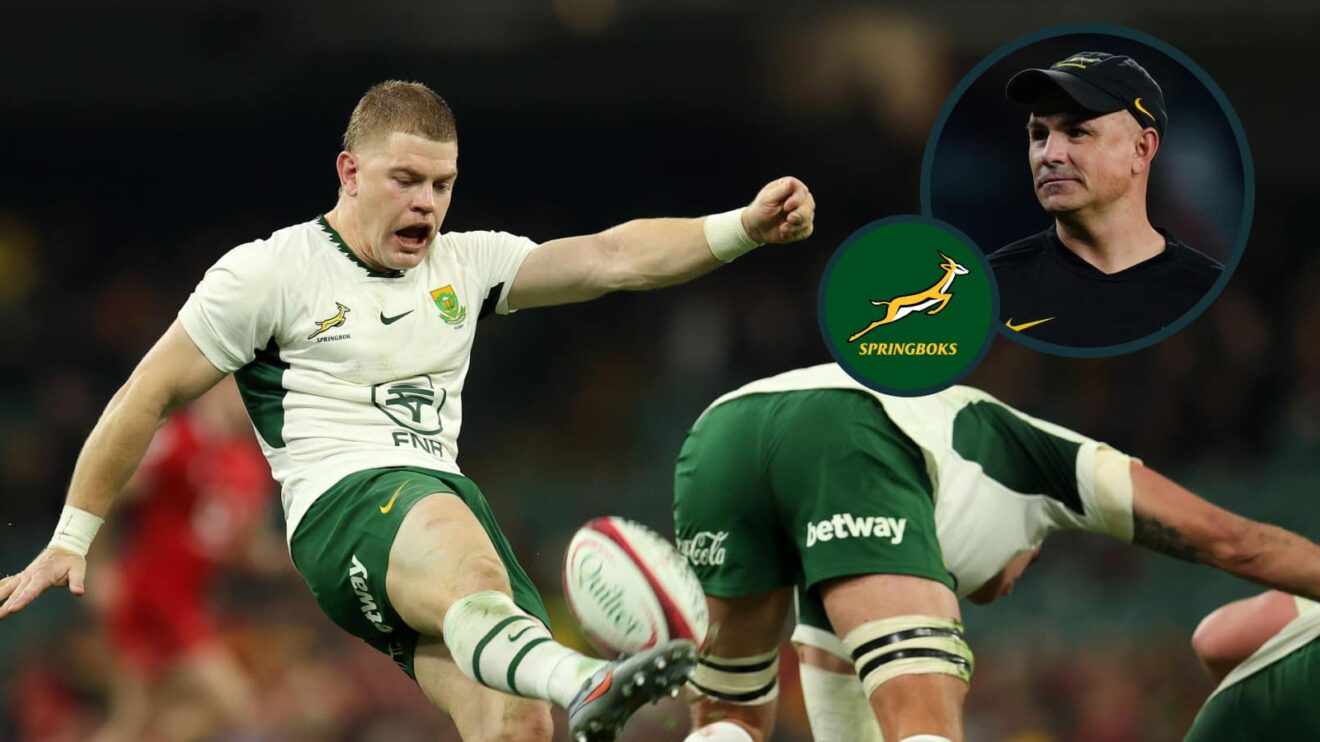
Springboks scrum-half Morne van den Berg kicks and an inset of Jaco Peyper.
The Springboks coaches have hit out at the use of the ball-in-play statistic as a metric for an entertaining game, dubbing it a ‘bikini stat’.
The statistic is often used to support an argument for World Rugby to speed up the game, as it measures the time the ball has been in the field of play before the next stoppage in play or set-piece.
Ball-in-play metric
World Rugby Chair Brett Robinson has referenced the stat, stating that there is too much senseless kicking in matches, while former All Blacks head coach Ian Foster also utilised it to criticise the quality of the 2023 Rugby World Cup pool stage match between the Springboks and Ireland.
“If you look at the South Africa-Ireland game, it was a different game of rugby,” he said after the All Blacks’ 96-17 hammering of Italy.
“The ball was in play for 27 minutes throughout the whole game. It was a very stop-start game, very physical, very combative. You saw a different spectacle tonight and at some point, the world has got to decide which game it would rather watch.”
On the latest Rassie+ podcast, Springboks head coach Rassie Erasmus discussed the stat along with his assistants Daan Human, Felix Jones, Andy Edwards, Mzwandile Stick and Jaco Peyper on the episode title The Shape of the Game.
During the 48-minute show, they discussed the impact of the outlawing of escorts, the pressures that officials are under and the ball-in-play stat, which former referee Peyper likened to a bikini: ‘It reveals quite a bit, except the best parts’.
The group of coaches were in agreement that it is not a fair reflection of the quality of a rugby match, Erasmus stating that it’s ‘false information, with Jones adding that for him it is irrelevant as he measures a game on moments that decide the outcome.
“Ball-in-play can change depending on how a team wants to play, maybe not as much as people think the ball and play change,” the former Munster and Ireland back explained.
“But for me, what makes a good game… is when I come out of a stadium, or I watch a game on TV, I think ‘Wow, what a contest’, that’s what makes the game. Where I think of a moment, it could be at a breakdown, a chargedown, a kick – I think of contest as being the thing of wow that was a great game.
“The best example I can think of is the World Cup, when France played against us in the quarter-final. It was an amazing contest, and I don’t know what the ball-in-play was for that. Then, you had Ireland play New Zealand – that was also an amazing contest, I don’t know what the ball-in-play for that was either.
“But I do know they were completely different types of games, but they were class, they were exciting, they had different elements.”
Referee’s manipulating the game
Strength and conditioning coach Edwards added: “The contest aspect goes back to what we’re saying about the shapes and sizes of people within rugby. Isn’t one of the most unique things about rugby the different types of contests within the games because of those people?”
Former international referee Peyper, who is now SA Rugby’s national law advisor, said that officials were encouraged to increase the ball-in-play time.
He also referenced a video from the 2022 Premiership Rugby Final that Jones put on a big screen. In the clip, the ball is in play for over two and a half minutes, but much of that time, Leicester and Saracens trade kicks with very little action.
The ex-Test official says that if referees are attempting to manipulate the ball-in-play, it is a disservice to the game, and they should rather be looking after the ball-out-of-play metric by speeding up the time it takes for set-pieces to occur and for the action to resume.
“We used to have a massive drive about ball-in-play. You look at this, and the ball is in play throughout the clip, but there is no action and no contest because the players are allowed to be in front of the kick; they’re allowed to block,” he said.
“So the moment you, as a referee, try to manipulate the ball-in-play, you’re actually doing the game a disservice. You should manage the ball out of play. Just get the ball back in play, but don’t manipulate that because the easiest way to get the ball-in-play up is to stop refereeing.
“Don’t make decisions at the breakdown, shout ‘release, release, hands away now’, ok, now five seconds are gone, and the defence is set.
“Now the defence has line integrity and can go again because the referee managed the breakdown. That’s the difference. So many times as a referee, I felt the heat to increase the ball in play. ”
Ball-in-play on the rise
Erasmus chipped in to highlight just how much the ball-in-play has increased over the years, referencing the 1995 Rugby World Cup, a point he has made previously.
“So the World Cup final in 1995, after 100 minutes, including extra, I think the ball in play wasn’t even 30 minutes. But it was exciting. Joel Stransky’s drop goal, we were all glued to the game,” he said.
“There were something like 70 kicks and 55 lineouts or something like that in the game, but it was intense. It was real Test match rugby, but since then, the game has got so much better, but then people started saying ball-in-play… Now, if you measure the ball-in-play, go through 20 phases, some people say it’s beautiful, but then it should not be measured on that.
“If a ball gets kicked out and you say, ‘Listen here, get it back in’.”
Peyper added that World Rugby has moved to address the ball-out-of-play time with the shot clocks on kicks at goal, lineouts and scrums, but the latter of which is not being officiated.
“30 seconds, that’s a drive at the moment, but it’s not applied. So maybe we should actually apply it, have you seen a sanction for 30 seconds for a scrum? But the law is there,” he added.
“So start controlling that, the ball out of play, and say ‘Hey, get the ball back into play’, then there will be more ball in play,” Erasmus replied.
More tries in the modern game
Last year, the Springboks scored more tries in an international season than ever before, and Edwards highlighted the fact that the ball-in-play average has hardly changed from when he joined the coaching staff.
He said: “The perception of South Africa in the last two years has been that we are playing better rugby, different rugby… but last year we scored 70-odd tries, do you think well since I’ve started since 2020 that our ball-in-play average changed?”
“No, it stays consistent, really the same,” Jones replied, with Erasmus adding, “There’s definitely more tries. It’s the most tries that the Springboks team has scored in the history of a season.”
Well-versed on the statistics, Jones confirmed: “There are more tries across the game, full stop, if you compare it to two or three years ago in every elite competition, pretty much.”
Want more from Planet Rugby? Add us as a preferred source on Google to your favourites list for world-class coverage you can trust.
He also agreed with Peyper and Erasmus that officials shouldn’t be concerned about the ball-in-play minutes but rather the ball-out-of-play stat.
“I know as a referee you can sometimes feel the pressure of all these stakeholders saying they want this, they want this, they want this, but if they prioritise the contest whilst the ball is in play, that’s the priority, and then when the ball is out of play, if we can minimise, then great,” he added.
“You don’t want people sitting in the stands for 5 minutes when no action is happening. I understand people’s frustrations when it’s out of play.”