World Rugby boss bemoans ‘hemispheric’ cultural problem after the north ‘frustratingly’ stalled 20-minute red card
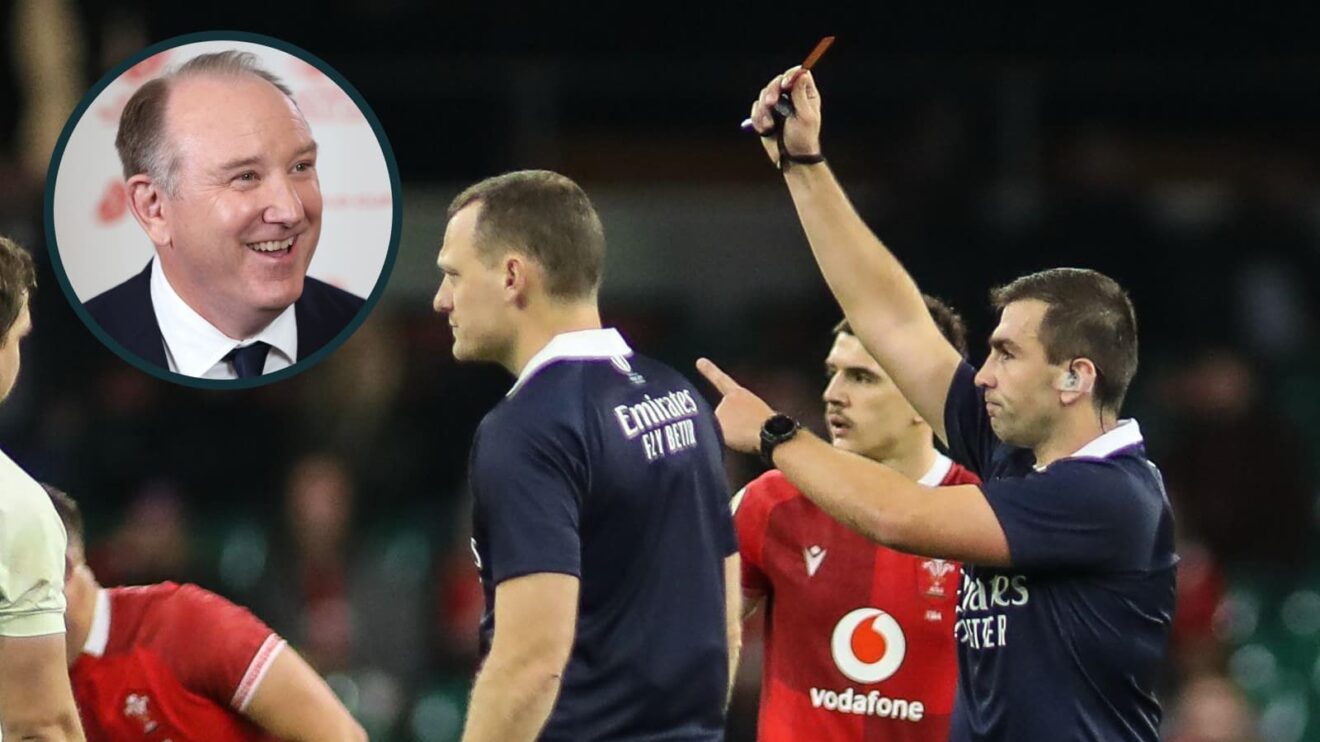
Referee Luc Ramos issues a red card (Photo by Andrew Lewis/News Images) and an inset of Brett Robinson, World Rugby Chair (Photo by Mark Kolbe - World Rugby/World Rugby via Getty Images)
World Rugby chair Brett Robinson has hinted that other law trials will likely be conducted before the 2027 Rugby World Cup.
With the tournament in Australia fast approaching, any law changes must be nailed down by the start of the Nations Championship next year, which kicks off in July 2026.
The game’s governing body has made a plethora of changes since the 2023 World Cup in France, including shot clocks for set-pieces and place kicks.
The scrum options was also removed from a free-kick, while the 20-minute red card has also been introduced with the tweaks made under the banner of making the game quicker and being fan-focused.
Too much senseless kicking
Robinson, who succeeded Sir Bill Beaumont as World Rugby chair, believes that there has been progress, he says that the game still has its challenges, which the governing body is hoping to address over the festive season with the shape of the game conference taking place early in the new year.
“We play a huge role in working with our members to create a better product, and when we say grit in our gears, look over the last 150 years, it’s been more than grit, it’s been clunky, and there’s been a need for a lot of oil to focus on the right things,” Robinson said on the Rugby Unity podcast with Eddie Jones and David Pembroke.
“After the 2023 World Cup, we did a lot of work, listening to our fans, and there was some research that was presented throughout the game about the things that were really frustrating our fans.
“And those primarily were too much senseless kicking, laws and management of the game that wasn’t promoting teams to attack, and then finally, there was just too much dead time. So since 2023, we have made some progress on some of those things and in some we haven’t.
“There’ve been changes to shot clocks, we’re trying to remove dumb and senseless actions like a not straight throw into a lineout and if no contest.
“The introduction of the 20-minute red card was really frustrating because it took us a lot longer, because some of our friends in the northern hemisphere needed to better understand it.
“There’s definitely been some wins, but I still feel there are some big challenges fundamentally.”
North and South disagreements
The World Rugby chair also bemoaned the hemispheric views on the game that are stalling changes and causing frustrations for fans.
The Australian hailed Australia and New Zealand’s willingness to trial and test tweaks in Super Rugby Pacific, with the Northern Hemisphere competitions being more resistant to change.
“We go to the TMO as an example; earlier this year, we had sort of two different perspectives from the north and the south about the role the TMO could play,” he explained.
“There have been some trials that have been underway, and I actually don’t think that they’re working, so we have acknowledged that and we’re establishing a review over the Christmas period, heading into the shape of the game to review that element of the game. To be fair, Super Rugby are trailing some new protocols around the TMO as well.”
The TMO and Foul Play Review Bunker caused frustrations in November, and the usage of full red cards, while the length of TMO reviews has also annoyed fans and pundits. However, Robinson reveals that World Rugby have tasked an independent panel to review the role of the fourth official, which will be led by outgoing New Zealand Rugby CEO Mark Robinson.
“Primarily, the principles of having the referee in charge of the game and the referee managing resources and being able to make decisions are the primacy of what we believe that the role should be, and I don’t think that’s necessarily the way things have transpired on occasion through the year,” he continued.
“So, it creates this frustration and confusion about the tail and the dog and who’s wagging, which we believe it isn’t working and we need to review it and consider it over the Christmas period because we have this this run into 2027 by about June-July next year, we have to have locked down all the things that we think we need to have done.
“I’ve put it to the team for our upcoming shape of the game meeting in February and we’ve appointed Mark Robinson who’s retiring from New Zealand Rugby to chair an independent review panel to challenge us about the way we look at at the TMO and some other elements that we may be able to easily shift ahead of the June-July internationals because if we don’t do it by then, we can’t do it a year any more than a year out [from the Rugby World Cup].
World Rugby have ‘created their own monster’ as prominent coach hits out at calls to depower scrums
South’s willingness to trial
“I don’t think we are moving at a [good] pace, we have a cultural problem in our game that involves us wanting to move all the world together and that’s hard because you have different perspectives on how the game should be played and it’s hemispheric; Eddie will have a strong view on this on on the way the game should be played and there’ll be alternate views and we don’t have a system that really enables that to move quickly. That’s something I’ve also challenged us to reconsider as to how we get the work done.
“Ultimately, we need unions and competitions to trial. So what’s been wonderful about the southern hemisphere, particularly Super Rugby, Australia and New Zealand, is they are open to trying new things, and they are playing with a whole lot of things, just frustrating things like turning scrums into free kicks if they’re sort of senseless, silly things like offside or in front of the kicker, and they’ve got some silly things like that that they’re trying to tidy up.
“For example, the quick tap from a free kick, if you’re not on the mark, it’s okay, you can be within a meter or roughly within a metre of the referee and you can go because that frustrates the hell out of people when referees start drawing people back when we actually want the game to be to be fast and operating more quickly.
“There’s a trial that they’re looking at around the 50:22, where it now doesn’t matter if you are kicking the ball from inside your half, if the ball’s passed from one side into the other side. So, again, to open up that vehicle of pushing players back on the wings to create more space for attack.
“So there are things like that that are being trialled, but again we rely on the unions and the competitions to trial these things, and then we embrace them and drive them into law trial and I probably think that there isn’t enough of that happening around the world, where different competitions are experimenting and innovating because it’s from there that we really get the changes in our game.
“The southern hemisphere, if you go back to the 50s of our century, were the ones who was always trying to agitate because of the pressure of rugby league and AFL, and the competitive sports market that is Australia.”
Want more from Planet Rugby? Add us as a preferred source on Google to your favourites list for world-class coverage you can trust.