Rassie Erasmus on the influence of rugby’s new ‘set phase’ against England and the ‘destiny’ of the Springboks losing Etzebeth and Kolisi to injury


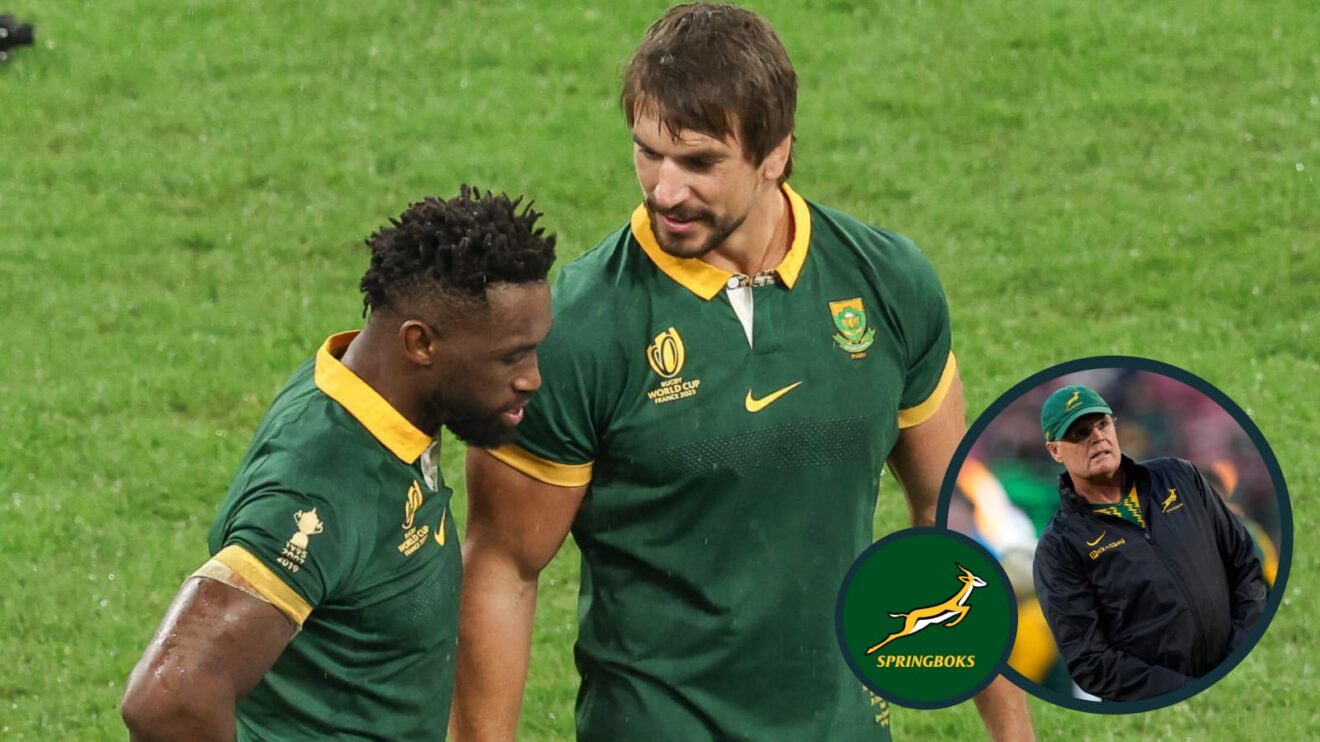
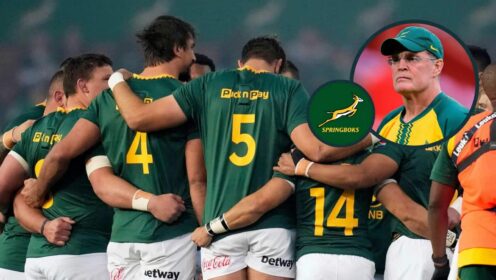
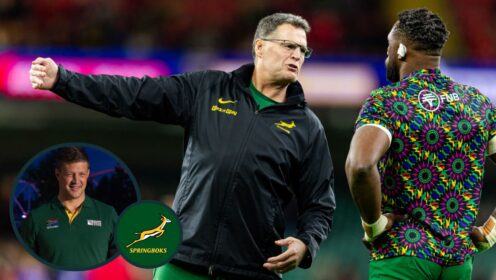
South Africa boss Rassie Erasmus, inset, had to do without legendary pair Siya Kolisi and Eben Etzebeth in Saturday's win over England
The Springboks have explained what it was like to readjust their team to play England after it was confirmed late in the week that Eben Etzebeth and skipper Siya Kolisi weren’t able to start.
Second row Etzebeth, South Africa’s most capped Test player with 141 appearances, and double World Cup-winning captain Kolisi, who has 103 caps, were both named last Monday in Rassie Erasmus’ side to host the English in Johannesburg in round one of the new Nations Championship.
However, Etzebeth sustained a bang to his head at training on Tuesday that he didn’t fully recover from, while Kolisi pulled up with a hamstring strain on Friday, resulting in the Springboks having to reshuffle their originally selected pack.
Cameron Hanekom was promoted from the bench for his second appearance while the uncapped Paul de Villiers was brought in for a debut in the back row that necessitated the switch of Pieter-Steph du Toit to lock, where he also took over the captaincy of the side.
“I wouldn’t prescribe it for any team to lose the guys…”
The late rejig reduced the average age of the starting XV from 31 to 27, but the loss of the experience Etzebeth and Kolisi are known for didn’t affect the Springboks as they raced into a 17-0 lead after 12 minutes and while England did fight back, the match ended in a 45-21 win for Erasmus’ side.
“Eben got a knock against his head, and we gave him as much chance as possible – of course we thought it was a really important game. Eben was Tuesday and then Siya on Friday pulled his hamstring. Those were the changes.
“Injuries happen, and it’s never nice. I wouldn’t prescribe it for any team to lose the guys, the captain and the guy with most caps, prior to a game. We had an average age of 31 when those guys were in and when the other boys came in our average age was 27, so suddenly you must see the positive in that.
“Paul has now had a taste of Test match rugby and he will certainly learn from this, and the same with Cameron. And Pieter playing lock and being captain at the same time and playing four lock which he hasn’t played for a while, we’re happy.
“Sometimes if we lost a game I would have sat here and said yes, we couldn’t handle what happened to us during this week, but now it’s nice to say that it did happen.”
Erasmus added: “Sometimes it is difficult, it takes a lot of courage to swap in and out, especially with the new competition. With the new competition, you are forced to make things.
“It’s tough not to play Siya, and Paul is coming through, and Cameron is coming through and you are thinking, where are you going to play them?
“You are saying it will come to us; you believe that it will come to us, but certainly we will have to make some big calls in this year to 100 per cent be sure about next year when we go into the World Cup that we test out depth. Today, destiny took charge of that, and we could cope with that, and it worked out the right way.”
Aside from the late withdrawal of Etzebeth and Kolisi, the Springboks lost Ox Nché and Andre Esterhuizen to injury during their seven tries to three win. Hazarding a guess about whether any of these injured players could be available to play against Scotland next Saturday in round two ot the Nations Championship, Erasmus said: “Ox will be out, that will be my gut feeling.
“Eben, with the head knock, I am not sure. Because he got the head knock early in the week, maybe he will be available. We’ll see, depending on his symptoms. Andre got a concussion in the game; I am not sure what category that will be. Lood (de Jager) might be ready… Siya, the scans will be on Sunday. If it’s a grade one, there is a chance; if it’s a grade two, then probably not next week.”
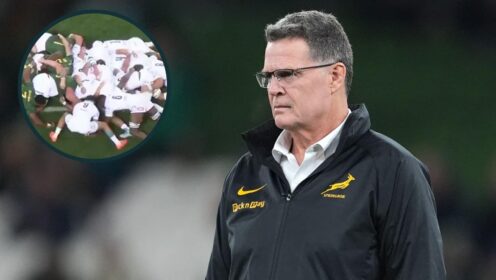
Player of the match for the Springboks against England was full-back Damian Willemse, who dominated the aerial battle. The duel in the sky was something that head coach Erasmus pondered post-game, declaring the contest that now exists in this facet of play as being almost like another set-piece similar to the scrum and lineout.
“England were sharp around the balls that weren’t caught clean and the scraps around it,” he reflected. “I thought they were really sharp, and I think we won 60 per cent (to their 40). I thought Damian was exceptional in his 50th Test under the high ball – he was exceptional there.
“It got a little pear-shaped when Kurt-Lee (Arendse) got the yellow card, and we had to play around with that.
“The aerial battle is certainly something with the way the laws are now that they can’t leave anyone blocking. I also thought that England may have lost some momentum with their late change (the loss of George Furbank, who was replaced by Marcus Smith).
“The aerial battle was massive. The aerial battle is becoming like a set phase. It’s another source of possession. I saw the games this morning; it was frantic rugby, it was just busy on slippery fields. I thought this one was a little bit different. I thought this one, the aerial battle was another source of possession.”