Ireland v Springboks: Five takeaways as bomb squad ‘diffused’ and ‘weaker scrum’ wins the day elsewhere
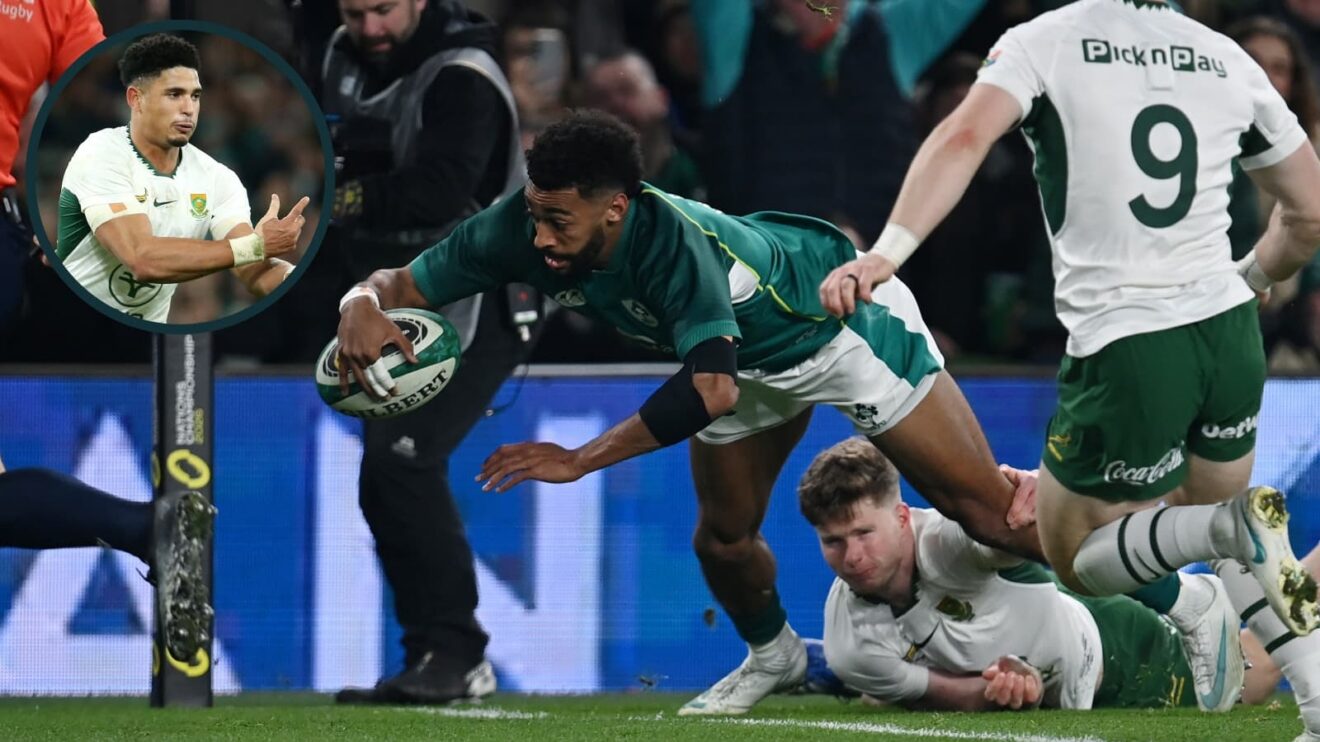
Robert Baloucoune dives over for one of his two Ireland tries and, inset, South Africa No.10 Sacha Feinberg-Mngomezulu (Charles McQuillian and Evan Treacy/Nations Championship/Getty Images)
After a deserved 20-17 win for three-try Ireland over two-try South Africa, Planet Rugby picks out five takeaways from the gripping Nations Championship round six match.
The top line
After all the histrionics of a dramatically controversial week in which the name of the banned Rassie Erasmus was on everyone’s lips, a superb rugby match swiftly broke out in Dublin on Saturday evening that bristled from start to finish and ended with Ireland defiantly holding on for a three-point triumph.
A scrum penalty – what else? – opened the scoring, Sacha Feinberg-Mngomezulu firing over, but Ireland weren’t in the slightest rattled, hitting back with an eighth-minute Robert Baloucoune try on penalty advantage from a Stuart McCloskey assist.
Eight minutes later, the home crowd was celebrating again, but this joy was short-lived as Cameron Hanekom had brilliantly dislodged the ball from Baloucoune’s grasp in the act of grounding. It was only a temporary South Africa reprieve, though.
Damian Willemse’s deflection resulted in Mack Hansen regathering and throwing a basketball-style assist to Baloucoune to dive in at the corner on 19 minutes for 10-3. Aviva Stadium went wild.
Those cheers were wilder still when a 26th-minute scrum penalty was won on a South Africa feed near the halfway line, but the shot of adrenaline didn’t equate to Irish points, the scoreboard next moving to the sound of South African points.
A clever Canan Moodie kick ahead after some lovely Kurt-Lee Arendse dancing resulted in Hugo Keenan conceding a five-metre scrum, and the three minutes of pressure ended with Morne van den Berg touching down on 35 minutes with an eight-man shove having penalty advantage.
Feinberg-Mngomezulu’s conversion seemed set to leave it deadlocked at 10-all at the interval, but a fabulous lineout drill ended with Ronan Kelleher showing Moodie he can boogie as well. Sam Prendergast’s extras left Ireland 17-10 up and thriving.
Further nourishment for their soul came four minutes into the second half when Hansen did enough to scrag Moodie, who had steamrolled Jamison Gibson-Park, into touch when grounding over the try line.
A 54th-minute Prendergast penalty after Joe McCarthy pressure stretched it to a 10-point gap that was reduced to three four minutes with Malcolm Marx’s close-range converted try.
We were now down deep into an exhilarating battle of inches. Of significance was Feinberg-Mngomezulu holding Dan Sheehan up over the line on 62 minutes, and then came the 73rd-minute double yellow card incident; Sheehan and Marco van Staden binned for clear-outs at the same breakdown.
The grind was intoxicating. Sub Nick Timoney’s carry from a five-metre scrum under is posts was especially gutsy, and especially daft was Jan-Hendrick Wessels illegal carry at a ruck before it all ended with Jesse Kriel’s knock-on. Well played, Ireland.
Want more from Planet Rugby? Add us as a preferred source on Google to your favourites list for world-class coverage you can trust.
Joyous scrum battle
Too much hatred exists for the scrum when it should be a rugby calling card that must be celebrated, as was the case at Aviva Stadium. The crowd was loudly invested in every scrum and it was a joy to watch. The tally at the finish read four scrum penalties awarded to South Africa along with two frees, while they also scored their only first-half try from an eight-man shunt that had penalty advantage.
In response, Ireland won one scrum penalty and two frees, the type of belligerence that demonstrated that while you can be in trouble in this set-piece, there is no reason it should cost you the result if you battle cleverly in other facets of play. The French highlighted this mission possible last weekend when they defeated the Springboks in Paris, but the Irish scrum was a better unit than the demolished Les Bleus one.
What best summed up this intriguing battle was the effect of what took place heading towards the Dublin interval. A year ago, South Africa took Ireland to the hurt locker and resulting overlapping yellow cards certainly didn’t assist the wounded home team’s cause.
Here, the Irish found themselves having to defend a five-metre scrum after Keenan carried back over his line. They survived that part of the pressure, but when South Africa got another scrum five metres out a few minutes later, Ireland wisely cut their losses on penalty advantage and allowed the visitors to score without interference.
It ensured there was no yellow card coming, and Ireland’s pluck, unlike November 2025, saw them quickly go downfield after the restart and score. The scrum was a wonderful, hard-fought spectacle, but the salutary lesson following on from Stade de France was that the team with the weaker set-piece won the day elsewhere.
Has muted Rassie Erasmus breached his World Rugby ban as Springboks boss delivers first-half verdict
The ‘scud’ squad
All year we have been hearing stellar reports about South Africa’s supposed imperiousness in the Test game, but this loss was the first time they have lost two on the bounce on Erasmus’ watch and it surely means that next year’s Rugby World Cup isn’t the predictable three-peat so many of the Boks’ fans believe it will be.
South Africa will still contest next weekend’s Nations Championship final and so are still in a position to quickly add a trophy to their glittering collection, but the reality they can’t turned a blind eye to is they have been beaten four times now in their last eight matches. That is hardly the form of an undisputed world’s best team.
As was the case in the France last weekend, they trailed at the break and didn’t have the cunning plan to rectify the situation.
Amongst their first half issues was the lack of standout ball carriers. For instance, seven Irish names topped the interval carry list before a South African name cropped up, illustrating the pressure they had come under, and the top three places were still all Ireland’s at full-time despite securing more sufficient possession and territory to finish at full-time with overall 48 per cent possession and 49 per cent territory.
Also, despite their scrum prowess, the full match penalty count ended 11-8 against Erasmus side, and it didn’t help that their feted ‘bomb squad’ had about as much impact those laughed at scud missiles in the Gulf War many years ago and was diffused.
Wessels is touted as an alternative to Marx when needed but he didn’t cover himself in any glory here. His first lineout throw was a crooked as an Irish drunk walking home after the post-game part, and the penalty he gave up for illegally taking the ball at the ruck smacked of someone who doesn’t yet have the composure to be reliable at this level.
Van Staden’s yellow was a further example of the bomb squad not delivering value and rather than blaming the world and its mother for its failings, it’s high time the Springboks took a long, lingering look in the mirror as themselves and realise they are not as fantastic as they have been made out to be in 2026.
Springboks player ratings: Marco van Staden’s ‘brain fade’ proves costly as Bomb Squad implodes
Welcome back, Ireland
Welcome back to the top tier, Ireland. Andy Farrell’s team has been dogged by too much inconsistency for quite some time, and the anxious feeling after an unconvincing Southern Series was that the potency they once had some years ago had been diluted and wouldn’t be back any time soon.
How wrong that consensus was, as a revved-up Irish side produced their best performance since the 2024 win in Durban. We’re not forgetting how tasty they were when filleting England last February in London, but this victory was some levels above and will go a long way towards restoring the faith that was lost in Project Farrell.
The drop-off in overall form was among the reasons why the stadium wasn’t sold out the past two weekends, but the display conjured up against South Africa will reignite the demand for tickets for all matches, not just the big ones against the best teams in the world.
We couldn’t get enough of McCarthy’s nuisance value at lock. It was his early hard carrying that asked serious questions, unlike what transpired a year ago when the teams last played each other, while Ryan Baird was another to put in a humongous shift.
Farrell also executed a decent plan regarding the involvement of Prendergast – he wasn’t left vulnerable to hungry Boks. And then there was the menace of Baloucoune, who scored two first-half tries in the same corner and had another in-field ruled out for a fumble at the line. The winger’s aerial brilliance was also an important influence on the success.
Sheehan versus Hanekom at No.8
Walking down Lansdowne Lane outside the stadium about three hours before kick-off, a man had emerged with a big sweeping brush to clear away some fallen leaves. It could have been a metaphor for Ireland’s gamble with Sheehan getting swept away by a Springboks onslaught, but it instead turned out that Farrell knew damn well what he was doing with the positional gambit.
A world-class player suited to No.8 was how Farrell surmised his bet-the-house punt on shifting his hooker to back row for a first-time start in that role. Injuries to Caelan Doris, Jack Conan, Sean Jansen and James McNabney, as well as Nick Timoney’s unconvincing audition last weekend versus Fiji, convinced him it was the right way to go, and he was proven correct.
Ireland needed a hard carrier at the back of the scrum and Sheehan was quick to take the ball and run twice in the opening 23 minutes rather than allow Springboks scrum pressure to build. Patrolling a different channel to what he was used to, there was a classy example of his skill early in the second half when he tidied up a kick and executed a super one-handed pass out of the follow-up tackle.
In the end, despite an absence for a HIA and also a yellow card clear out, he made 31 metres off his 12 carries, eclipsing the impact made by Hanekom, his rival rookie No.8, who was handed the South African role due to Jasper Wiese’s suspension.
The Springbok deserves credit for the way he denied Baloucoune a try and outscored Sheehan on the head-to-head tackle count 17 to 14. However, Ireland got way more out of their rookie No.8 than the visitors, and it had an influence on the round six result.