Australia v Ireland: Five takeaways as ‘relieved’ Irish overcome ‘four areas of concern’ to pip ‘encouraging Wallaby remedial work’


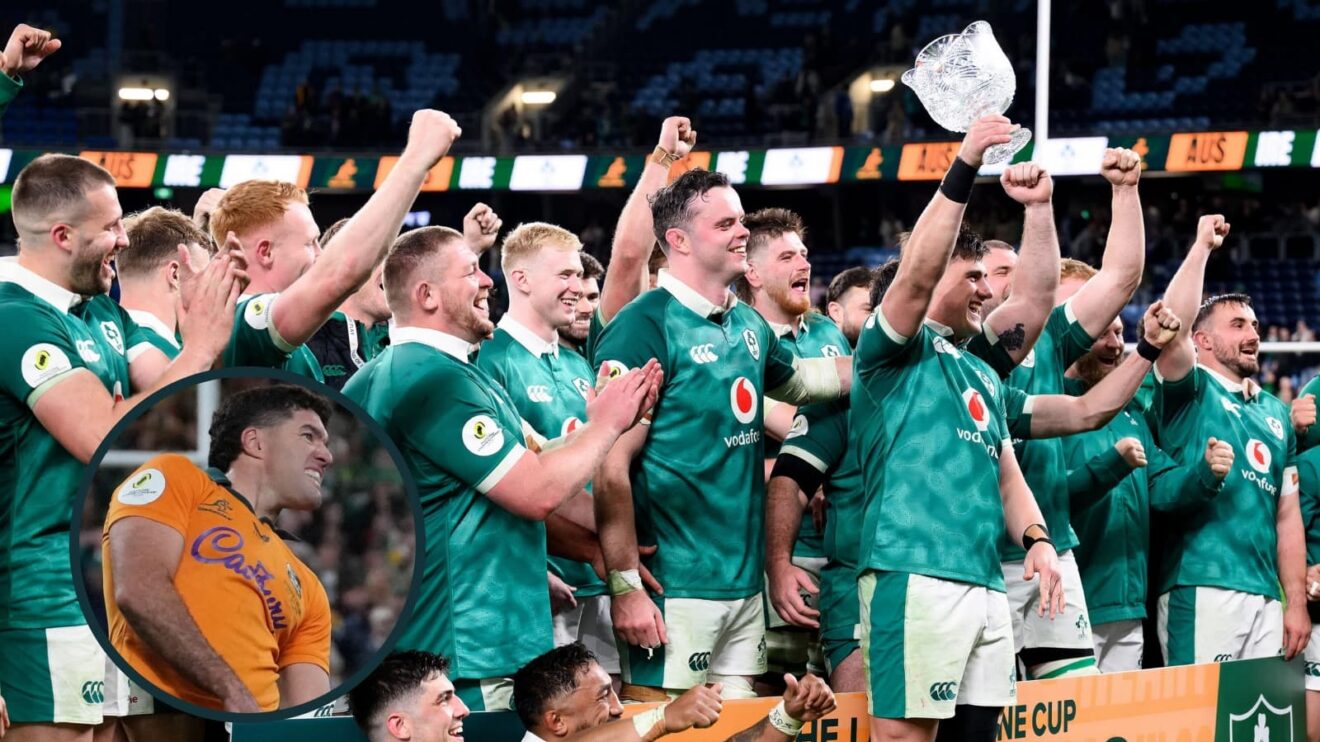
Ireland celebrate the Nations Championship victory that was confirmed by a late penalty miss from Ben Donaldson, inset
Following Ireland’s dramatic 33-31 victory over Australia in the opening round of the Nations Championship in Sydney on Saturday, Planet Rugby picks out five takeaways from the 10-try thriller that went down to the wire.
The top line
The pre-game script for this day one encounter in Test rugby’s new dash for cash was written for recent Triple Crown winners Ireland to secure a sixth successive win over the Wallabies with comfort.
However, this crystal ball gazing was bunkum as the Wallabies were in front until Thomas Clarkson’s 77th-minute try and even then the clunky Irish were left reliant on Ben Donaldson missing with his second penalty kick in the second minute of added time.
This breathless contest full of entertaining moments enjoyed a rollicking start, six tries scored in the opening 26 minutes. A lineout loss at the front was the trigger for Australia to strike for the first three minutes in, brilliant continuity after snaffling turnover ball ending with Dylan Pietsch enjoying a clear run to the line.
Power in the contact from Cian Prendergast got Ireland on the board eight minutes later, but the visitors were exposed again in the right-hand corner on 14 minutes. Carter Gordon, the sixth Australian No.10 in the soon-to-end Joe Schmidt era, left Josh van der Flier for dead and the sweep ended with Jock Campbell, last capped at Test level in 2022, galloping over.
Back came the Irish a second time, deception from Dan Sheehan at a tapped five-metre penalty resulting in Van der Flier diving over on 19 minutes, but the Wallabies then struck for the next two tries.
Josh Canham burrowed over on 24 minutes, benefiting from Rob Valetini’s defence-panicking break, and the hosts were celebrating again two minutes later when Max Jorgensen picked off Sam Prendergast’s pass to Hugo Keenan on his team’s 10-metre line, going in to give the assist pass over Stuart McCloskey’s head for Ryan Lonergan to finish.
Australia should have added to this double-score, 24-12 lead before the interval. However, Keenan, playing for Ireland for the first time since the 2025 Six Nations, executed a try-saving tackle on Joseph-Aukuso Suaalii and this rescue was followed by a clinical clock-in-the-red, length-of-field sweep that culminated with the move-starting Jamison Gibson-Park sprinting in from a Jack Conan assist.
Instead of a potential 29-12 gap, this swing left it 24-19 at the break and Ireland needed less than seven second-half minutes to take a two-point lead, another tapped five-metre penalty the catalyst and the move ending with Keenan darting over from Garry Ringrose’s assist.
That should have been the signal for the Wallabies to wilt, but they didn’t. Instead, they wrested back the advantage with Tate McDermott quickly tapping a free awarded against Ireland for early scrum engagement and worming over the line. This 31-26 lead stayed intact with Sheehan’s 58th-minute break-off-maul try cancelled for James Ryan’s obstruction on Valetini, and Ryan’s 66th-minute fumble near the try line didn’t help the Irish cause either.
Sub Donaldson couldn’t make it a two-score Aussie lead when wide with the penalty awarded for a Jimmy O’Brien obstruction. Back came the Irish and with offside home sub Lachlan Shaw yellow-carded for one team penalty too many, Clarkson powered over.
Prendergast converted for the lead but there was still one final moment of jeopardy, Donaldson getting handed the tee out wide on the 10-metre after Bundee Aki went off his feet. The kick had the length but not the accuracy, leaving a relieved Ireland clinging onto their two-point win.
Want more from Planet Rugby? Add us as a preferred source on Google to your favourites list for world-class coverage you can trust.
Four areas of Irish concern
Ireland finished second to France in the recent Six Nations following an in-tournament rejuvenation, but concerns about their collective standard of play persisted after that campaign and resurfaced in Sydney. Their breakdown play wasn’t of sufficient quality, their set-piece was inconsistent and their defensive shooters in the first half hurt proceedings.
The Irish defence had taken a shellacking for some porous efforts across 2025/26. This includes France and South Africa scoring four tries each less than 50 minutes into their fixtures against Andy Farrell’s side. Here, Australia disbelievingly needed just 26 minutes to score four tries, reheating questions about Farrell’s rearguard organisation under Simon Easterby.
It tightened up after that, and in the end, this was a match that Ireland didn’t lose, unlike against the French and the Springboks. But their slow starts have become too frequent, and the All Blacks will be licking their lips ahead of the July 18 hosting of the Irish in Auckland.
Ireland’s lineout was also a source of frustration, with four Sheahan throws not working out before he gave way to Rónan Kelleher, while their scrum also struggled against the Wallaby sub front row which won two set-piece penalties coming down the pipe.
For a team aspiring to reach the final of this new tournament in London in November, a major uptick in reliability is needed if they are to trouble New Zealand’s Eden Park fortress.
Schmidt’s encouraging remedial work
In the end this was an agonising defeat for Joe Schmidt’s Wallabies, but it was a loss with plenty of positives in comparison to how the flopped last November when last in action. That horrible northern tour ended with four successive lost matches, leaving them with a poor record of just five wins from 15 outings in 2025.
Defence was a repeated bugbear in that miserable tour, Australia conceding an unacceptable total of 145 points. Laurie Fisher’s replacement next month by Scott McLeod as defence coach in the new Les Kiss era can’t come quick enough, but their defending was of a feisty level in this outing.
With the Irish left needing a 77th-minute try to take the lead for the victory, this was indeed a very different performance to the 46-19 the Aussies suffered in Dublin eight months ago, so they have ample reason to feel pleased with this improvement.
Another bounce happened in their attack play. Departing boss Schmidt stated before kick-off that they aimed to open the game up and play, and they very much did this, especially in the first half where, if player of the match Keenan didn’t mow down Suaalii, they could have been out of sight on the half-time scoreboard.
Australian teams that find an edge out are always dangerous. If Schmidt can build on this and keep his side playing creatively against the French next Saturday in Brisbane, he will have done a heck of a remedial job in changing the feel surrounding Aussie rugby.
It was all doom and gloom at the end of their tour last November, but what they achieved here against the Irish with a team inspired by Valetini bodes well after all the fears that they were a beaten docket on a very bumpy slide.
Potential try of the year winner
It was 2016 when Ireland last won the World Rugby Try of the Year award, but they now have a contender a decade later that could potentially reclaim that mantle. Shortly after Lions try-scoring hero Keenan had saved the Irish bacon with a super try-saving tackle nearing the interval, they had a scrum on their 22 with the first half clock having turned to red.
Gibson-Park could have easily just collected the ball out the back of the set-piece and booted into touch, cutting the Irish losses at a 12-point deficit. Instead, he went for broke, and he was finishing off the move 56 seconds later under the Australian posts.
His converted try cut the gap to a complexion-altering five points, and it was a critical score in this Irish win. Gibson-Park initially passed to McCloskey and by the time Keenan handled, Farrell’s team had advanced from the 22 to the 10-metre line.
A second chunky McCloskey carry followed and there were also important metres from O’Brien near the sideline before the fast-tempo move reaped reward down the middle with Ringrose and Conan combining to usher in their support-line-running scrum-half.
It was a collective thing of beauty up there with the award-winning Jamie Heaslip score 10 years ago, and it was ultimately worth its weight in gold in terms of the final result.
Wallabies v Ireland: Result, match details, stats, line-ups
The tale of the 10s
This was a massive fixture for the respective out-halves. Prendergast was back in a Test shirt for the first time since he was hooked amid a crisis moment versus Italy in round two of the Six Nations last February, while Gordon was making another step along his rugby union comeback journey since his return from rugby league.
First, we’ll deal with Prendergast. The inconclusive way the Irish pack played at times was very unhelpful for him, and he also had to endure the confidence knock that was his intercepted pass that resulted in an Australian try.
However, whereas he suffered in this situation earlier in the year versus the French and the Italians before getting taken out of the firing line, he demonstrated an encouraging maturity here to better roll with these punches and showed excellent composure to kick his side ahead with his conversion of Clarkson’s late try. It was an okay performance that he will take plenty from.
Gordon will feel the same way about what he managed to knit together for the Wallabies. He showed plenty of glimpses of his front-foot threat before he gave way to Donaldson, who went on to become the villain of the piece.
It was 2022 when his missed kick on debut resulted in defeat for Australia against Italy, a loss that contributed to the sacking of Dave Rennie some weeks later.
The two kicks he missed here four years later were admittedly far more difficult as they were out near the touchline near halfway, but it was further evidence that he has yet to enjoy a big kick-on in his international career.