Why Rassie Erasmus’ Springboks are the ‘ultimate benchmark’ as Six Nations coaches remain one step behind
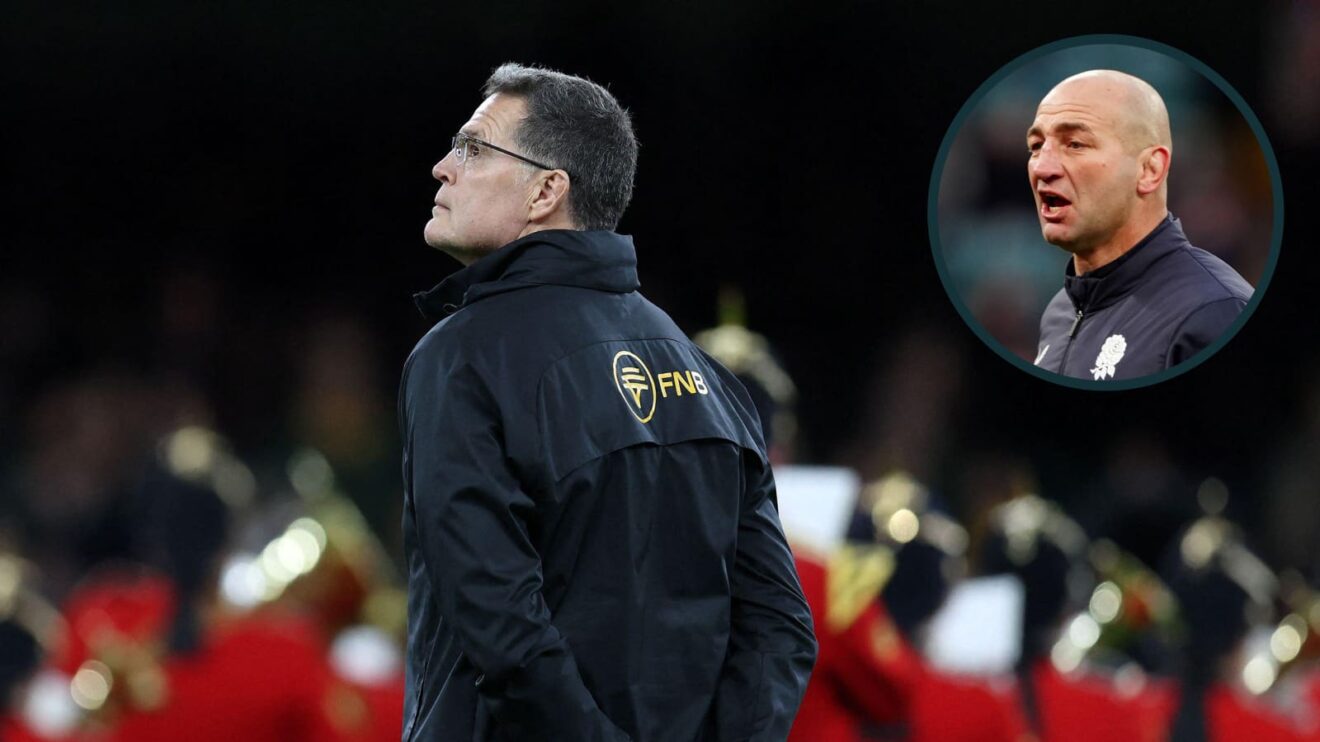
Springboks head coach Rassie Erasmus and an inset of England boss Steve Borthwick.
If your ambition is to be as good as South Africa in two years, you’ve already lost, because when you arrive they’ve moved on and you’re benchmarking against where they were, rather than projecting where they’ll be.
That’s the fundamental error that keeps Six Nations coaching perpetually one step behind whilst Rassie Erasmus operates two World Cup cycles ahead. The smart coaches understand this, which is why Fabien Galthié and Steve Borthwick aren’t copying the Springboks‘ 2023 playbook but are engineering tactical systems designed to challenge the evolved version South Africa will deploy in 2027.
Infrastructure operating on different time horizons
Rassie has assembled a Formula One technical operation: Tony Brown running attack, Jerry Flannery and Felix Jones providing tactical expertise, Duane Vermeulen as mobile unit coach feeding real-time tactical communications from a former World Cup eighth man, and Jaco Peyper as laws and discipline advisor, a former international referee decoding law interpretation. Rassie is contracted to 2031, planning for the next two World Cups whilst most Six Nations coaches are trying to survive the next one.
When New Zealand Rugby sacked Scott Robertson two years into a four-year deal after he lost the dressing room, their first move was attempting to raid South Africa’s coaching team for Tony Brown. Rassie posted an AI-generated Wolf of Wall Street meme with Brown’s face saying “I’m not f**king leaving.” Brown confirmed no break clause, and will stay until 2027.
Six Nations unions appoint coaches on four-year cycles and act surprised when they can’t compete with decade-long infrastructure planning. Robertson lost his job after two years. Steve Tandy has inherited Welsh decline whilst Gregor Townsend survives only because Scottish Rugby lacks alternatives- although that may well soon change. The unions that close the gap are those willing to back the likes of Galthié, Borthwick, and Quesada through 2031, resource their infrastructure properly, and accept that matching South Africa requires patience measured in decades.
World Rugby meeting agenda details revealed including Bomb Squads, scrum cards and TMO verdicts
Depth that functions independently of individuals
Erasmus used 49 players in 14 Tests in 2024, won back-to-back Rugby Championship titles, and maintained South Africa’s number one ranking for a third consecutive season. When Eben Etzebeth gets injured, the system continues without structural collapse.
The smart Six Nations coaches are building the same capacity. Galthié has dropped Gregory Alldritt and brought in Lenni Nouchi alongside Oscar Jégou and Paul Boudehent without losing breakdown intensity, rotates Mickael Guillard between lock and eight, uses Matthieu Jalibert at ten when needed, and has Theo Attissogbe adding width threat.
Borthwick now has Guy Pepper emerging at flanker, Ben Spencer and Alex Mitchell competing at nine, Fin Smith and Marcus Smith as options alongside George Ford at ten, and Ollie Lawrence and Fraser Dingwall at twelve. When Tom Curry went down, England’s breakdown work continued through Earl and Underhill.
Andy Farrell lost Johnny Sexton and Ireland’s attacking variety disappeared. That’s the difference between depth as system design versus depth as injury cover.
Culture built on empowerment not compliance
Rassie was named Daily Maverick’s Person of the Year for 2025 because he’s shown success is defined in empowerment, transparency and innovation rather than just results. Those 49 players bought into a model that genuinely values them. Games are won between 52 and 68 minutes when physical capacity meets psychological resilience.
The smart Six Nations coaches are copying this. Gonzalo Quesada at Italy has Michele Lamaro and Nacho Brex as his cultural heartbeats, players who set standards through how they train and carry themselves. Quesada is asking his players what makes them happy, combining Nordic discipline with Latin passion to create an authentic Italian identity. Galthié operates the same way, which is why the Tricolore system works. Borthwick builds culture through clarity of role and a wonderful ability to make his players feel like adult pros. The numerical wave requires Earl to sprint behind pods for eighty minutes, Freeman to straighten seams repeatedly, Ford to stand suicidally flat. Those players trust the system enough to execute it under pressure because they trust Borthwick, Lee Blackett, and their own culture that they’ve created.
France’s tactical engineering: Le Principe Tricolore
France divides the pitch into three vertical zones: rouge, blanc, bleu. For the first three to four phases after winning possession they attack exclusively in the white zone through inside passes, tight running lines, forwards hitting direct channels with support runners stationed on seams.
Against Ireland in Paris, whose defensive system has dismantled almost everyone for two years, France made them look pedestrian. Jalibert brought Nicolas Depoortère and Guillard into straight line carries on eleven occasions. Louis Bielle-Biarrey scored twice from chaos created by getting to the edge of the white zone then exploding wide when defenders had committed.
But the key question is why? Galthié is building for South Africa’s 2027 rush defence evolution and the system creates compression and exploitation, beating big men; attack exclusively in white zone for three to four phases, force the rush defence to commit centrally, then explode width when defenders are compressed. France creates fracture through disciplined phase work that forces compression before exploiting it.
Against South Africa’s evolved rush defence that will suffocate wider channels by 2027, France’s system creates the central compression that opens those channels rather than attacking them directly. That’s projection thinking, building for the Springboks they’ll face rather than the ones from 2023.
England’s numerical wave attack
Borthwick constructed a wave around three components; Tommy Freeman straightens seams in the thirteen channel with square-hips running that forces defenders to stop lateral drift, Ben Earl wraps behind pods to reappear as the plus-one from positions he has no right to be in, and George Ford stands flat distributing late in the tackle pulse.
Against Wales at the Allianz Stadium: 48-7. Freeman topped carriers with well over 100 metres by fixing defenders and creating soft shoulders for support runners whilst Earl’s relentless wrapping created mathematical problems by appearing where he shouldn’t be.
The problem is England’s wave requires Earl to maintain wrapping intensity for eighty minutes creating overload through cycling speed, and South Africa’s Bomb Squad means fresh legs arriving in minutes 50-65 exactly when England needs to be exhausting defenders. But you can’t exhaust the Bomb Squad; many have tried, few, if indeed none, have succeeded. Freeman’s straightening seams is brilliant until you’re doing it against Eben Etzebeth at 65 minutes when he’s just arrived fresh off the bench. Ford standing flat is brave until South Africa’s evolved rush defence reads the late distribution and swallows him.
England creates overload through relentless cycling aimed at exhausting defences, which will terrorise every other team in world rugby but might hit the one defensive system engineered specifically to absorb relentless cycling through fresh legs and superior depth.
Want more from Planet Rugby? Add us as a preferred source on Google to your favourites list for world-class coverage you can trust.
Intellectual influence beyond tactics
Rassie released a three-part YouTube series arguing against “zombie rugby” and homogenisation. Scrum resets and lineout walks are features. Pursuing pure speed creates “sporting eugenics” when rugby’s beauty lies in physical diversity. Cheslin Kolbe at 80kg and Frans Malherbe at 135kg prove the game should celebrate different body types.
Whilst Steve Tandy is solving discipline problems at Wales and Gregor Townsend is managing player availability at Scotland, Rassie is debating the philosophical direction of the sport whilst winning everything. When you influence how World Rugby thinks about law interpretation, you define the terrain opponents compete on.
Conclusion
We believe France may still be the side to beat- as the rivalry continues because Galthié has built a system designed to challenge Rassie’s evolution rather than his past. France versus South Africa in 2027 will be a classic precisely because both coaches are projecting where the game will be.
England versus South Africa will test whether numerical overload survives the Bomb Squad’s rotating brutality and Italy’s cultural transformation (do not underestimate it- Rassie himself doesn’t) under Quesada means when they finally do compete in the latter stages of a World Cup, it won’t be a fluke but the product of years building an authentic identity.
The Northern Hemisphere craves beating South Africa because Rassie has made it the ultimate benchmark, and the classics will continue because the best coaches understand the game isn’t won by copying yesterday’s playbook but by projecting where the sport is going and getting there first.
READ MORE: England ace outlines ‘deliberate’ attacking strategy as honest admission made on role