‘Never done’ George Ford backed for world first as coach believes England fly-half ‘dumbs down’ messages to him
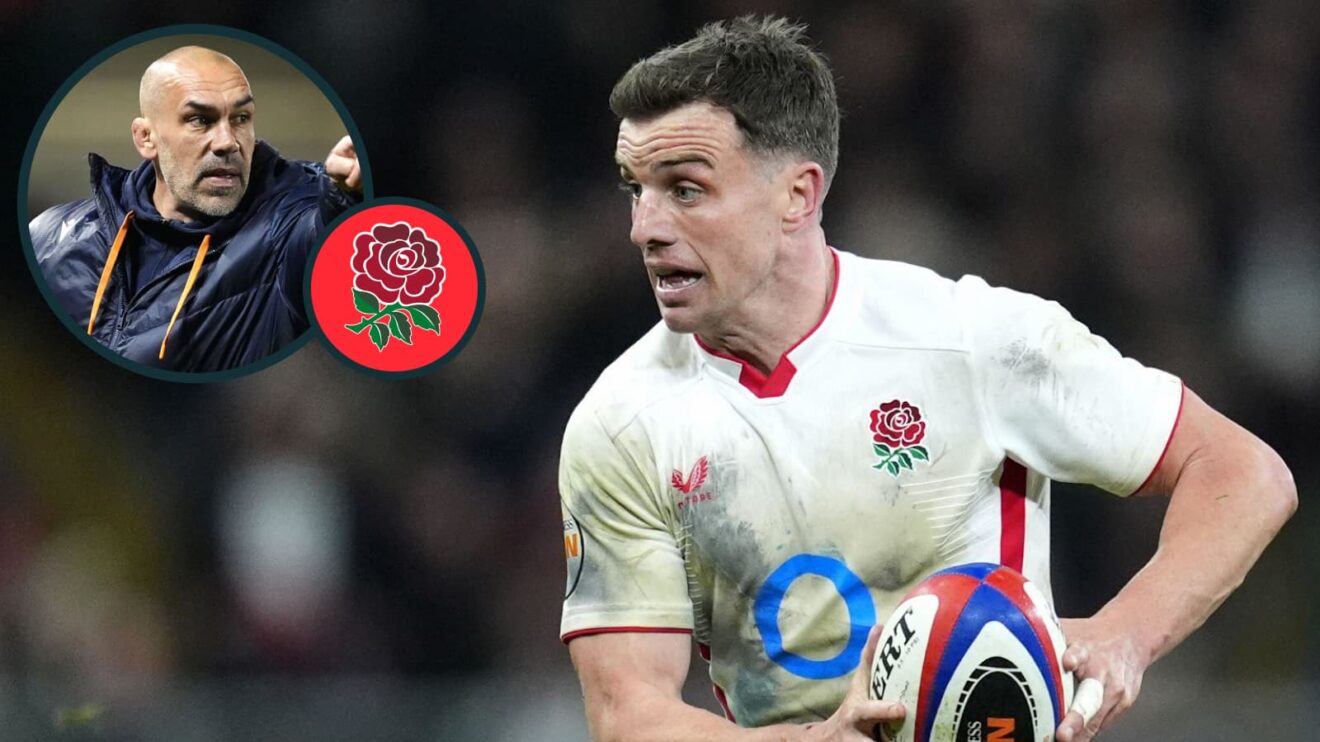
England fly-half George Ford hailed by Sale Sharks boss Alex Sanderson.
Tuesday training, four days before a new Six Nations campaign, and Steve Borthwick halted England’s session with a shrill blow of his whistle.
George Ford, all 5’10 and 13 stone of him, had put in what the coach later described as a “moment of incredible physicality” to bring about a turnover for Jamie George.
A year unbeaten and two players with a combined age of 67 still driving standards; Borthwick was buzzing and wanted his squad to know why.
“It was a point to say, the two most senior players in the squad, training at that level, setting an example for everyone,” he said.
“When you’ve got that – and youngsters like Henry Pollock bringing the energy they bring – it’s a great mix.”
Masterclass
Wales discovered that to their cost on Saturday night. Captained by George, England won 48-7. On the occasion of his 106th cap, Ford put on a masterclass at 10.
The fly-half will be 33 next month yet, a decade after starting every match in that same shirt in England‘s only Grand Slam campaign since 2003, was an easy choice for player of the match.
“Put simply, George Ford has looked the best player on the pitch,” said David Flatman, commentating on ITV. “He’s looked imperious.”
Up in Manchester, there was no surprise on the face of Alex Sanderson, Ford’s director of rugby at Sale Sharks.
Sanderson will tell you his pivot is getting better and can play on until he is 40. Most strikingly of all, he believes he “could be the first player-coach in international rugby”.
Sentiments like that are easily thrown about after days like this. England were on the front foot throughout, Wales spent a quarter of the match playing with 13 and endured their worst ever first half: 29 unanswered points trumping the 28-0 scorelines against both France and South Africa in 2025.
Yet hear Sanderson out. Like Borthwick, his opinion of Ford is built not on hype but on what he sees for himself day in day out. He paints a picture of a player chasing perfection.
“George wants to be the best decision maker in the game, so he rates himself with a percentage and he does it after every game,” Sanderson says. “What we do with him, all the decisions he makes. He puts it down on paper and we share it with the game drivers.
“Because his skill set is so high, it’s not like you need to work on this pass or that kick. Invariably, the execution is always good. For him it’s about, ‘have I made the right decision to run, to kick or to pass?’
“Say he gets the ball in his hands 70 times a game. Of those, 50 are going to be black-and-white good decisions. Of the other 20, say five or six may be poor ones, not even a discussion.
“It’s the ones in between. ‘Would I have done something better or differently?’ That’s the level of detail he goes into on a weekly basis. He is never done.”
Want more from Planet Rugby? Add us as a preferred source on Google to your favourites list for world-class coverage you can trust.
Sanderson continues: “It is like having an extra coach. With him it’s never ‘let’s just do the same thing’. It’s ‘how can we make it better?’ That challenges me as a coach. And in the right way.
“Clearly his rugby IQ is higher than mine. It’s higher than anyone’s I’ve met. He probably dumbs it down for me a little bit! But it’s never a case when we talk of he knows better.”
Back at Twickenham Wales were beating themselves up for, in their own estimation, letting themselves and their country down. Losing four players to the sin bin is a recipe for disaster in anyone’s book. That’s now 10 yellow and one red in their last 10 Tests.
The matchday programme contained a 50-year flashback to JPR Williams and Gareth Edwards scoring on the same pitch in a win which set Wales on the road to a Grand Slam. You could weep for how far this rugby nation has fallen.
It is three years since they last won in the Six Nations. With France at Cardiff next week it is impossible to imagine their tournament losing streak not extending to 13.
Mention of France is a reminder that giving England a Grand Slam billing on this evidence is dangerous. Fabien Galthie’s side were another level against Ireland and will have home advantage for Le Crunch on the final weekend.
Nonetheless, Les Bleus will have noted that their notoriously slow-starting rivals have bolted out of the blocks. Henry Arundell scored with each of his first three touches, Tommy Freeman has now dotted down in seven successive championship matches.
Running through pretty much every England score was the influence of Ford. It was his lightning flat pass which put Arundell in to start the rout, his pin-point chip which gave the winger his second.
His switch of play that enabled Ben Earl to cross, his vision and soft hands that put Tom Roebuck through the hole which led to his try.
For the only England player on parade to have started every match of their 2016 Grand Slam to still be doing all this speaks volumes for his durability and ability to adapt to differing coaching environments.
Scotland next
This time a year ago Ford was behind the two Smiths, Fin and Marcus, in the fly-half pecking order. He did not gripe. He trained the house down.
“You’ve never seen a performance like it,” George confirmed. “It was ridiculous. He was tearing the starting team to shreds individually.”
Ford is already onto the next challenge. Murrayfield in February is an inhospitable place to visit in a white shirt, the more so when a much-vaunted Scotland team has just bombed against Italy.
The brain behind this England side is already working on a strategy to deal with that.
“Some older players maybe lose the drive to keep improving,” says Sanderson. “To be curious, to keep working on aspects of their game. To be humble enough to accept what they need to work on.
“I’ve been in a couple of cycles with players who’ve run the course. Increasingly, as players get long in the tooth, they start to, shall we say, self-preserve and you have increasingly more difficult conversations.
“Not George. He feels fresh, he feels good, his body is fit. While the drive’s there, and it clearly is, who knows how long he could go on.”