Scotland are demonstrably worse by every measurable metric than England but the script has been written
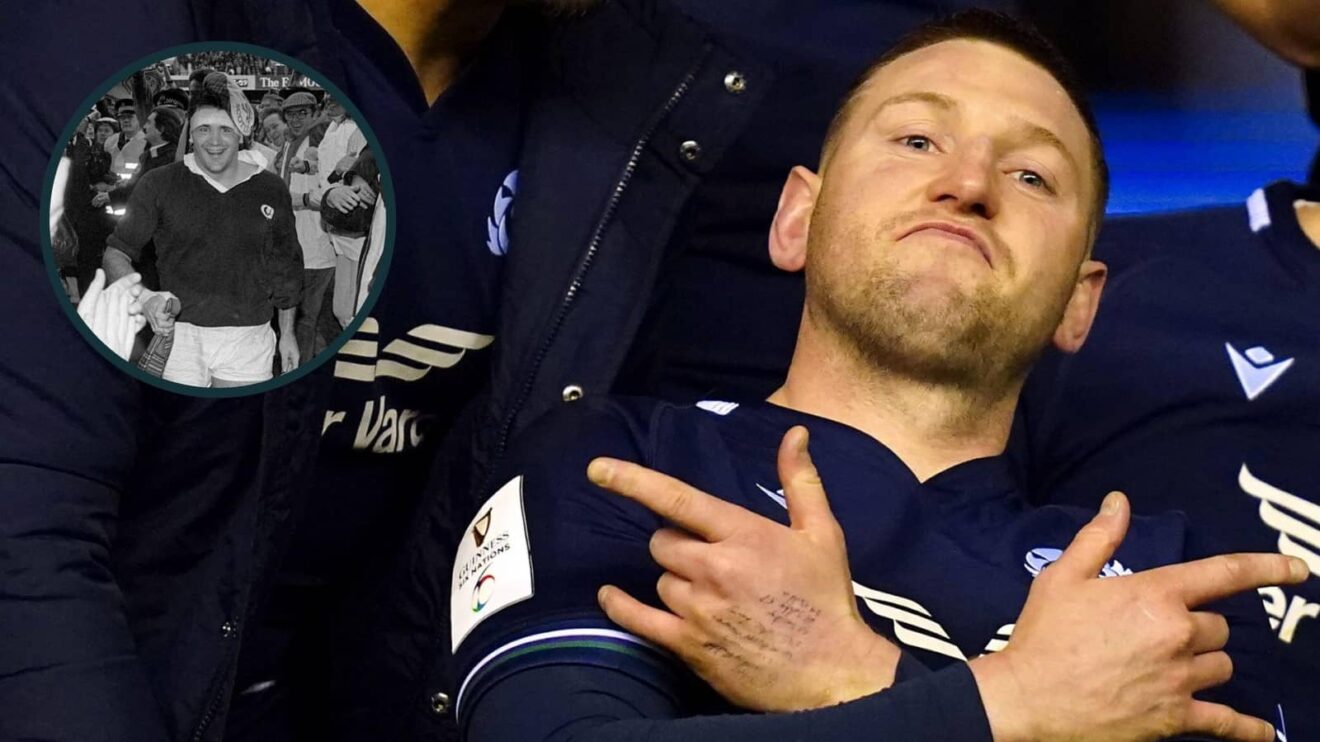
Scotland players Finn Russell and David Sole
I know how this ends because I’ve lived it before, and the scar tissue hasn’t healed in 36 years.
It was March 1990. I drove to Murrayfield with Bob Harding, my Walsall skipper, a lock that played over 500 first-team games, near 100 for Staffordshire, a man who once survived a four-inch-diameter fence post through his stomach and out the other side. He was so big it missed every vital organ. The post is still framed behind the bar at Walsall to this day.
We drove north expecting a coronation as England had dismantled everyone that season, the Grand Slam was a formality, and Scotland were the final administrative hurdle between us and glory.
Then David Sole led Scotland out in a slow march that rewrote the emotional physics of international rugby. They sang Flower of Scotland for the first time as an anthem, and 67,000 people created something that transcended sport and drifted into collective national psychosis. Tony Stanger scored that try, and Sole, Finlay Calder and John Jeffrey became temporarily superhuman, as England’s Grand Slam died on a hill of tartan fury that no rational tactical analysis could have predicted or prevented.
Bobby and I didn’t manage a single word on the drive home until Tebay motorway services. At Tebay, Bob ordered a coffee, looked at me, and muttered something unprintable about Scottish forwards. That was the entire debrief.
I tell you this because what happened in 1990 is about to happen again.
800 years of implausible victories
Scotland’s entire sporting identity is built on a historical pattern of being demonstrably worse on paper, acknowledging the numerical disadvantage, then winning anyway through forces that transcend logic.
It’s Stirling Bridge where Wallace routed an English army with superior cavalry through sheer bloody-minded refusal to acknowledge the tactical disadvantage. It’s Bannockburn where Robert the Bruce defeated an army three times larger through disciplined schiltron formations that shouldn’t have withstood cavalry charges. It’s Culloden where they finally lost but made such a bloody mess of it that English commanders spent the next hundred years having nightmares about Highlanders charging through musket fire.
It’s the entire plot of Braveheart, where an Australian Scot with an accent that wouldn’t fool anyone north of Gretna somehow convinced the world that passion and face paint could overcome medieval military superiority. Nonsense, but we believed it anyway because the film understood something fundamental: losing is expected; winning is transcendent.
And it’s James Bond. Bond was always Scottish. Connery was an Edinburgh boy, and Craig played the role like someone who’d learned to fight in a Leith pub car park. Which means that, by default, England were always SPECTRE. Every time England arrive at Murrayfield expecting to overwhelm Scotland with superior numbers, they’re replaying the volcano-lair scene from You Only Live Twice, where thousands of SPECTRE henchmen should have won but didn’t, because Bond is Scottish, and Scottish people refuse to lose when the script says they should.
England’s Spectre
Steve Borthwick has engineered a numerical wave through Ben Earl wrapping behind pods, Tommy Freeman straightening seams, and George Ford distributing late in the tackle pulse, which demolished Wales 48-7 and should, by every rational metric, do something similar to a team that’s lost to Italy. By every objective measure, England win this comfortably. (I said exactly the same thing to Bob in 1990 too.)
If Scotland are Bond, then Ford is Blofeld, standing suicidally flat behind the gain line, stroking the white Persian whilst pressing buttons that launch numerical overloads from his volcano lair. Henry Pollock, with that peroxide blond hair that looks like it was styled by a SPECTRE barber working from a photograph of Robert Shaw, becomes Red Grant; a physically perfect killer, tactically ruthless, appearing at the breakdown with the clinical violence of an assassin whose hair alone constitutes a legitimate act of psychological warfare.
Earl becomes Rosa Klebb, the most hated Bond villain ever committed to screen, all poisoned blades concealed in sensible shoes, doing the ugly wrapping work behind pods with relentless, joyless efficiency; Klebb’s genius was making you forget she was brilliant until the blade was already in your thigh. Freeman operates as Jaws, enormous and apparently indestructible, turning up in places he has no right to be, except unlike Richard Kiel he doesn’t have the decency to eventually fall off a building. Jamie George on the bench becomes Oddjob’s razor-edged hat, a weapon kept in reserve to decapitate Scottish defensive structures if the conventional armoury fails, thrown as accurately as the George lineout.
Against this SPECTRE line-up, Finn Russell is Connery himself, or Daniel Craig, for the younger readers who need their Bond brutal and unsmiling, because Craig emerged from the sea looking like he could dismantle a defensive line through physical intimidation alone, which is essentially what Russell does with a cross-field kick except he adds the Connery eyebrow.
Ben White, the most improved nine in world rugby after learning his trade at Toulon, provides the service speed that turns SPECTRE’s carefully planned operation into something they can’t control. The Scottish centres, Sione Tuipulotu and Huw Jones, who looked like The Krankies against Italy, habitually transform against England into something unrecognisable, running lines and straightening defences until Earl’s Rosa Klebb jackalling looks less like villainy and more like desperation.
Murrayfield: Where numerical advantage dies
I can still hear and smell Murrayfield in 1990. Not the specific sounds and fragrances, but the weight of it, the way 67,000 people singing Flower of Scotland for the first time created a pressure that sat on your chest. I looked across at Bob when Sole began that slow walk and saw something I’d never seen on his face; the recognition that tactical analysis was now irrelevant. This from a man who’d survived a four-inch fence post through the abdomen and played again the same season.
Murrayfield, when Scotland play England, is more than home advantage. It’s acoustic waterboarding.
It’s the Geneva Convention taking one look at the decibel levels and quietly leaving the room. It’s The Proclaimers and Deacon Blue on permanent loop at a volume designed to destroy the English soul, twin brothers with spectacles screaming 500 Miles until English forwards confess to war crimes they didn’t commit, just to make it stop; except it never stops, because there’s always another chorus, always another moment for 67,000 Scots to remind you they’d walk 500 more.
This is sonic violence disguised as folk music, compressing eight hundred years of grievance into eighty minutes of psychological warfare that renders England’s systematic numerical advantage irrelevant.
Curry will clatter, Mitchell will probe, Ford will distribute with Blofeld-level precision. It won’t matter. Scottish forwards, operating on historically implausible plot armour, will disrupt just enough phases, win just enough turnovers, and create just enough chaos that England’s mathematical advantage never becomes scoreboard dominance.
By the 65th minute, England’s tactical superiority is drowning in a sea of terrible Scottish pop music and generational rage, which is exactly how Scotland planned it.
The inevitable conclusion
This isn’t a prediction, moreover it’s my scar tissue. England should win by 20, but I know, deep down, Scotland will win by six. Not because Scotland are better; they’re objectively worse by every measurable metric, but sometimes sporting contests follow Scottish logic rather than mathematics.
Wallace won at Stirling Bridge. Bruce triumphed at Bannockburn. Gibson made face paint beat cavalry. Connery survived the volcano. Sole led the walk in 1990.
At Murrayfield, against England, Scottish forwards have spent centuries proving they’re Wallace, Bruce, Connery, Calder and Sole. Equally implausible, equally victorious.
Bob Harding could have told you, if he’d been able to find the words before Tebay.