Super Rugby law trials judged as the south risks taking sport down ‘slippery slope’ despite ending the ‘bane’ of the game
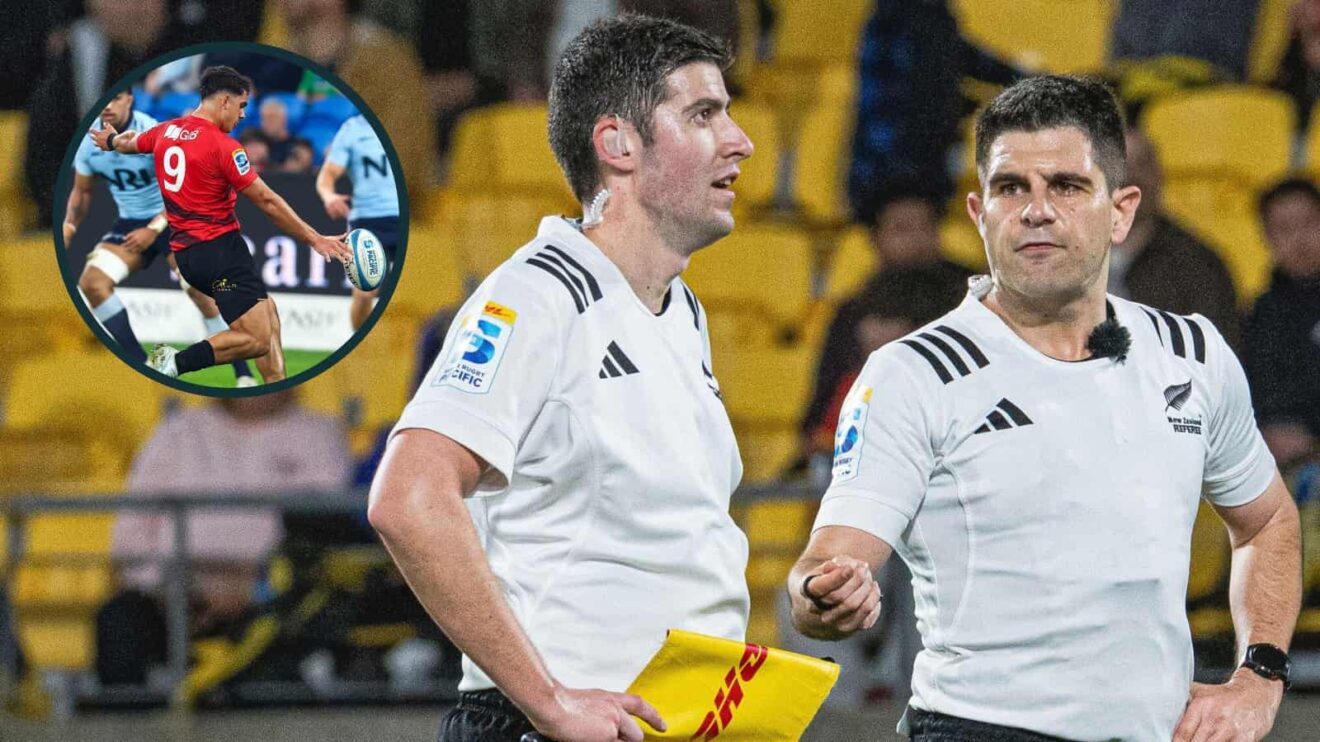
Super Rugby officials debate decision after TMO intervention and a box-kick following caterpillar ruck.
Super Rugby Pacific organisers have announced a further set of law amendments for the 2026 campaign which has got plenty of people talking.
We delve into them all and pick which trials could benefit the game and the ones that probably should find itself on the scrapheap at the end of the season.
The good
No mandatory card for penalty try
Referees have been instructed to always give a card when penalty tries have been awarded, but that has been amended in Super Rugby this year. In the upcoming competition, it is now up to the referee’s discretion as to whether they issue further punishment and it is a move which will be welcomed by many, especially when it comes to deliberate knock-ons.
Obviously, there could be controversy if there is a lack of consistency, and opening it up to interpretation always carries that risk, but the officials will look to distinguish what is truly cynical in comparison to players that are at least trying to stay legal.
Equally, if there has been a collapsed maul which has led to a yellow card in the previous passage of play and then another drive results in a penalty try, referees may prefer not to issue a card that would ordinarily take them down to 13 men.
There may be some teething issues early on as officials get to grips with the amendment and what constitutes a card, but it should be a positive move for the game.
The change to the ‘use it’ law at the ruck
The caterpillar has been the bane of everyone’s rugby watching experience, but this is something that will help limit them and also speed up the game. Under this new law, once the referee has said ‘use it’, no more players can be added to the ruck. How many times have we seen two or three more individuals labour to the breakdown after the official has uttered those words, thus slowing it down further?
Thankfully, this will put an end to that, while also testing the skills and decision-making of the half-backs as they determine what is the best course of action when the ball is at the base of a ruck. A knock-on effect could be increased fatigue for the forwards, who will now have to rush to set up for the box-kick.
The one potential drawback could be that half-backs simply go to another ruck to give themselves more time to organise before clearing, but that comes with inherent risk, so it will be interesting to see what teams do in Super Rugby.
More leniency with quick taps
Another excellent move is to not be so exact about players – predominantly scrum-halves – not taking a quick penalty at the mark. The new law states: “Players will be allowed to take quick taps within one metre either side of the of the mark, or anywhere behind the mark, if they are within that two-metre channel running parallel to the touchlines.”
That means sides have a better opportunity to go quickly in order to catch the opposition unawares, providing it is within that channel. They can be five or 10 metres behind the mark but they cannot, obviously, be on the other end of the field and take it.
The mixed
TMO restrictions
Super Rugby have recommitted to the pledge first trialled in 2023 which restricts what they can adjudicate on. They can only intervene if the referee has overlooked an act of foul play which is yellow or red card worthy and if there has been a clear and obvious infringement leading up to a try. That is in contrast to World Rugby’s laws which allows the video official to alert the referee to anything that he might have missed while the game is going on, such as the tiniest knock-on.
On the face of it, we can get behind that but, as we know, a game can be decided on the smallest thing, so it opens up the chance that an incorrect decision will lead to a team losing, which will automatically create controversy. The aim is to stop too many TMO interventions, which can slow the game significantly, while also maintaining a certain amount of officiating accuracy.
It is an admittance that officials cannot be 100 per cent correct all the time, something we think most would agree with, but it will be interesting to see if that is accepted when something goes against your particular team. That is the main concern but, if a balance can be found and everyone can abstain from criticising if a slight error is made, then great, but let’s be honest that isn’t going to happen.
The bad
Removal of scrums for accidental offsides
After World Rugby introduced an amendment which stopped scrums from being taken following free-kicks, this latest move from Super Rugby will lead to further to further accusations that certain elements of the game are trying to depower the scrum.
This new law trial refers to a couple of infringements. One is awarding a free-kick, rather than a scrum, for delaying the play of the ball, which we actually don’t mind, but the other is giving a short-arm for accidental offsides. Both are, to some extent, rare, so the impact may not be too great, but it is another example of the Australian and Kiwi bigwigs trying to limit the impact of the set-piece.
Want more from Planet Rugby? Add us as a preferred source on Google to your favourites list for world-class coverage you can trust.
Once people, and especially those within World Rugby, start accepting and implementing these types of law amendments, it can lead to a slippery slope where the scrum is effectively rendered moot, thus doing away with the assertion that it is a ‘game for all shapes and sizes’.
This particular law may also not do as intended and lead to more kicking, given that those committing the offence will be in possession of the ball and will not pass it to the opposition quickly.
The change to the 50/22 law
Super Rugby’s final amendment will now allow teams to obtain a 50/22 if passing back into their own half before kicking it. That law been has a great innovation but this slight alteration could have a negative impact.
Of course, it gives more chance that a 50/22 will occur but, with that motivation, will teams look to kick more? That is the opposite of what it is intended to do. Equally, a successful kick gives the attacking side a position inside the opposition 22, but what can that lead to? Mauls and the pick-and-go.
The one possibility is that teams are more wary of the kick and will then look to either drop more players into the backfield or potentially react when they think someone is about to attempt the 22, potentially opening more space out wide, but we’re not so sure.
READ MORE: Jaco Peyper: Why a Super Rugby law trial will slow the game down, not speed it up