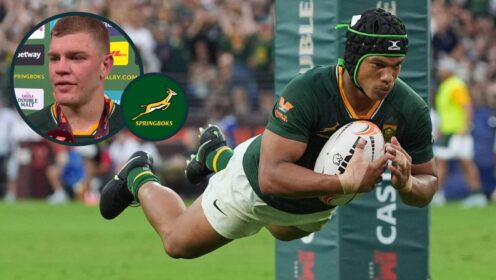
Rugby’s Greatest Rivalry’s top 10 players: Springboks ‘powerhouse’ and All Blacks ‘superstar’ take leading spots



Springboks hooker Malcolm Marx, All Blacks back-row Ardie Savea and inside centre Jordie Barrett.
Following the completion of Rugby’s Greatest Rivalry series between the Springboks and the All Blacks, here is our selection of the top 10 players from all the thrilling action.
10 Cheslin Kolbe (South Africa)
Although the world champions’ hot stepper had some good attacking moments, he was not as influential as usual with the ball in hand, as he was closely marked by the All Blacks defence. Kolbe’s participation in Rugby’s Greatest Rivalry series came to a premature end after he suffered a broken jaw in the third Test in Soweto.
However, the 32-year-old has added a new string to his bow in the form of goal-kicking, which proved invaluable in the second Test in Cape Town. Kolbe delivered a faultless display off the kicking tee in that encounter courtesy of four penalties and three conversions, and his efforts were rewarded with the official Player of the Match award. This, after he also slotted three penalties and a conversion in the opening Test in Johannesburg.
9 Ox Nche (South Africa)
A dominant scrum was, once again, the cornerstone of South Africa‘s success during Rugby’s Greatest Rivalry series and loosehead prop Nche was at the forefront of his team’s efforts at the set-piece, where he delivered several outstanding performances. As part of a front-row trio alongside hooker Malcolm Marx and tighthead prop Wilco Louw, he seldom came off second best at scrum-time and their efforts in that department were used as an attacking launchpad by the Boks on several occasions.
Nche also impressed with a high work-rate on attack and defence but he makes this list primarily for his scrummaging efforts and injured All Blacks loosehead prop Tamaiti Williams paid Nche the ultimate compliment when he said the following about Nche: “I think you’ve got to give him his flowers. He’s a freak and he’s made a name for the way he’s played. And I guess it’s a confidence thing too, right? When you’re going well, you usually have more confidence and he’s full of confidence when it comes to scrums.”
8 Morne van den Berg (South Africa)
The Lions scrum-half was not in the Springboks’ matchday squad for the opening Greatest Rivalry series Test, but after Grant Williams sustained an injury in that fixture, Van den Berg was promoted to the replacements bench with Cobus Reinach ahead of him in the pecking order. And although Reinach was solid in the next two fixtures, Van den Berg caught the eye with superb second-half cameos off the bench as he played a key part in helping the Boks close out those victories in Cape Town and Soweto.
The 28-year-old’s performance during the latter fixture was particularly impressive as he hit the ground running with a superb all-round shift that included excellent box-kicks and clearances into touch. That display was rewarded with a promotion to the run-on side for the final Test in Baltimore and Van den Berg continued with his outstanding form and it was no surprise when he walked off with the official Player of the Match award after the game.
7 Cam Roigard (New Zealand)
The second number nine to make this list and the first of a quartet of New Zealanders who showed during this series that they have become invaluable to their country’s cause at international level. Ahead of the series, Roigard was recognised as one of the international game’s best scrum-halves and he justified that evaluation with excellent performances in each of the All Blacks’ four matches against the Springboks.
Roigard was in the starting line-up for each Test and provided a slick service to his outside backs while he also impressed with his decision-making and option-taking despite playing behind a retreating pack of forwards for most of the series. The 25-year-old was also a constant threat with ball in hand, and although he only crossed the whitewash once – when he dotted down in the second Test – he was a constant attacking threat and provided three try assists.
6 Jasper Wiese (South Africa)
As usual, the Springboks’ forward play was of an outstanding standard during this series and Wiese was one of their standout performers as he took the fight to the All Blacks whether that was on attack or defence. Since replacing the great Duane Vermeulen as the world champions’ first-choice number eight, Wiese has been solid in most of his matches, but he took his game to another level during this series as he delivered several outstanding all-round performances.
One of the 30-year-old’s biggest strengths is his ball-carrying ability, and throughout the series he showed his class in that department with several barnstorming runs which gave the Boks valuable momentum. Wiese’s best performance was in the opening Test when he proved a real handful to the All Blacks defence on attack and continued to shine in that aspect of the game during the other Tests, while also impressing on defence as he made several big hits.
5 Will Jordan (New Zealand)
Another one of the All Blacks’ leading men, Jordan entered the tour with a reputation as one of the world’s leading attacking players and with a phenomenal try-scoring strike rate. He came into this series after breaking New Zealand’s Test try-scoring record but despite the Boks’ defenders always keeping an eye on him when he launched attacks, Jordan was always a handful with ball in hand.
The 28-year-old flyer hit the ground running in the opening Test when he crossed for a brace of tries and although he failed to dot down in Cape Town, he crossed the whitewash in Soweto and Baltimore which meant he finished as the series’ leading try-scorer. Jordan has now scored 55 tries for the men in black in just 61 Test appearances and he showed why he is rated so highly on attack with some superb finishes during the series.
4 Damian Willemse (South Africa)
Also adept at playing at inside centre, fly-half or on the wing, Willemse’s utility value has earned him the Swiss Army Knife moniker in the past but he is now firmly established as the Springboks’ first-choice full-back. The Boks possess several attacking threats in their backline and the 28-year-old was amongst those who kept the All Blacks’ defenders on their toes with his brilliance with ball in hand.
However, Willemse’s skill-set was not restricted to his attacking abilities during Rugby’s Greatest Rivalry series. He was also excellent under the high ball, and outstanding on defence which thwarted several of the All Blacks’ attacks. After two solid performances, he missed the third Test due to a hamstring injury but returned for the final encounter, where he delivered another superb all-round display as the Boks clinched the series.
3 Jordie Barrett (New Zealand)
Although the All Blacks suffered a 3-1 series defeat, Barrett can hold his head high as he was one of their best players on the tour and that is illustrated by his high ranking on this list. The 29-year-old did not make a big impact with ball in hand, as he was used mostly as a decoy on attacking moves as the men in black unleashed their dangerous outside backs and that tactic reaped rewards as they eventually outscored the Boks by 17 tries to 14 during the series.
However, Barrett’s contribution was visible in other facets of play with his defensive work of a high standard throughout, as he eventually made 48 tackles which means he finished the series with an average of 12 tackles made per match. Barrett also did his bit at the breakdowns, where he won some crucial turnovers, while he also relieved plenty of pressure when his team were under the cosh with some long-range kicks into touch.
2 Ardie Savea (New Zealand)
After shining in three successive Nations Championship Tests – against France, Italy and Ireland – the All Blacks superstar was given a break, which meant he missed his side’s opening tour matches against the Stormers, Sharks and Bulls. That decision from the men in black’s head coach Dave Rennie proved to be a masterstroke as Savea was refreshed for the Test series and came to the fore with excellent showings in the first three Tests before injury ruled him out of the fourth one.
The 32-year-old certainly made his presence felt as he put in huge efforts on either side of the ball in the first two Tests while his brilliance on attack was rewarded with a brace of tries in the third clash. However, his participation in the series was ended when he dislocated his shoulder during the latter stages of the first half of that match, and his presence was missed in the final Test.
1 Malcolm Marx (South Africa)
The Springboks powerhouse showed why he is the current World Rugby Player of the Year as he produced high-quality performances throughout the series and his contributions were a major reason that the men in green and gold emerged victorious after the completion of the four Tests. Marx did what was expected of him in the execution of his core duties, as he was solid in the scrums while his throw-ins at the lineouts were also accurate throughout.
Despite shining in those departments, Marx also did well as a ball carrier and one of his highlights of the series was when he powered his way over the try-line for a deserved five-pointer off the back of a 20-metre lineout drive. The 32-year-old also had a high work-rate on defence and finished the series with a total of 40 tackles made at an average of 10 per match while his breakdown work was also of a high standard as he won several vital turnovers.