State of the Nation: Rassie Erasmus ‘magic’ central to Springboks ‘juggernaut’ consolidating their position as the world’s best


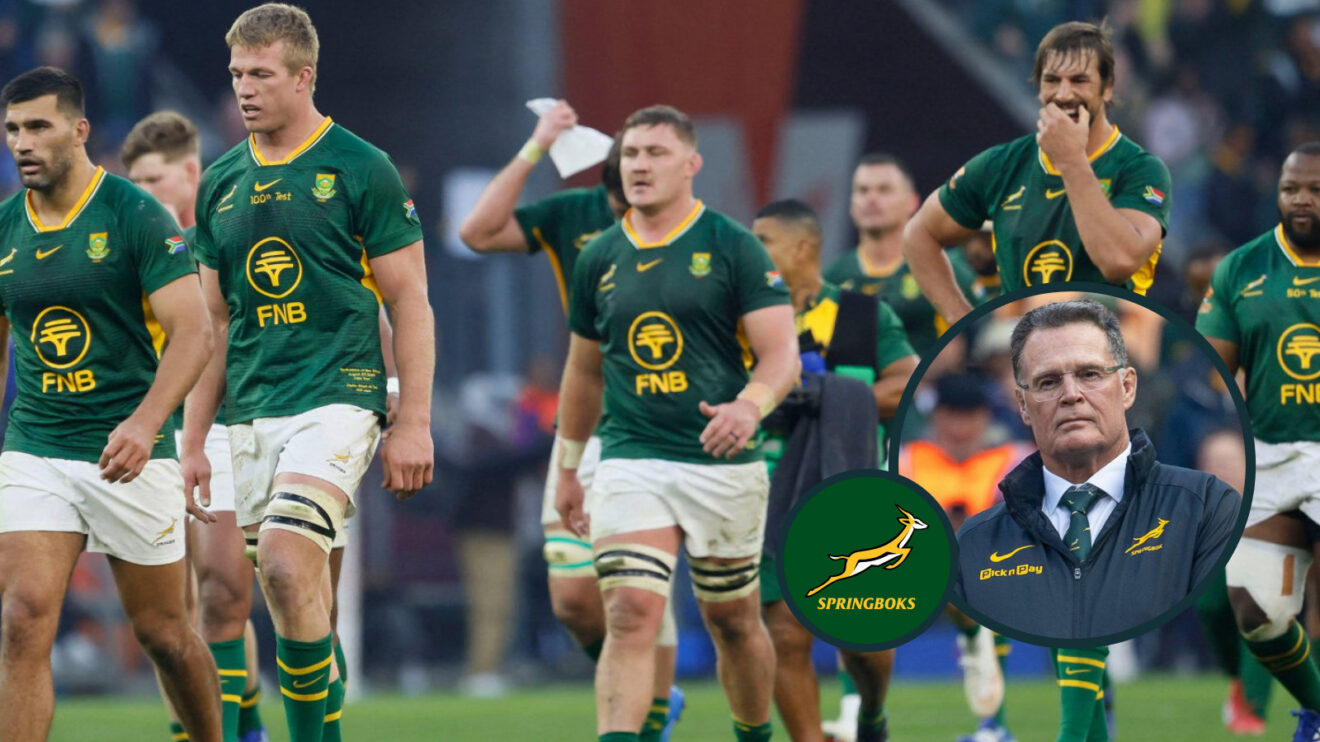
Springboks players leave the field after a Rugby's Greatest Rivalry Test and their head coach Rassie Erasmus (inset).
Following the conclusion of Rugby’s Greatest Rivalry series, we update you on the state of the two participating nations. First up, it’s Rassie Erasmus’ Springboks.
Rugby’s Greatest Rivalry series summary
After clinching a hard-fought win in a warm-up Test against Argentina in Buenos Aires, the world champions were quietly confident ahead of the opening match of the eagerly anticipated series at South African rugby’s spiritual home, Ellis Park in Johannesburg. However, things did not go according to plan as the Springboks made a horrific start to the series with their arch-rivals eventually clinching a comfortable victory, outscoring them by five tries to one in the process.
The Boks were guilty of committing a plethora of unforced errors at Ellis Park and if they wanted to level the series, a much more assured performance was needed in the second Test at DHL Stadium in Cape Town. That encounter was highlighted by Erasmus chopping and changing his starting line-up a few times before kick off. With their backs to the wall, the Boks had to pull out all the stops to bounce back and level the series and they did just that.
Following that match, All Blacks head coach Dave Rennie accused the Springboks’ front-row of walking around in the scrums. That allegation was like a red rag to a bull and Erasmus responded with an expletive while denying it. The claim eventually backfired on Rennie as the Boks responded with a dominant scrummaging performance en route to another deserved triumph in the third Test at FNB Stadium in Soweto which gave the world champions a 2-1 lead in Rugby’s Greatest Rivalry series.
Despite knowing that they could not lose the series, Erasmus’ charges were far from finished and they produced their best performance in the final Test in Baltimore, USA, where forwards and backs combined brilliantly as the world champions ran in six tries to New Zealand’s four. That victory secured a 3-1 series triumph for the Boks and, in doing so, they also consolidated their position as the leading team in World Rugby’s official rankings list.
Standout players
Much of the Springboks’ success comes through their power game and their forwards are crucial in that aspect, with hooker Malcolm Marx leading the way. Marx showed why he is the current World Rugby Player of the Year as he was excellent in the execution of his core duties while his ability to win turnovers also proved invaluable to the Springboks cause.
Meanwhile, in Ox Nche and Wilco Louw the world champions have two of the most destructive scrummagers in the game while veteran lock Eben Etzebeth showed that he is still one of the world’s best players in his position despite his advancing years. The back-row duo of Pieter-Steph du Toit and Jasper Wiese also showed their class as both shone on defence and attack while the former was also a handy option in the lineouts.
Amongst the backs, Damian Willemse missed the third Test due to a hamstring injury but prior to that, and when he returned to action in the series finale in Baltimore, he showed that he is a vital cog in the Springboks machine as he gives them good attacking momentum when he joins the line from full-back, is safe under the high ball and solid on defence.
Meanwhile, as usual, Cheslin Kolbe had some good attacking moments but also impressed with accurate goal-kicking in the first two Tests where he delivered faultless displays and eventually succeeded with 11 successive shots at goal off the tee. Meanwhile, fellow excitement machine Kurt-Lee Arendse was only on the field for 10 minutes at Ellis Park before being forced off due to a head knock and although he missed the Cape Town clash, he made a try-scoring return in Soweto before blowing the All Blacks away with a brilliant attacking display in Baltimore where he also dotted down.
It was a similar story for Morne van den Berg who, after impressing with superb cameos off the bench in the second and third Tests, was promoted to the run-on side for the Baltimore clash and came to the fore with an excellent all-round display which was rewarded with the official Player of the Match award. There were also fine performances from the experienced midfielders Damian de Allende and Jesse Kriel while Ethan Hooker also made his mark with fine showings on either side of the ball.
Stat leaders
After seeing only 10 minutes of action during the opening Test and missing the second one, Arendse made up for lost time on attack in the second and third encounters and eventually finished with a team-high 220 metres gained during the series.
Meanwhile, Kolbe’s accuracy as a goal-kicker means he is the team’s top points-scorer as he contributed 29 points in the three matches which he played in and he is just one adrift of All Blacks fly-half Ruben Love in that department.
On defence, Du Toit leads the way with a team-high 49 tackles made which is an average of just over 12 tackles per match, although the likes of De Allende (44), Wiese (43), Etzebeth and Ruan Nortje, who both made 42 tackles, were not far behind.
Success story
The Springboks have been the dominant force in international rugby for several years now and for them the saying The whole is greater than the sum of the parts is a very apt one. They showed yet again that they are a well-oiled machine in which every department make excellent contributions to the cause and the end result is the reward which they received in the form of Rugby’s Greatest Rivalry trophy.
From their head coach Erasmus down to the rest of the coaching staff and the players, under the leadership of captain Siya Kolisi, everybody’s contributions were excellent throughout the series and their diligent efforts and hard work paid off ultimately. As the team’s leader, Erasmus deserves plenty of credit for the team’s success as he worked his magic to get the Boks’ campaign back on track after their disappointing start to the series.
The Boks juggernaut’s next major challenge is to continue on their upward trajectory under Erasmus’ guidance as they aim to be crowned world champions for an unprecedented third successive time.
Want more from Planet Rugby? Add us as a preferred source on Google to your favourites list for world-class coverage you can trust.
Main regret
After clinching a 3-1 series triumph, there were very few negatives which the Springboks will reflect on but it’s fair to say that having just one warm-up match played a fortnight before the opening Test is something which Erasmus and the rest of the world champions’ brain trust would regret.
After delivering impressive performances in three Nations Championship victories – over England, Scotland and Wales – in July, Erasmus opted to leave several of his first-choice players in South Africa while the rest of the squad headed to Buenos Aires to take on Argentina. That match was three weeks after their last Nations Championship victory over Wales and the Boks were made to work very hard ahead before securing a 17-10 win over Los Pumas.
With the first Test against the All Blacks taking place at Ellis Park two weeks after the win over Argentina, it meant that several players who were in the matchday squad for the Greatest Rivalry series opener had not been in action for five weeks. That decision proved to be a costly one as the Boks were clearly under-cooked against the men in black who had already played matches against the Stormers, Sharks and Bulls on their South African tour.
South Africa eventually paid the price against the All Blacks at Ellis Park as their play was characterised by numerous handling errors and poor decision making which eventually resulted in them suffering a humiliating defeat.
Results
South Africa 16-33 New Zealand at Ellis Park in Johannesburg
South Africa 33-26 New Zealand at DHL Stadium in Cape Town
South Africa 29-24 New Zealand at FNB Stadium in Soweto
South Africa 43-28 New Zealand at M&T Bank Stadium in Baltimore