State of the Nation: ‘Aesthetically pleasing’ All Blacks find their ‘identity’ under Dave Rennie but are they really better?


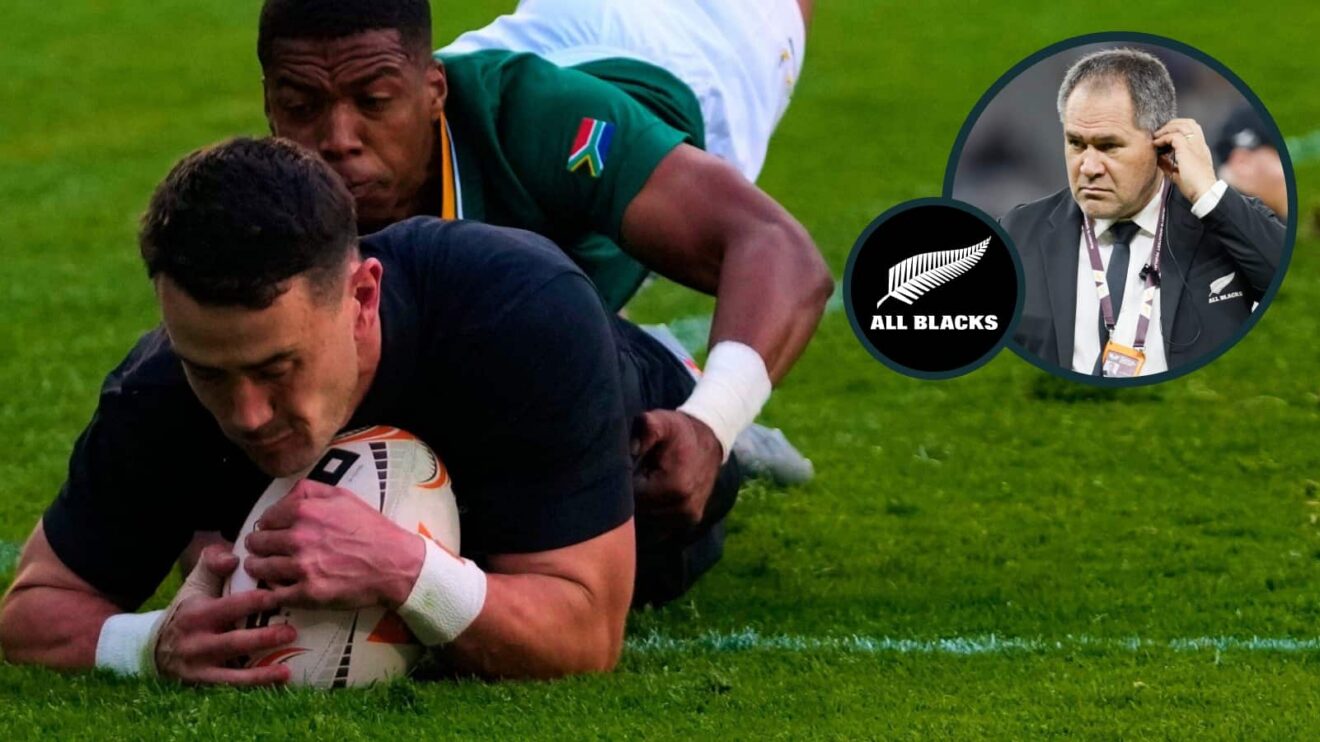
Will Jordan scoring a try for the All Blacks and head coach Dave Rennie.
Following the conclusion of Rugby’s Greatest Rivalry, we update you on the state of the two participating nations. Second up, it’s Dave Rennie’s All Blacks.
New head coach Rennie enjoyed a positive start to life in the hotseat, claiming wins over France, Italy and Ireland in the Nations Championship, but everyone knew that their tour to South Africa would be the acid test.
What the July series showed was that a clear identity was developing under the 62-year-old, but could they continue in the same vein and bring the same plan at the home of the back-to-back world champions?
They knew the Boks would challenge them in the fundamentals, particularly set-piece, kick receipt and breakdown. The All Blacks have shown that they are far more aesthetically pleasing in comparison to the turgid rugby they produced when Scott Robertson was at the helm, but it is one thing to do it at home to a second-string French and a declining Ireland, but another to do it against the mighty South Africa.
Rugby’s Greatest Rivalry summary
Before we get to the internationals, there was of course three matches – the fourth came between Tests one and two – against the South African franchises, which gave Rennie a chance to try out some different combinations and new players.
Results alone would not determine whether this tour could be deemed a success with the coaches knowing that they needed to both build depth and strengthen the first choice 23. It was not the auspicious start, however, with the Stormers providing especially obstinate opponents, but you could ultimately put that down to first day nerves.
They went from strength-to-strength in the subsequent two encounters, winning easily against the Sharks and Bulls, with the team looking more cohesive and certain individuals, even those not necessarily in the Test picture, impressing.
After their scrum struggles in the opener in Cape Town, the All Blacks were much better in Durban and Pretoria, but that clash at DHL Stadium hinted at what was to come in the Tests.
Rennie’s men were annihilated in the set-piece against the Boks, with the tourists regularly going into reverse in Johannesburg, but the off-colour hosts could not take advantage. In fact, the all-out attack mindset – combined with a defensive resilience – was central to this triumph as the All Blacks’ ability to move the ball, as well as clinicalness in the opposition half helped them secure a remarkable 33-16 triumph at Ellis Park.
Considering that logic dictated New Zealand would improve as the tour went on, given they were only in their fourth Test under Rennie, a series victory, which had appeared unlikely prior to the tour, looked a distinct possibility.
The All Blacks were back most people thought, but they ultimately thought wrong. While the All Blacks complained over the legality of the Springboks scrum, the fact remained that their pack was regularly being shunted backwards.
It was an area they failed to rectify in Cape Town or Soweto and, with the hosts reducing their error count, it proved too big an obstacle for the visitors to overcome. In some ways, there were improvements from the All Blacks, who managed to find their way into opposition territory more often in Tests two and three, but those weaknesses were quite simply more costly as South Africa moved 2-1 ahead in the series.
That meant they could not win Rugby’s Greatest Rivalry but only draw heading to Baltimore. While some claimed this was simply an exhibition match, a victory for Rennie’s men would provide a major fillip and suggest that they are making real strides in this new era, but this was their worst performance of the lot.
Granted, plenty of changes were made – some of those enforced – but they yet again looked physically a step below the 2019 and 2023 World Cup winners. Although the scrum was better, the Boks were too powerful and, on this occasion, too skilful as they ran in six tries in a 43-28 victory over the men in black.
Standout players
If you are purely focusing on the Tests, three names often cropped up and that was backline trio Cam Roigard, Jordie Barrett and Will Jordan, who maintained high standards for the majority of the series.
Barrett was probably the All Blacks’ best, even if his influence in attack wasn’t quite as noticeable the longer the tour went on. Instead, the inside centre put in a mammoth defensive effort, winning a number of turnovers for his side through his ferocious tackling and intelligent work without the ball. Jordan, meanwhile, was New Zealand’s best attacker, scoring four tries in as many Tests, while Roigard was outstanding in keeping the tempo high.
Picking three forwards of the same quality was slightly more difficult, certainly over the four internationals. Fabian Holland, Peter Lakai, Luke Jacobson and Asafo Aumua all had standout games or moments but, for sheer consistency, only Ardie Savea could claim to match what Barrett, Jordan and Roigard produced. Captain Savea was excellent for the first three Tests and they missed his leadership and quality in Baltimore.
Stat leaders
After hailing the brilliance of Jordan, it was therefore not a surprise to see him lead New Zealand’s try charts for the tour alongside Josh Moorby, Rieko Ioane and Leroy Carter, but most impressively the All Blacks record try-scorer’s four all came in the Tests after he missed the tour games.
Moorby, Ioane and Carter had one, zero and one respectively when the proper action got underway, which means that Savea with three was the only other All Black to score more than one try during the series with the Springboks.
Another standout was Barrett, who was effective in attack but particularly outstanding in defence, which was demonstrated by the staggering five turnovers he won in the first Test alone and that was complemented by 15 tackles in that clash – the most of anybody.
Elsewhere, Ruben Love was unsurprisingly the team’s top points-scorer with 30, 10 more than the aforementioned outside backs, but they were split evenly between the tour games and the Tests with 14 in the former and 16 in the latter. Interestingly, however, they were all from conversions with Love not scoring a try or a penalty in the four matches he played over the past month or so.
Success story
There are two key questions which have already been touched on but are worth repeating given that it will determine whether the past month has been a success; do the All Blacks have an identity? And, more pertinently, have they improved?
The response to the first one is a categorical yes, with Rennie formulating a style of play which is reminiscent of the pre-Robertson days, but the worry is whether it can effective in the modern game, and that has therefore put the answer to the second one in doubt.
While there appeared to be fundamental issues within Robertson’s set-up, with player dissatisfaction at the heart of it, there seemed to be a firm belief that what had served the All Blacks so well for over 100 years would not necessarily work now.
There was certainly logic in that with the Springboks the game’s innovators as they looked to get the best of their core strengths; set-piece, kicking, high ball and sheer forward power. Robertson was reluctant to follow South Africa’s Bomb Squad example but he knew the importance of the aerial game and thought running the ball from deep was fraught with risk.
The All Blacks players evidently disagreed and so has Rennie, who has created a game plan which is far more expansive and many would argue suited to the individuals he has at his disposal. That confidence in their skills has led to a massive improvement in their attack, even against one of the game’s best defences, and some sublime tries. It kept them in games which could have easily got away from them and is very much their success story from the past few weeks.
Main regret
New Zealand’s attacking game has duly given them a pass mark from the tour and just about keeps them trending in the right direction, but it comes with real caveats. Ultimately, their ability with ball in hand will count for little if they can’t rectify their fundamentals of set-piece and kick receipt.
In 2023, the front-row that started the World Cup final, which kept the fearsome Boks pack at bay, was Ethan de Groot, Codie Taylor and Tyrel Lomax, the same trio which featured in the opening Test in Johannesburg and would have likely started the second match had it not been for the loosehead’s injury.
They are proven performers and, at 28 and 30 respectively, De Groot and Lomax should be coming into their prime. However, the former has suffered a concerning drop-off since the global tournament – albeit he has had a better 2026 – and the latter has struggled since the middle of 2025 due to injury. The tighthead returned to fitness in May and has had plenty of time on the field since, but he was constantly shunted backwards in South Africa.
It could well be that South Africa’s scrum is streets ahead of the rest and, if that is the case, you may as well hand them the Webb Ellis Cup now, but England by comparison were competitive at Ellis Park in July and did a job on the All Blacks forwards in November.
The encounter with the English at Twickenham later this year will be a better indication of whether the All Blacks have developed but, either way, there will be frustration that they were dominated in the set-piece and in the air.
Their struggle under the high ball was arguably the bane of Robertson’s tenure and they have not managed to rectify it under this regime. There is still enough time to get it right, but it remains a concern that a new era has not brought about a tangible improvement in those areas. If that trend continues then New Zealand can write off their World Cup hopes.
Results
All Blacks v Stormers (All Blacks won 38-21)
All Blacks v Sharks (All Blacks won 54-0)
All Blacks v Bulls (All Blacks won 50-19)
All Blacks v Springboks (All Blacks won 33-16)
All Blacks v Lions (All Blacks won 41-35)
All Blacks v Springboks (Springboks won 33-26)
All Blacks v Springboks (Springboks won 29-24)
All Blacks v Springboks (Springboks won 43-28)