Rassie’s reckoning: how the 2026 Nations Championship squads will write the first draft of Rugby World Cup 2027


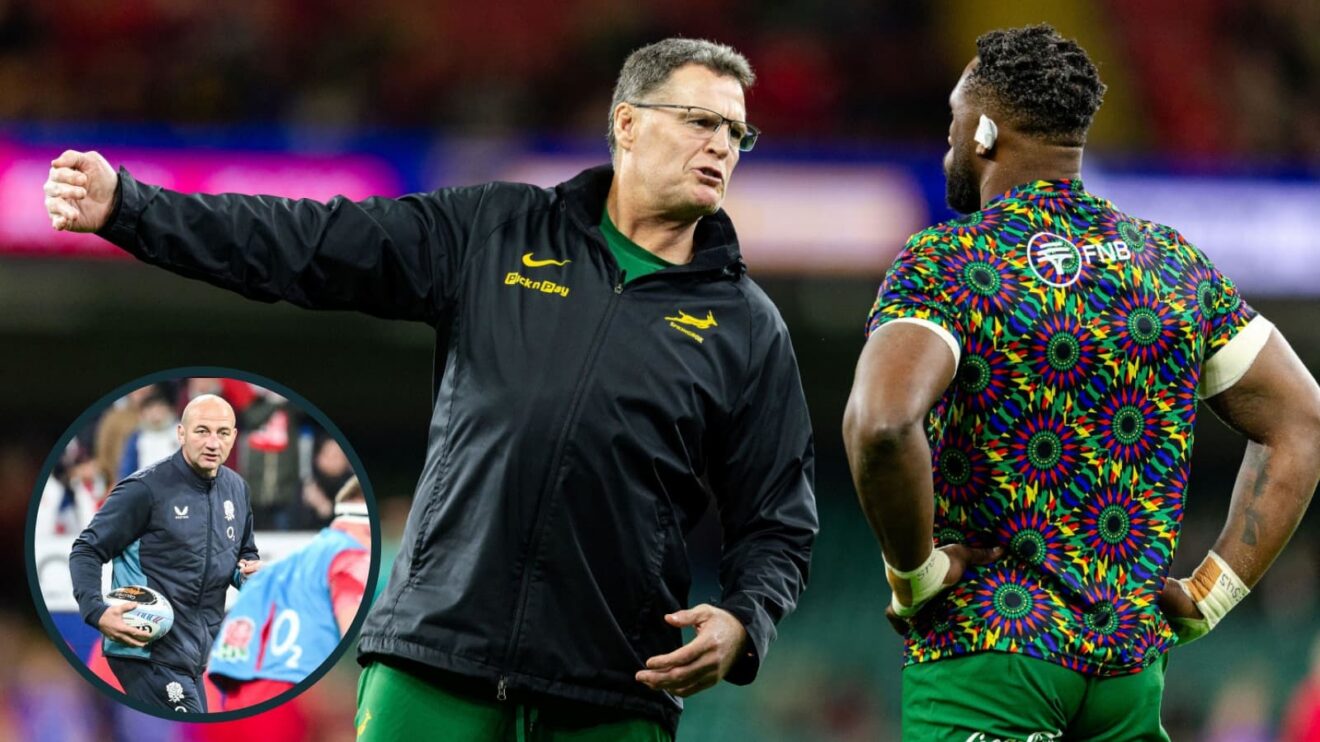
Springboks head coach Rassie Erasmus talking with captain Siya Kolisi.

South Africa carry 21 players over 30 into the inaugural 2026 Nations Championship, in a working group of 37 that includes 12 with caps in excess of 50. The selections Rassie Erasmus makes across his July Tests will deliver the most honest read yet on the central question facing the world champions: defend their crown in Australia with the spine that won them the 2023 trophy, or accept that continuity has finally given way to regeneration.
The reconfigured calendar agreed between Six Nations Rugby and SANZAAR hands every leading contender six Tier One Test matches across July and November against opposition from the opposite hemisphere, forcing every serious World Cup contender to declare a 2027 selection direction 12 months earlier than any previous cycle has demanded.
The age and caps profiles of the seven leading contenders read profoundly differently from each other, and the gap between best-placed and worst-placed is already considerable enough to shape how the closing weekend at Stadium Australia plays out in November 2027.
South Africa: the world champions’ demographic problem
57 per cent of the Springbok working group is already in the second half of their careers, and the 12 players carrying the bulk of senior leadership represent an attrition profile the regenerating sides around them no longer carry.
Erasmus has spent the latitude of the 2023 victory on continuity, understandable from the man who lifted the trophy yet increasingly difficult to justify as Australia 2027 narrows into view. The Nations Championship summer schedule will require Erasmus to declare his hand across his July fixtures on three central questions: which of the over-30 leadership group is genuinely being protected for the World Cup, which of the under-25 cohort he trusts with meaningful Tier One minutes, and how aggressively the Bomb Squad model can be carried forward into Australian conditions that bear no resemblance to the temperate French autumn that made 80-minute carrying loads sustainable in 2023.
Australian recovery windows complicate those loads through repeated dehydration and soft-tissue stress under humidity, both of which interact poorly with the age curve of forwards absorbing peak Test attrition. Watch the body language of Eben Etzebeth across the closing 20 minutes of recent Tests and the demographic argument writes itself in the visible cost of carrying the most-capped Springbok career in history into a fourth World Cup cycle.
That said, the Springboks have a unique habit of turbo-charging their veterans at World Cups. Deon Fourie was essentially dragged out of Western Province club rugby to make his Test debut at 35 before playing 76 minutes of the 2023 final at 37 after Bongi Mbonambi went down early. Os du Randt won his second title in 2007, a full 12 years after his first in 1995, and Schalk Brits came out of retirement to make the 2019 squad at 38.
Springbok history and demographic determinism do not always agree, which is part of why Erasmus’ continuity bet is harder to dismiss than the raw numbers alone suggest. Pool B against Italy, Georgia and Romania looks navigable on paper, yet the Springbok medical staff will run their protocols on bodies that have absorbed four additional years of Test-match attrition since the last cycle peaked.
Argentina: the cleanest reading on the board
Felipe Contepomi arrives with six players over 30, 10 holding 50-plus caps and only 12 carrying fewer than ten, which is the cleanest demographic reading of any leading contender and produces a leadership spine sitting on a squad in its peak window with enough capped ballast to manage knockout weeks calmly.
Contepomi has executed the most controlled succession work of any head coach in this analysis, advancing his eight under-25s without burning the experience that carried the Pumas through their 2023 semi-final, and his July fixtures hosting Scotland, Wales and England give him the political freedom to use the Nations Championship for genuine cap-hardening rather than balancing.
The practical caveat remains tighthead depth in the more humid pool venues, yet the broader squad architecture is tournament-coherent in a way several better-fancied northern hemisphere sides cannot currently demonstrate.
Australia: the right trajectory, the wrong capped depth, the coaching handover
Joe Schmidt has constructed a working group with 29 players under 30 and only eight in their 30s, alongside a freshness profile that suits a home tournament played in conditions Australian-conditioned bodies are better adapted to than any visiting side.
The complicating factor is the coaching handover, with Schmidt concluding after the July leg of the Nations Championship and Les Kiss taking over from August through to the 2027 World Cup. Only five Wallabies hold 50-plus caps, the lowest figure of any leading contender, which represents a meaningful risk in close knockout matches where fatigue management in the closing 20 minutes separates sides whose senior decision-makers have navigated identical scenarios from those who have not.
The Nations Championship is therefore arguably more consequential for Australia than for any other side, since Schmidt’s July squad sets the foundation Kiss will inherit, and Kiss’s November selection across the European tour will tell observers whether he intends to continue Schmidt’s youth profile or to broaden capped depth ahead of a home World Cup the Wallabies open in Perth on 1 October 2027.
New Zealand: a new head coach with an inherited project
The All Blacks arrive with a head coach appointed only in March, after Scott Robertson’s January departure following the 2025 end-of-season review and the subsequent recruitment of Dave Rennie.
The squad Rennie has inherited counts 33 players, the smallest of the seven leading contenders, with eight on 50-plus caps and 25 under 30, while the under-25 cluster of four is the joint lowest in this analysis and suggests the All Black next-generation pipeline slowed during the Robertson cycle. The question the Nations Championship will answer most clearly is how aggressively Rennie reshapes a squad assembled under a head coach whose dismissal was driven by the very results the new regime is charged with reversing.
His opening fixture against France in Christchurch on 4 July is the first declarable selection of his tenure, and the November tour across the European powers will pressure-test the squad in a manner the Rugby Championship has not since 2019.
Ireland: regeneration delivered, hardening required
Andy Farrell has executed the most dramatic squad reshape of any side in this analysis, taking Ireland from a 2023 group in which more than half the playing squad was over 30 to a 2026 working group with 13 of 37 in that bracket and 15 on sub-10 caps, across a cycle that produced a 2024 Six Nations title, a 2025 third-place finish under Simon Easterby during Farrell’s Lions sabbatical, and a 2026 Triple Crown behind France’s dramatic final-round title defence.
The risk is hardening time, since the back five of the pack remains the area where the under-25 cluster needs the most Tier One exposure before August 2027, and the Nations Championship is precisely the cap-rich window Farrell needs.
His July squad will reveal whether he is using the six fixtures to harden the new generation against southern hemisphere opposition or to preserve his experienced figures for a final World Cup tilt.
England: profile intact, performance not
England arrive from the bleakest Six Nations campaign of the Steve Borthwick era, finishing fifth in 2026 after four consecutive defeats including a first-ever loss to Italy, yet the demographic data continues to argue Borthwick has more to work with than the discourse currently credits him for.
30 players under 30 paired with 11 on 50=plus caps represents the working definition of peaking on time, and the gap between the squad profile and the tournament results is the most interesting analytical question in northern hemisphere rugby eighteen months out from Australia.
The selection question for the Nations Championship is courage rather than balance, since Borthwick has assembled the profile and now must demonstrate the willingness to start his under-25s against South Africa in the July opener rather than rotating them into autumn fixtures where the political pressure on his tenure is lower.
Whether the tactical model recovers sufficiently to allow the demographic profile to translate into tournament performance is the question the RFU has taken the summer to answer.
‘It doesn’t sit right with me’ – England great hits out at Benhard Janse van Rensburg call-up
France: the developmental gamble that defines the cycle
Fabien Galthié arrives as a back-to-back Six Nations champion with the largest and youngest working group of any leading contender, a squad of 47 in which 14 are under 25 and 21 carry fewer than 10 caps, leaving close to half uncapped at meaningful level with 15 months before final tournament selection.
The 2026 title defence concealed defensive frailties that surfaced in heavy concession against Scotland and England across the closing two rounds, and Galthié heads into the Nations Championship knowing the depth on paper has yet to convert reliably into knockout-grade resilience.
Australian heat exposes under-tested forward packs quickly, particularly at scrum time when humidity drops fitness levels in the front five sooner than backline athletes, and France’s exposure to that risk reduces with every Tier One appearance banked between now and the Twickenham finals weekend in November 2026.
Australian conditions and the November reckoning
Perth Stadium hosts the opening match of Rugby World Cup 2027 on 1 October in a Mediterranean climate typically between 22 and 28 degrees with humidity in the 40s and 50s, while Brisbane Stadium’s quarter-final weekend on 30-31 October will deliver subtropical humidity climbing through the 60s and 70s and afternoon temperatures around 26 degrees, before the semi-finals and final at Stadium Australia in Sydney across early November.
Squad demographics interact with those venues differently, since the dry warmth of Perth and Adelaide places different recovery demands on older players than Brisbane’s humid subtropical conditions, with Sydney’s November shoulder-season sitting between the extremes in ways that benefit the freshest squads more than the oldest.
Want more from Planet Rugby? Add us as a preferred source on Google to your favourites list for world-class coverage you can trust.
Conclusion: the Bok squad that defines the cycle
The 2026 Nations Championship was designed as a commercial reset of the international calendar and a fan-engagement vehicle for the Twickenham finals weekend, yet its accidental consequence is to compress the World Cup selection cycle by 12 months.
Form will recover across the year, since form always does, whereas squad architecture rarely undergoes meaningful reshape inside the 12 months before a tournament. The selection decisions made in July 2026 will accordingly carry more analytical weight than the November results, since November will speak to coaching adjustment within fixed personnel, whereas July will speak to the personnel themselves.
South Africa face the most consequential of those declarations, with demographic conditions and Bomb Squad questions converging on a moment in which Erasmus must confront the question that continuity has so far allowed him to postpone.
The July squad will reveal whether the world champions intend to defend the title with the spine that won it or whether the cost of carrying that spine into Brisbane and Sydney knockouts in late 2027 has finally been recognised in the team sheet.
The answer will be visible long before the fixtures play out, and will be read more carefully than any World Cup squad announcement in recent memory.
All age and caps profiles are calculated from publicly named national working groups as of 19 May 2026.