Maxime Lucu v Jamison Gibson-Park: The Investec Champions Cup battle that will ‘settle’ the best in the world question


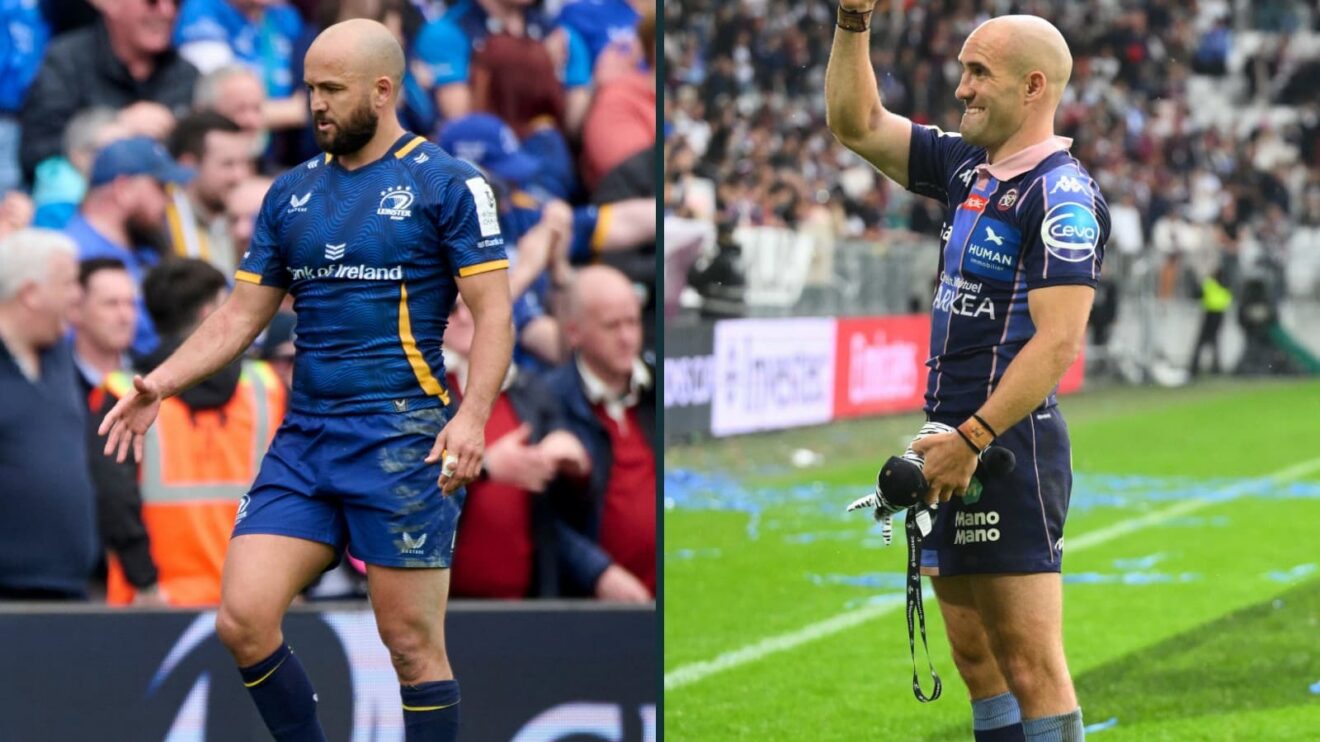
Jamison Gibson-Park and Maxime Lucu face off in the Investec Champions Cup Final.

The Investec Champions Cup final on Saturday brings together two clubs separated by tradition, structure and pathway, united by a common conviction that the most important player on a modern rugby pitch wears the number nine on his back.
Maxime Lucu and Jamison Gibson-Park have arrived at San Mamés Stadium as the two finest exponents of the position currently operating in the European game. Saturday afternoon will sort one from the other, and in the process settle a question that has been quietly gathering force across the post-Christmas knockout phase. There’s a growing view that the best scrum-half in the world today is French but it may not, at this precise moment, be Antoine Dupont.
How the nine became the conductor
The modern elite scrum-half is no longer a distributor from the base of the ruck. The position has become rugby’s primary tactical management role, a hybrid of field marshal, pressure kicker, defensive organiser and tempo governor. The French school has driven that evolution further than any other system. Dupont’s emergence from 2018 onwards established the template, and the Top 14 production line has spent the last seven seasons refining it. Lucu, Le Garrec, Serin, Couilloud, Jauneau and Graou are all variations on the same governing nine, all expected to direct forward energy, manage territory and read defensive shape simultaneously. The Bordeaux model has weaponised that template more completely than any other side in club rugby. Their nine is their conductor. Bilbao is, in many ways, a referendum on how far that model has spread, and on which captain executes it best on the biggest day available.
The Lucu evidence
Lucu has spent the last six weeks building a body of evidence for this thesis that is difficult to talk around. In the quarter-final at Chaban-Delmas against Toulouse, with the stadium sold out for the 31st consecutive time, he produced the single most influential performance on a pitch containing Dupont, Ramos, Jalibert, Ntamack, Bielle-Biarrey and Willis. He kicked 10 points, including a 52-metre penalty that flattened any remaining Toulouse momentum in the third quarter. He hounded Dupont and Ramos at every breakdown ruck he could reach. He governed Bordeaux’s tempo for 80 minutes against the best forward pack in the competition. Many in Chaban left believing Lucu had outshone Dupont in a fixture that deserved to be a final. The Player of the Match award merely confirmed what every supporter had already watched.
A fortnight later, against Bath, the same pattern asserted itself in different conditions. Lucu landed five conversions from six, kicked his only penalty attempt, scored a try from short range after Jalibert’s dummy split open the Bath defence, and orchestrated his side to five tries against the Premiership champions playing some of their best rugby of the season. The numbers tell a fraction of the story. What he has produced through the knockout phase is a sustained masterclass in the modern scrum-half craft: tempo manipulation off both feet, kick-pass execution to either touchline, defensive line-speed organisation, breakdown intelligence, and the captaincy of a side that scored 64 points against Leicester earlier in the campaign and has now beaten Toulouse three times this season. He has, on the available evidence, been the most influential player in European rugby through the knockout phase. The fortnight since the semi-final has done nothing to weaken that case.
The Dupont question
This is where the more interesting question begins. By the impossible standards he has himself established, Dupont’s Six Nations was a quieter championship than rugby has grown used to seeing from him. He was not at his pre-injury authority at the breakdown against Scotland at Murrayfield, where Ben White genuinely outplayed him in one of France’s more chaotic afternoons of the championship. ESPN left him out of its team of the tournament. RugbyPass selected Gibson-Park ahead of him at scrum-half. The official Player of the Championship shortlist did not include him. Several outlets that still picked Dupont at nine did so with caveats and acknowledgements that Gibson-Park had run him close.
None of this is to suggest the player is finished, or that his ceiling has lowered permanently. The honest read is that Dupont has returned from a second major knee ligament injury after 266 days out of the game. He played his first competitive minutes only in late November against Racing 92. He has needed time, and is still finding the explosive lower-body authority that defined his pre-injury rugby. The player who navigated contact like no one else at the position is still recalibrating that contact. He remains an elite operator. The case that he is the best nine in the world right now requires considerably more charity than the case for Lucu does.
Reading the field
Which brings us to Gibson-Park, the genuine challenger across the halfway line in Bilbao, and to the wider landscape of the position. Of every scrum-half currently operating in the Northern Hemisphere outside France, Gibson-Park is the one most explicitly modelled on the French template. He governs tempo, reads forward energy, manages territory, and treats the box-kick as a discriminating tactical instrument rather than a default exit option. The closest English equivalent is Ben Spencer at Bath, whose rebuild of his international standing has followed similar lines, and whose own Investec Champions Cup semi-final against Bordeaux this month confirmed he belongs in any honest top-five conversation. Cobus Reinach is operating at exceptional level for Montpellier in his mid-30s. Cam Roigard at the Hurricanes is the most exciting young nine currently anywhere in the game, the architect of a Super Rugby Pacific side topping the standings by daylight. None of those four, on current evidence, has yet matched the sustained quality Lucu has produced across this knockout phase.
Gibson-Park, the genuine challenger
Gibson-Park is the one who can. He is operating at the highest level of his career. Dropped for the Italy fixture in February in what Andy Farrell evidently intended as a corrective, he responded by producing one of the great individual displays by an Ireland player in years at Twickenham, taking the Player of the Match award in a 42-21 dismantling of England. His subsequent showings against Wales and Scotland in Dublin operated at the same register. Mike Ross, the former Leinster prop, captured the consensus among those who watch him weekly: only Dupont still sits ahead of Gibson-Park in his current ranking, and even that ordering is now openly contested. The 34-year-old has aged into the petit general role with a tempo-setting authority very few number nines in history have ever possessed. The Leinster pack he plays behind on Saturday contains Porter, Sheehan, McCarthy, Ryan, Conan, Van der Flier and Doris. That is a Test back five with one of the best front-rows in the world bolted onto it. He has the platform of his career to operate behind.
Want more from Planet Rugby? Add us as a preferred source on Google to your favourites list for world-class coverage you can trust.
Where the trophy turns
The interesting tactical question is which nine will be allowed to dictate his own terms. Bordeaux’s defensive line-speed has been one of the quiet stories of the knockout phase, and Lucu marshals it with intelligence and voice. Leinster’s breakdown work, particularly the jackal threat from Van der Flier and Doris, has the potential to disrupt the tempo Lucu wants to set. The UBB back-rowers of Matiu, Bochaton, Woki and Gazzotti has the carrying weight to slow Gibson-Park’s ruck speed, and Tameifuna’s bench impact has consistently arrived at precisely the point in matches when most teams begin to surrender territory. Both nines will need to read the ebb of forward pressure and adjust their tempo on the move. Whichever half-back survives that adjustment more cleanly will likely settle the trophy too.
Saturday will not resolve the global pecking order in perpetuity. Dupont will reassert his ceiling at some point, possibly during the summer tour, possibly in next season’s Champions Cup. For the 80 minutes that exist between kick-off in Bilbao and the moment one of these two captains lifts the trophy, however, the conversation about the best scrum-half in the world belongs to the man who plays the modern version of the position best on the day. The strongest case currently available says he is French, and that he plays in navy, claret and white at Stade Chaban-Delmas. Whether Gibson-Park ends the day still in pursuit or will be crowned elite will be one of the genuine sub-plots of this final, and one sure to inform the result.