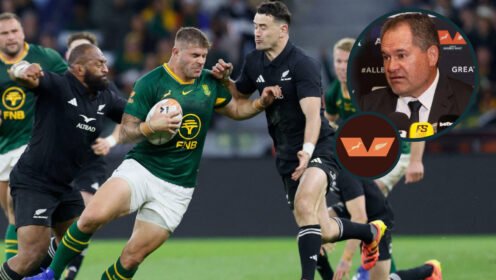
Nick Mallett’s verdict on Rassie Erasmus and Dave Rennie’s scrum spat as referee ‘abdicated’ responsibility


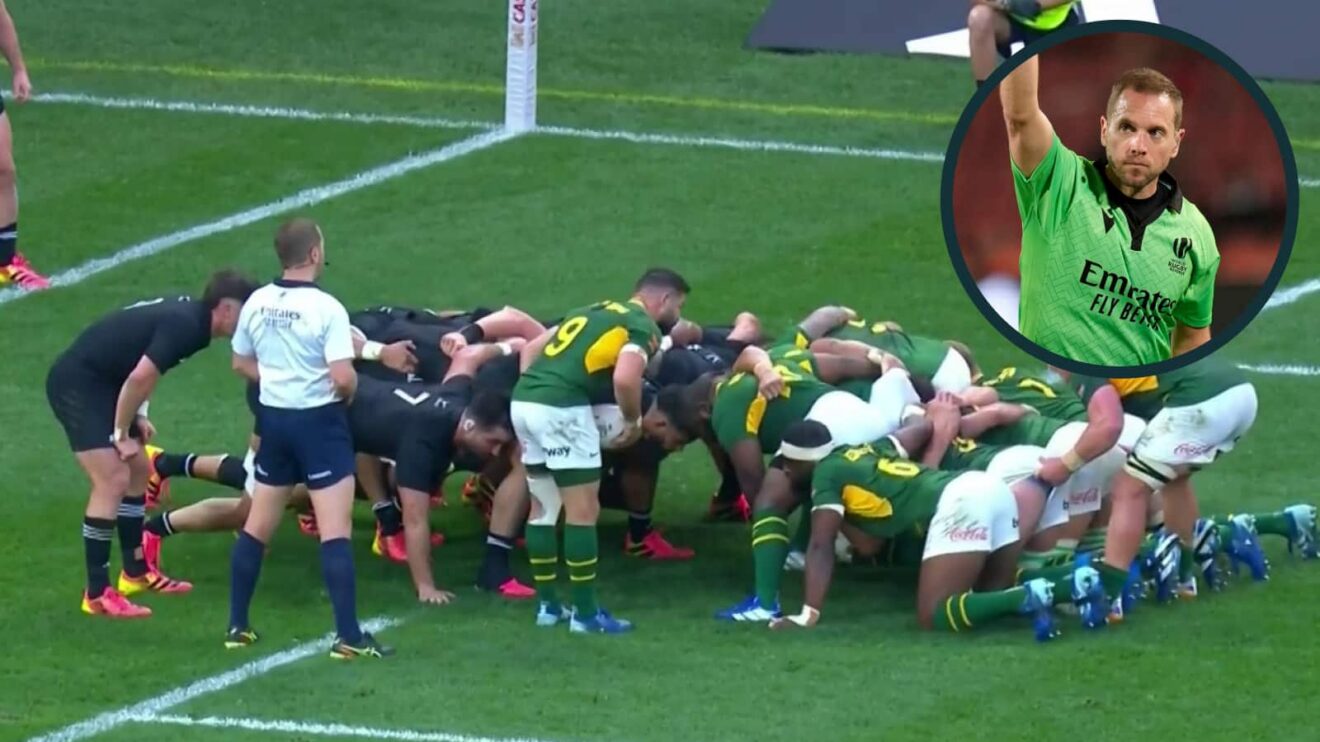
Scrum between the Springboks and All Blacks in Cape Town and an inset of referee Angus Gardner.
Nick Mallett believes that Angus Gardner abdicated his responsibility to officiate the scrums and, in doing so, nullified a weapon of the Springboks.
New Zealand conceded just two penalties throughout the 80 minutes of the second Test of Rugby’s Greatest Rivalry series despite South Africa putting the All Blacks’ set-piece under pressure.
Rassie Erasmus boldly changed his entire front-row an hour before kick-off on Saturday, with the lighter trio of Gerhard Steenekamp, Deon Fourie and Thomas du Toit taking the starting roles with Ox Nche, Malcolm Marx and Wilco Louw switching to the bench.
This led to far more even scrums for much of the first half, though Erasmus did complain in the post-match press conference that the visitors weren’t penalised for collapsing the set-piece. That came after New Zealand boss Dave Rennie accused the hosts of ‘walking around’ in the scrums, blaming the Boks’ loosehead props.
Still, the penalty count against the All Blacks in the second Test read at just two; one was an advantage that Jesse Kriel scored off of, a stark difference to the six they conceded at Ellis Park the week prior.
Angus Gardner managed the game and players
According to former Springboks head coach Mallett, the lower penalty count was because referee Gardner wanted the set-piece as a manner of restarting the game and didn’t want it to play a major role in the outcome of the match.
While he was critical of the referee, who took charge of the game in place of the ill Nika Amashukeli, he said that the Australian official did allow the result to be decided by the players and not his decisions.
“You can say that the referee managed the game a lot, managed players and coached players out of bad positions, but a game with only four penalties against the Springboks and eight against the All Blacks – that was nice to see. The game was won by the players,” Mallett remarked on the Talking Boks podcast.
When the conversation moved to the scrums, he added: “I just felt that Angus Gardner didn’t want to have to adjudicate on who was dominant in that area of the game. He wanted the set piece to restart the game, and if a team managed to get the ball to the number eight, even if that front row just pancaked and went to ground, which is illegal, you’ve got to stay on your feet, he said, ‘play on.”
Mallett believes that the penalty count against the All Blacks should have been similar to that of the fixture at Ellis Park, especially once Nche and Marx were introduced. While Erasmus dropped the duo to the bench before kick-off, he threw them both into the mix at a crucial point in the first half with the Springboks having the feed to a scrum inside the All Blacks’ 22.
All Blacks got lucky in the scrums
The two penalties South Africa won at scrum time came when that change happened. They won a penalty with the first feed and attacked with an advantage from the second, which led to the try for Kriel.
“The All Blacks got lucky with that. They were able to avoid three or four penalties in that area of the game,” Mallett said, referring to Gardner’s reluctance to reward dominant scrummaging side.
“I will say that in the beginning of the game, with our lighter front-row and their starting front row, they scrummed well in that first half. There was a lot of parity there. That set the tone for Gardner, he thought, ‘Okay, fantastic, now it’s a game where I won’t have to make some really tough decisions.’
“Then of course when Marx and Ox came on, there was a real bloody difference in terms of momentum. He gave two penalties quickly, but the second one was called by the touch judge because I heard him say, ‘Can you give me the picture? Who was it who went down?’ He wanted to know why there was a penalty there and why the assistant referee had called it from his side.
“At the end of the day, he just wanted it put in, get the ball away, and let’s move on; it’ll be interesting to see if that continues with the Georgian referee at the FNB Stadium. It took away what has always been a real weapon of ours, and there were several scrums in that game where we could have done the double shove, but we weren’t given the reward. So, a fine performance despite not getting the advantage from penalties at scrums, and also getting the penalties where we could kick them over.”
Nick Mallett on Dave Rennie and Rassie Erasmus’ spat
As mentioned above, both Rennie and Erasmus addressed the officiating of the set-piece, with the latter getting rather animated in his response to the former’s accusation of the Springboks’ loosehead walking around in the set-piece.
Mallett believes that it was the touring team that kicked off the tension with their comments before the Test series, stating that South African teams like to slow the game down.
“I think it started well before the New Zealanders started talking about illegal scrummaging or walking around. It started right at the beginning of the tour, when they said that South African teams like to walk from set piece to set piece, and we slow the game down to our pace,” he said.
“The chatting to the media about your concerns about the opposition started with the All Blacks. It didn’t start with South Africa; there was nothing said until the week before [the first Test], when Rassie felt, ‘Okay, well, if he’s going to chat about it then we’ll also chat a little bit about our concerns’,” he said.
“But on that scrummaging issue, it is something that I’ve been concerned about from World Rugby: they are doing their best to tell the referee that if the side goes backwards and goes legally backwards, there’s no penalty just because you go backwards, but if you can hook or hack the ball out as best you can – it’s not a penalty. It’s only if you collapse it under pressure or if you walk around and wheel it.
Want more from Planet Rugby? Add us as a preferred source on Google to your favourites list for world-class coverage you can trust.
“Victor Matfield did a very good piece on SuperSport where he showed that penalty against Steenekamp, but he shows it from the side of the Springboks’ tighthead. Their loosehead is at an angle right at the very beginning of that scrum and is walking around on our side, and Steenekamp gets penalised because if you walk around on one side, it’s almost impossible not to walk around on the other side.
“Rassie said the whole week that the referee got that decision right, but my issue was that I don’t think he did. It definitely started with the All Black loosehead walking around.
“The benefit that New Zealand got from having the scrum refereed in a way where Angus Gardner didn’t want to have to penalise – he just wanted the ball put in and won by the side putting it in – was a huge benefit to them. So I think it is important how the referee manages that in the next game.
“It’s definitely a strength of ours, and it is in the laws that you are allowed to have a good scrum, and you are allowed to put pressure on the opposition, and if they can’t handle your scrum, you get a penalty and until they change that law I’m sure South Africa is going to continue to try and and win an advantage in that area.
“It shouldn’t be negated by a referee who’s coaching that situation and literally nullifies it and abdicates responsibility there.”