Springboks v All Blacks: The truth about the Cape Town scrum as Dave Rennie’s ‘walking around’ charge runs into Ox Nché’s hips


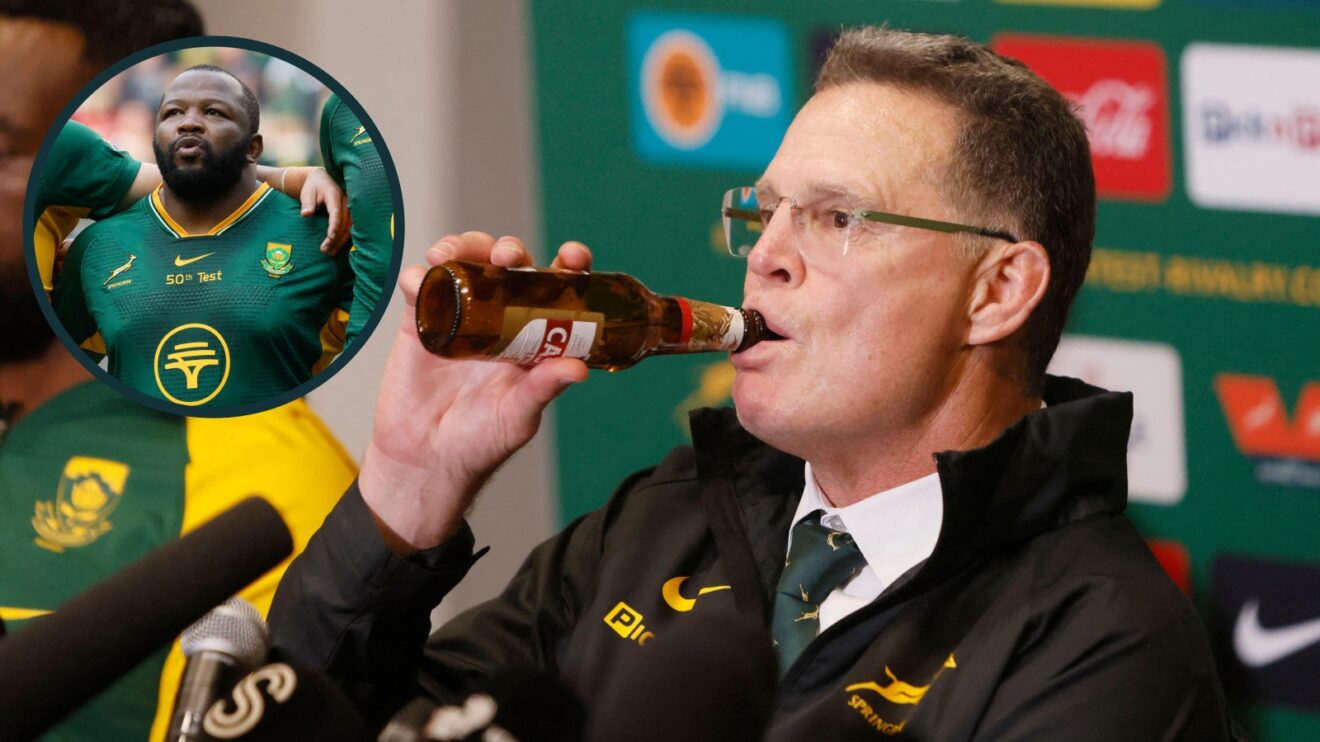
Springboks v All Blacks: The truth about the Cape Town scrum as Dave Rennie's 'walking around' charge runs into Ox Nché's hips
One scrum penalty for South Africa in Cape Town, six a week earlier at Ellis Park, and two coaches who left DHL Stadium telling completely different stories about why in a tense presser. Here’s what was actually going on in there.
The top line
Let’s just examine the legal arguments presented. For the Prosecution, Dave Rennie says the Springboks walk around and go straight through his tighthead, and that Angus Gardner did well to set a mark and keep the hookers in matching spacing.
The Defence barrister, Rassie Erasmus, says nobody in the history of the game has accused South Africa of walking around, that New Zealand’s first six scrums on their own ball collapsed and were reset every single time, and that his men scrum through rather than around.
Erasmus’s best argument wasn’t the first-time-in-history line; it was the quieter one underneath it. These front rows have been packing down together for years, in front of every referee in the game, scrummaging the same way throughout, and nobody has levelled this charge at them before. If the technique hasn’t changed and the accusation is new, then whatever changed isn’t the technique, which does, on the surface, appear odd.
His second claim was the more testable one, although you have to ask if it entirely holds? He asked why the scrum collapsed every time only on New Zealand’s ball, but the longest collapse cycle of the night came immediately after half-time and, on the available accounts, not on a New Zealand feed. The record is only partly reconstructable in print, and what can be reconstructed doesn’t quite say what he says it does.
Both men are describing something real, but, rather paradoxically, neither is describing what actually happened, and the explanation nobody has offered is a good deal more interesting than either version.
Springboks: Rassie Erasmus calls for improvement in key area against ‘brilliant’ All Blacks
A scrum is a chain, and you attack a link
Close to two tonnes engaged at once, but mass alone tells you little unless the force can travel. Ground, feet, knees, hips, spine, shoulder, bind, opponent. The research on scrum force has been consistent for years that sustained push tracks body height, joint angles and collective timing at least as closely as it tracks the number on the scales, which is why South Africa’s 923kg against New Zealand’s 915kg, more than 900kg a side and barely eight kilos between them, settled absolutely nothing, other than BMI scores, before kick-off.
Every trick in the set piece attacks one link in that chain, and the good ones are almost invisible. World Rugby asks both packs to stay square and stationary before the engagement, to hold the bind they started with, and to push straight and parallel to the ground. Almost everything that goes on in there is an attempt to break one of those three requirements whilst appearing to satisfy all of them.
What Rennie is actually alleging
Not eight men marching sideways, which is what most people hear.
His charge is that South Africa set fractionally to their left, so their hooker is no longer square to his opposite number at the referee’s mark. That leaves the New Zealand tighthead separated from his own hooker and from the lock behind him. Then the Boks change direction and drive forward through a man who is, at that moment, on his own.
The word for it is shear. The tighthead takes pressure along one line whilst his support arrives along another, and once his shoulders or hips turn even slightly, a perfectly legal-looking straight shove finishes him off. It is the oldest trick in the book, one perfected by Wallaby Bill Young, a man who avoided actual scrummaging in the same manner labradors avoid dietary planning.
Which is why Rennie praised Gardner rather than complaining about him. Set the mark, hold the hookers opposite one another, stop any drift to the left, and the manoeuvre can’t get started.
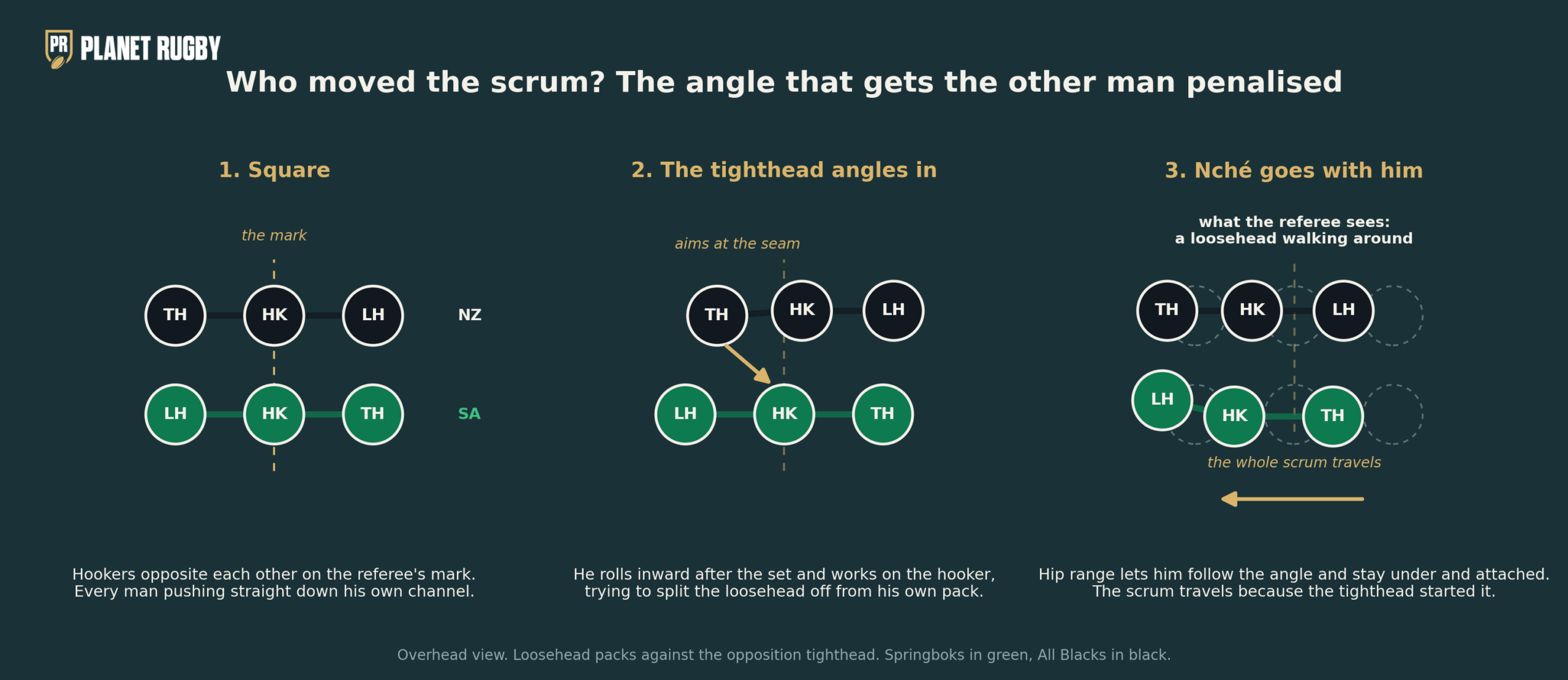
Who moved the scrum: the angle that gets the other man penalised.
Why Ox Nché makes the charge look true
One tighthead response to a strong loosehead is to attack the connection between the loosehead and his own hooker. The legal version is to stay square and work that seam. The darker version is to roll inward after the set, drop the outside shoulder and apply pressure towards the hooker rather than through the opposing prop. Either way, it leaves the loosehead with two bad options: hold square and get split from his own hooker, opening a gap that kills the unit, or follow the angle and lose his own squareness, at which point he’s boring in, or he’s lost the bind, or he’s on the floor, and the penalty comes to you.
Nché is unusually capable of resisting both, and he does it with his hips. His rotational range lets him follow the angle a tighthead sets whilst keeping his spine alignment and his connection to his hooker, so he goes with the man and is still underneath him when he gets there. At 1.76m he can also operate beneath a taller tighthead without manufacturing that height by folding at the waist, which is a mechanical advantage rather than a complete account of how he scrummages.
Follow that through and the tighthead does the work of changing the geometry, gets nothing back for it, and the scrum travels sideways through overall momentum.
If the initial angle came from the tighthead, the loosehead can follow it and end up looking responsible for a movement he never began, particularly to a referee who can only see one side of it. That is the alternative explanation South Africa would advance, and it is a hypothesis rather than a finding, because nothing in the public record establishes who initiated the movement in any given scrum.
Victor Matfield made the same argument from the other side of the scrum after Ellis Park, where Gerhard Steenekamp was penalised for walking around on South Africa’s own feed. Matfield’s read was that the New Zealand loosehead came in on an angle, that Wilco Louw stayed straight, that the whole thing stepped left as a consequence, and that the side which followed it got blamed for causing it.
It also explains why the accusation attaches to Steenekamp rather than to Nché. At 1.94m with long levers, he hasn’t got the rotational answer, so he gets displaced instead of travelling, and displaced looks guilty too.
The height ambush
Nché wasn’t on the field for the first thirty-six minutes, and that was the point.
Tyrel Lomax is 1.92m and 127kg. Steenekamp is 1.94m and 128kg. For two thirds of the half, Lomax packed down against a man his own size, chest to chest, which is exactly where a tighthead wants to be, setting high, binding over the top and driving down, and he grooved a body height doing it.
Then, for a five-metre attacking scrum in the thirty-fifth minute, Erasmus sent on a loosehead sixteen centimetres shorter with elite hip mobility. Nché and Malcolm Marx arrived, South Africa won their only scrum penalty of the night, took another scrum rather than the three points, and Siya Kolisi scored three minutes later.
At Ellis Park, Nché had taken Lomax apart, and Steenekamp was the man who got pinged. Erasmus knows both of those things better than anybody, and his use of Ox was considered deliberate and pivotal.
Then there’s the grass
DHL Stadium has previous, here. The 2022 Test against Wales was widely slated for a surface that gave way underneath the players, running described as treacherous, both sides losing men to injury, and a conspiracy theory doing the rounds that the pitch had been prepared to suit a forward-dominated game. The ground moved to a hybrid surface in 2023, which blunts the older complaints, but it’s still a dual-use football and rugby bowl on the Atlantic seaboard, and a five-past-five kick-off runs straight into evening dew forming on a root zone that stays firm underneath.
That combination is the worst case for a set piece. The top layer greases, the studs skate on the hit, nobody gets the purchase to drive, and more than nine hundred kilos a side folds without anybody doing a single illegal thing.
One scrum went down four times in succession and consumed close to four minutes. Gardner spoke repeatedly to both front rows, moved the mark to fresher grass and ordered them to stay high before eventually free-kicking Nché for moving his head inward. Damian Willemse had already slipped taking a clearance in his own half and been forced to call a mark.
The surface is the most persuasive non-conspiratorial explanation for at least some of that instability. It isn’t the walk-around and it isn’t a non-engagement pact, and neither coach reached for it because neither had the slightest use for it.
Who was right
Well, the argument’s been amusing, but the votes are in, and we reckon Rennie had the better mechanics and Erasmus had the better outcomes.
The manoeuvre Rennie describes is real, it works, and it’s illegal when it’s deliberate. Gardner took it seriously enough to referee the setup rather than the shove, and setting a mark and policing hooker spacing removes a loosehead’s ability to travel with an angle at all.
Constraining Nché’s best attribute at the point of engagement was a better outcome for New Zealand than any penalty count would have been.
But one penalty against six is not the record of a pack winning a Test through the alleged manoeuvre, and a low count establishes what the referee detected rather than what happened. New Zealand got usable ball off most of their own feeds, including the platform for the late surge, and if the Bomb Squad had dismantled them once the full reserve front row was on, those feeds would have produced retreats and turnovers instead of clean possession.
Erasmus thinks the argument was never about scrummaging at all. His view is that if the opposition are briefing the media about your technique, they’re under pressure, and the four head contacts he counted in the first forty minutes went unmentioned by everybody until he raised them himself.
There’s an irony in that, which New Zealanders will enjoy rather more than South Africans. The man objecting to a coach shaping the refereeing conversation through the media is the same man who, during the 2021 Lions series, put out an hour-long video dissecting twenty-six clips of Nic Berry’s refereeing, was suspended for it, and changed how every coach in the game has behaved since. He also asked, in this same press conference, not to be clipped, and requested that the whole answer be run rather than the headline at the end of it. He apologised afterwards for the language. He did not apologise for any of the content.
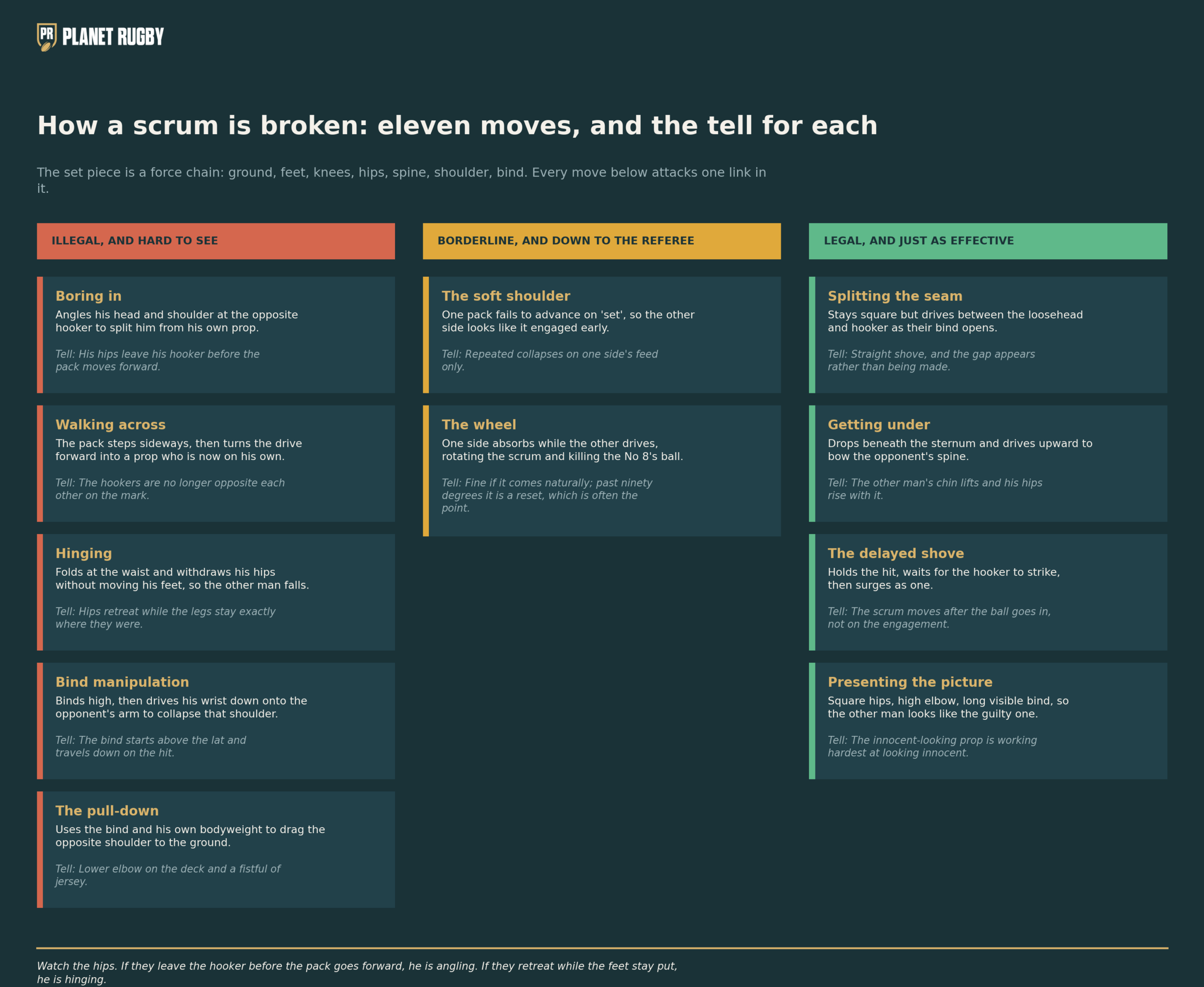
How a scrum is broken: eleven moves, and the tell for each.
Soweto
All three factors that suppressed the scrum in Cape Town may change in Soweto.
FNB Stadium is firm Highveld ground with real purchase, so a loosehead can hold an angle rather than skate off it. Nika Amashukeli has the whistle, having missed the entire Cape Town build-up with illness, and he will bring a different cadence and a different set-piece interpretation. He will not, however, arrive uninformed, because Gardner drops to assistant referee alongside Christophe Ridley, Eric Gauzins moves to the TMO and Brett Cronan to foul play review officer, and a fortnight of public argument has made sure the alignment question announces itself.
And if Nché starts, Lomax gets the low man from the opening scrum and can set his height for it throughout his starting stint, rather than having it changed on him at the thirty-sixth minute.