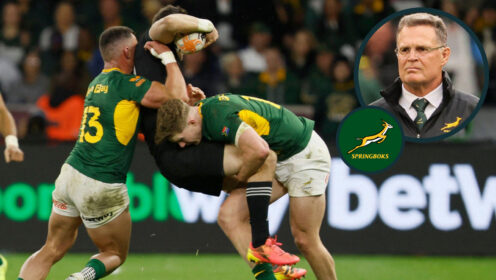
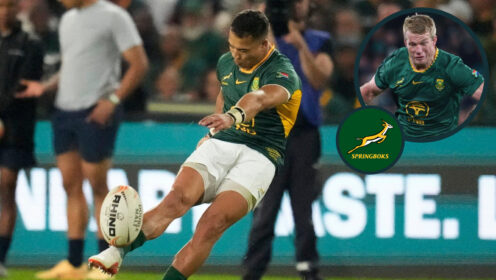
Springboks v All Blacks: Seven things we learned as Rassie Erasmus’ front-row switch squares Rugby’s Greatest Rivalry


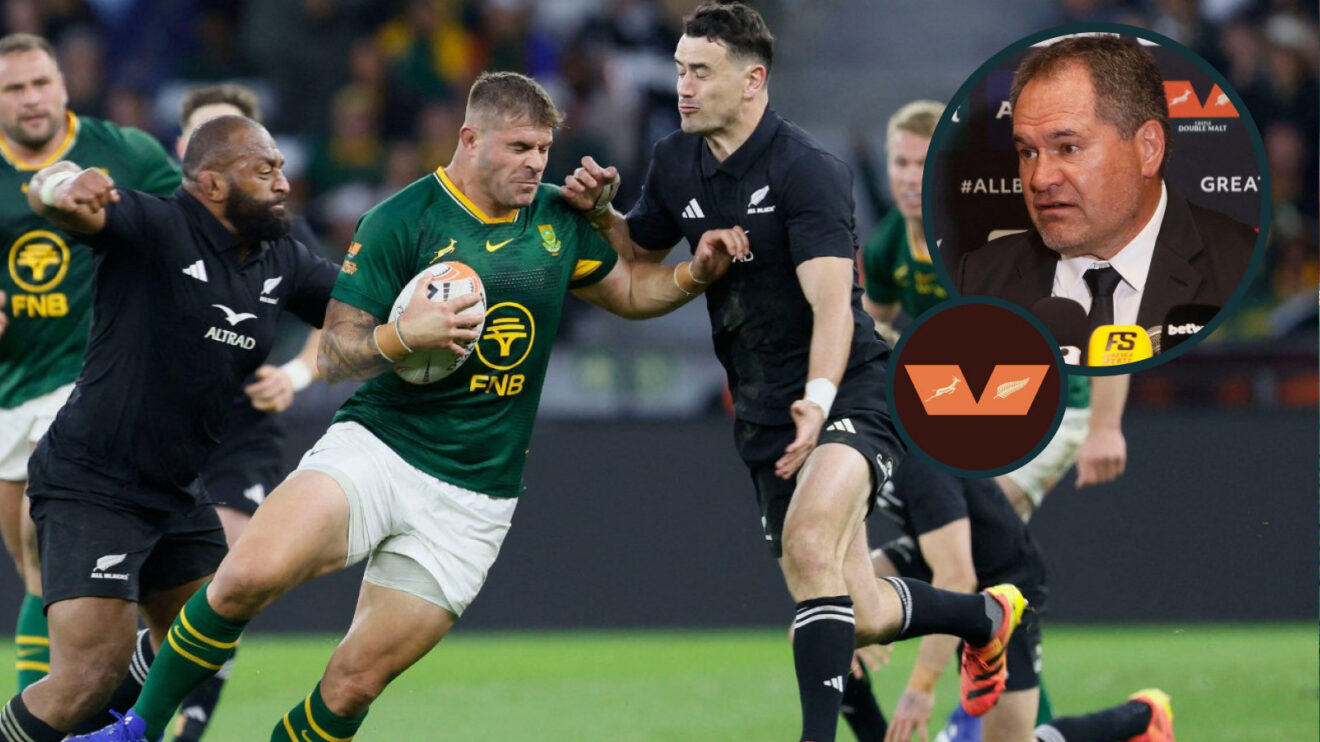
Springboks hooker Malcolm Marx takes on the All Blacks defence and New Zealand's head coach Dave Rennie (inset).
Following the second Test of Rugby’s Greatest Rivalry series, here are the seven things we learned from the thrilling action at the DHL Stadium in Cape Town on Saturday.
It finished South Africa 33, New Zealand 26. For the second Saturday running the Boks lost the try count, but this time they won the Test anyway, courtesy of Cheslin Kolbe boot.
The top line
Start with the aeroplanes.
Airlink have painted two Embraers for this tour, one green, one black, and they came over the stadium before kick-off at a height that split the internet clean down the middle.
Half of it purred, but, rather predictably, the other half went looking for the National Transportation Safety Board incident report form, and having watched it back about nine times, you can understand why.
Nobody fancied the safe option after that; when Jordie Barrett caught the kick-off he put it straight into touch rather than take the first collision of the evening, perhaps mindful that one of the jets might be coming around for a second circuit.
Here’s what should worry both coaching boxes. South Africa‘s three tries came off a maul, off a maul, and off a five-metre scrum. New Zealand‘s four came off two lineout strikes, a kick return and a pick-and-drive in the last minute.
Between them these sides created nothing from structured multi-phase attack; both score from set-piece and from chaos, the defence speed has reigned supreme, a testimony to the organisational work of both coaches.
Cheslin Kolbe’s boot made the difference
Seven kicks. Seven successes. Eighteen points.
Three of those penalties made up the entirety of South Africa’s second half, and Kolbe hasn’t been this team’s designated kicker for very long, so his newly found role is good news for SA. However, he wasn’t flawless elsewhere; an early sliced clearance handed New Zealand the lineout that led to Cam Roigard’s try.
Compare it with Ellis Park, where the Boks bullied the scrum, got into the 22 again and again and came away with 16 points. Here they had less ball, less second-half territory and scored 33, their first three entries producing points every time, a lot of that down to the pragmatism of taking the points on offer.
But look at what that rests on. The world champions won a Test on a hundred per cent goalkicking from a 32-year-old wing who has the tee because Handre Pollard has a calf strain, and on three tries from within five metres of the line. Take two of those penalties away and it’s a one-point game; take three and New Zealand win.
Their points model is maul, penalty, maul, and it works beautifully until the night the kicking lets them down. At altitude at FNB they need a second way of scoring and that wasn’t obviously forthcoming.
They also conceded one penalty by the 62nd minute, absolutely outstanding, which for a side accused all week of slowing the game down is a fairly loud answer.
The front-row lineout
Monday’s front-row: Ox Nche, Malcolm Marx, Wilco Louw.
The sheet that arrived 45 minutes before kick-off: Gerhard Steenekamp, Deon Fourie, Thomas du Toit, with the advertised three suddenly on the bench. Desks all around the world scrambled for re-writes, prediction and form guide writers groaned and sucked their teeth with annoyance.
Nobody has done that in top-flight international rugby before. It’s skelm (sly), inside the letter of the law, and there is exactly one coach on earth who would have thought of it.
The reason given afterwards was the weather; wet forecast, heavy front-row, then the ground dried out. Which kinda makes sense.
Believe that if you like.
Fourie is a month short of 40, an old ‘doring’, and a hooker who spends most of his club rugby in the back-row. What he gave them was a fast, mobile thrower and an extra loose forward in the maul.
He hit his first two jumpers, the maul went 15 metres and Jesse Kriel was over inside two minutes; both of the first two tries came from that source. The scrum, meanwhile, went from six penalties won at Ellis Park to one, with South Africa managing only 75 per cent of their own ball.
So Rassie Erasmus traded his best weapon for a faster start and better lineout ball, and won by seven. Whether he repeats it at altitude, where the scrum matters more and the legs matter less, is the selection question of the week.
Every announced Springbok front-row for the rest of this series should now be read as a working draft and a memo has been sent to the shirt printer to ‘not get too excited’.
Malcolm Marx was the bench call of the series
Look at when the changes came, not what they were.
Steenekamp and Fourie went off before half-time. Nche and Marx came on and won a scrum penalty almost immediately, then Marx won two breakdown penalties in the second half. Kolbe kicked both.
Six of the seven-point margin therefore came from penalties won by a hooker introduced four minutes before half-time. New Zealand’s own match report concedes their replacements brought nothing comparable; that isn’t a Saffer writer’s spin, that’s the All Blacks’ website.
The Bomb Squad argument used to be about weight arriving late to hurt tired men, but this is sharper deployment. Winning penalties at the breakdown is a fresh forward’s skill, and coaches say that the window in which a referee still rewards the jackal can be measured; it comes just before the game goes loose and he waves play on, running roughly from the 45th minute to the 60th. Erasmus put his best jackalling hooker into exactly that window and took six points out of it.
Which gives Rennie a straightforward instruction for Soweto. Move the first change forward. Marx and Nche were on by the 36th minute, New Zealand’s front-row replacements did not arrive until around the 48th, and Kolbe kicked his penalties in the 48th and the 50th. Concede that head start every week and, on this evidence, you concede the match.
Rennie got the refereeing picture he wanted, which is why Rassie will go harder
Dave Rennie praised Gardner’s handling of the set-piece. Then he said South Africa were still able to walk around and go straight through his tighthead.
Erasmus was told about it at his own press conference and went from cheerful to volcanic in roughly four seconds. Nobody in history, he said, has accused South Africa of walking around, so why did New Zealand’s first six scrums on their own ball collapse and get reset, every single time?
He doesn’t come with that nonsense, and he isn’t going to moan about it either, though his version carried a stronger and unprintable adjective, especially if your Afrikaans is fluent.
Set the theatre aside and look at the number. Six scrum penalties to South Africa at Ellis Park, one in Cape Town. That’s a five-penalty swing inside seven days, and at Test level five penalties is somewhere between nine and fifteen points of scoreboard and field position.
Rennie spent 10 days telling anybody who would listen that the Boks wheel and walk, and whatever you make of that, the set-piece was refereed differently on Saturday.
So, the media week is a live tactical lever, worth more than most training sessions, and on this evidence Erasmus has been beaten with it by a man five months into the job.
He noted afterwards that Rennie will now feel what South Africa felt a week ago and the All Blacks, we assume, will take that as a warning shot.
New Zealand mended one set-piece and broke the other
The scrum was fixed, and properly. Every All Black put-in won, against 75 per cent for South Africa, and George Bower’s promotion from the bench looks right twice over. But then the lineout, more or less, lost them the Test.
Codie Taylor had a rotten night with the darts, missing throws in the first half including one with New Zealand hot on attack in the red zone, and Asafo Aumua came on and lost a key one inside the 22. Fifteen from 18 reads respectably but the key misses were howlers that cost the All Blacks so much more than the stats suggest.
That’s because the lineout is New Zealand’s attack. Both first-half tries came off first-phase strike, Roigard’s from a double-pump move that dragged the Bok defence in, McKenzie’s from Ardie Savea charging onto a ball off the top.
It is their only reliable source of clean ball against a set South African defence. Just past the hour they built fourteen phases, won the penalty, kicked to the corner and watched Eben Etzebeth pinch the throw.
Rennie called the lineout a work-on. He was being kind, and Taylor at thirty-five is a genuine selection call now rather than an automatic one.
All that ball, and nothing to show for it
Fifty-seven per cent possession. A hundred and fifty-four carries to a hundred and four. Two hundred and forty-six passes to ninety-three. Eight line breaks to five, yet, in the final analysis, beaten.
South Africa made 188 tackles and missed 39; New Zealand made 122 and missed 26. One side is happy to hand you the ball and back its collisions, the other wants it in hand and trusts that width will eventually tell, and on the highveld the second theory won at a canter. At sea level it didn’t, because the Boks arrived at the contact point in numbers and quicker than they had a week earlier, led brilliantly by Jesse Kriel in the 13 channel.
The uncomfortable conclusion for New Zealand is that despite eight line breaks they scored only 26 points, and three of the four tries came from set-piece or a kick return. They break the line and then run out of ideas, because the second defender has to come from somewhere and the Bok scramble is built to make you take one more carry than you wanted to.
The speed of the blitz pushed New Zealand sideways all evening, and they never solved it. None of which makes them a bad side. Roigard and Ruben Love were excellent whenever the tempo went up, and Leroy Carter’s 65th-minute finish was the best try of the night by a distance.
Want more from Planet Rugby? Add us as a preferred source on Google to your favourites list for world-class coverage you can trust.
Siya Kolisi is now a 40-minute Test player
He missed Ellis Park, yet you could see the difference inside two minutes.
Kolisi scored three minutes before the break from a five-metre scrum and roared about it, which summed up the South African first half. Then he klapped Savea off the restart, his mate and his church companion from last Sunday, with a hit they’ll still be discussing in the Cape at Christmas.
Then he came off in the 42nd-minute for Andre Esterhuizen and South Africa saw it out, albeit outscored 12 points to nine after the break and defending a possible draw after the hooter. At 35, Kolisi is being selected as a 40-minute captain who sets the tone and hands it over, but what he does in that time is set the agenda, the culture and the belief.
Around him, Pieter-Steph du Toit played his 100th Test with the work rate of a man on his 10th, and Ethan Hooker was outstanding in the air from the first Cobus Reinach box kick onwards, enough to hold the 11 shirt for the rest of the series. Sacha Feinberg-Mngomezulu moved to full-back when Damian Willemse didn’t reappear, with Manie Libbok taking over the attack, and he looked better at 15 than he had at 10, which is a thought Erasmus will have had too.
The last act was Esterhuizen turning Will Jordan over near halfway, with Lood de Jager in the bin for head contact on Carter, which is worth a nervous glance towards the citing commissioner.
South Africa are back to number one in the world after a week without it, and they haven’t lost back-to-back home Tests to the same opponent since the Lions in 1997. Third Test at FNB Stadium in Soweto on September 5, fourth at the M&T Bank Stadium in Baltimore on September 12, where these two countries have never played each other.