Munster v Glasgow: Five takeaways as ‘Scottish bench makes crucial difference’ with ‘fierce rivalry reignited’


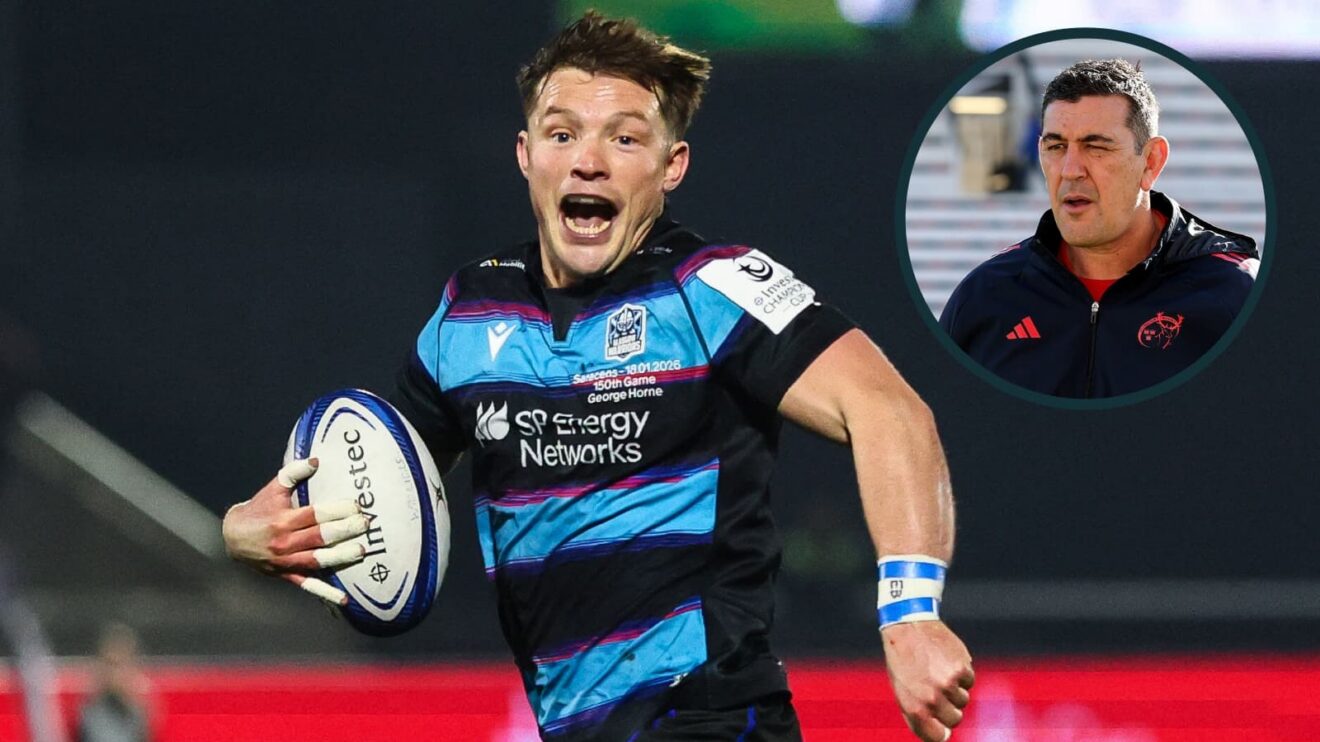
George Horne was a match-winning influence for Glasgow and, inset, Munster coach Clayton McMillan
After a 26-20 victory for Glasgow over Munster in their United Rugby Championship (URC) clash at Thomond Park on Saturday, Planet Rugby selects five takeaways from the opening-round action in Limerick.
The top line
This was a feisty contest where the outcome left the visiting Glasgow jubilant. It was only 12 minutes from time when the winners finally hit the front, and their joy was unconfined after they went to clinch a four-try bonus point just before the finish.
The Scottish bench made the crucial difference, its impact gradually eating Munster’s 10-point interval advantage, and by the time the final whistle sounded, the hosts couldn’t really complain as they had run out of gas and the level of infringement spun out to a damaging level.
It was Munster who had got the scoreboard moving with JJ Hanrahan’s early penalty kick punishing an offside, and they went on to ‘win’ the Ollie Smith deliberate knock-on sin-bin 7-0 with a neatly executed 14th minute try.
Hanrahan’s 50:22 kick presented a lineout opportunity, and the resulting strike play featuring Ben O’Donovan on the wraparound ended with Ben O’Connor easily making it to the line.
Glasgow’s attack was essentially non-existent, and they were relying on a couple of turnover penalties to keep their defence intact, with Munster’s confidence growing in their snappier brand of play.
The Warriors eventually woke up, and a 31st-minute converted maul try, finished off by Jamie Dobie’s snipe, cut the gap to three points. However, the visitors then fell foul of referee Morne Ferreira, and the consequence was a 36th-minute converted try from Michael Milne for a 17-7 interval advantage.
This was reduced to three again when sub Nathan McBeth finished off an attack founded by fellow replacement Seb Stephen’s dance through the cover for a converted 51st-minute try.
The margin was pushed out to six through Hanrahan’s 58th minute penalty kick, but Glasgow then took complete control after a scrum penalty came their way four minutes later.
Dobie’s break fractured the Munster defence on 68 minutes to invite George Horne to dive over and the winger was scoring himself eight minutes later to settle the result and reward the pressure instigated by Brian Gleeson’s ruck penalty concession.
Want more from Planet Rugby? Add us as a preferred source on Google to your favourites list for world-class coverage you can trust.
Munster finesse
Following last season’s discontent on and off the pitch, Clayton McMillan’s second season in charge was viewed as a fresh start for Munster. There will be grievances over how they faded in the closing 20 minutes; losing at home is never an easy thing to swallow, but there were green shoots in the opening hour that will give optimism.
Of particular interest was their decision to have two new assistant coaches, Jared Payne and Mossy Lawler, in charge of the attack. While Munster appeared to run out of ideas with their bench failing to add second-half energy and impetus, their first-half approach was refreshing.
They were up to mischief right from the off, swiftly attacking from a scrum on halfway to reach the opposition 22, and the advance tempted Glasgow offside at the cost of three points. Plenty more examples materialised to highlight how their approach to using the ball has been finessed, and their handling skills also looked sharper.
For instance, there was a smart O’Connor offload on hitting the ground to the supporting Hanrahan after the winger had gobbled up a Kyle Rowe kick and countered.
Time will be needed to make even more of an improvement, but this first glimpse was decent. It had them in a winning position before they visibly tired and the penalty count against them became a wounding, unmanageable 15-8.
Momentum-shifting Warriors
Coming off the back of a season where their double trophy dream was firebombed by home losses to the Bulls (21-20 in URC) and to Toulon (22-19 in Europe), getting over the off-season hump can’t have been comfortable for ambitious Glasgow.
An incredible amount of hard work getting themselves into great seedings for the play-offs had gone up in smoke and for a long time in Limerick, it seemed as if there was a hangover lingering into this new campaign.
Their respected attack play came across as clunky and ineffectual, but the upside to Glasgow’s useful habit of winning way more games than they lose under Franco Smith is they have an ability to keep calm in the knowledge that they can turn backs-to-the-wall situations around.
That was certainly the case here. Munster had bounced into the interval, buoyed not only by their lead but also by how the stopped a Glasgow maul producing a score in the final play.
That fizz should have kept them bubbling when the match resumed, but instead it was Glasgow who knew what they were about and understood how to manipulate the situation they were in.
There were momentum-shifting scrum penalty wins, and they also had a clutch of players who carried harder than what Munster could offer. It said a lot about the energy-sapping contest they created that five home players had to make 20 or more tackles, whereas the busiest visiting tackler was credited with 16.
Add in the potency of Horne and Dobie when it came to exploiting even the tiniest of gaps and the mix became too much for McMillan’s side to cope with.
Warriors’ ambition was such that instead of going for the posts for a certain three points to extend their lead to four, they had the swagger to kick to the corner and turn the ensuing pressure into a try on the other side of the pitch. Well played.
Rivalry reignited
It was January 2016, eight months after they had clashed in the 2015 league final in Belfast, when the fierce rivalry between Munster and Glasgow really ignited.
The Irish accused the Scots of skullduggery, repeatedly targeting the standing leg of Conor Murray, and the niggle carried over into an October follow-up in Europe where Munster’s Keith Earls was red-carded.
Munster’s recent decline had diluted the needle, but Saturday’s collision fired things up again. The South African ref had already issued a warning to both teams over their use of foul language, and a spiky row followed before the interval.
With Munster debutant Kieran Brookes awarded a scrum penalty after a Glasgow put-in, scrum-half O’Donovan went to wrestle the ball from George Horne to try and tap and go.
This face-off resulted in Matt Fagerson shoving O’Donovan over from behind, an intervention that sparked the schemozzle that ended with Glasgow penalised another 10 metres on top of the scrum penalty award, and a warning was given that the incident was “not true to the values of this game”.
It was costly for the visitors, as Munster were soon burrowing over for their second try after the play restarted, but the dust-up was a reminder that these two clubs do not like each other.
Ireland’s opening-round blank
It’s only one round of matches, but the sight of all four Irish provinces getting defeated this weekend suggests this URC campaign is going to be incredibly hard-fought.
Munster versus Glasgow in Limerick, Ulster versus Edinburgh in Belfast and Connacht versus Stormers in Galway all resulted in away victories, and title hat-trick chasing Leinster also took a box to the nose as they lost out by a point to the Lions on the road in South Africa.
It is a rare sight to see all four Irish occupying places on the table outside the league’s top eight. While of course it is very early days in an 18-match regulation URC season, next weekend’s response will be intriguing.
Connacht are away to Benetton on Friday night, with Leinster at the Sharks, Ulster at Glasgow and Munster hosting the Bulls on Saturday looking for results that will leave round one of the 2026/27 edition written off as a rare blip.