Springboks team: Five takeaways as Rassie Erasmus ‘not in the business of sympathy caps’ with squad ‘overhaul’ but head coach opts for ‘insurance policy’ bench


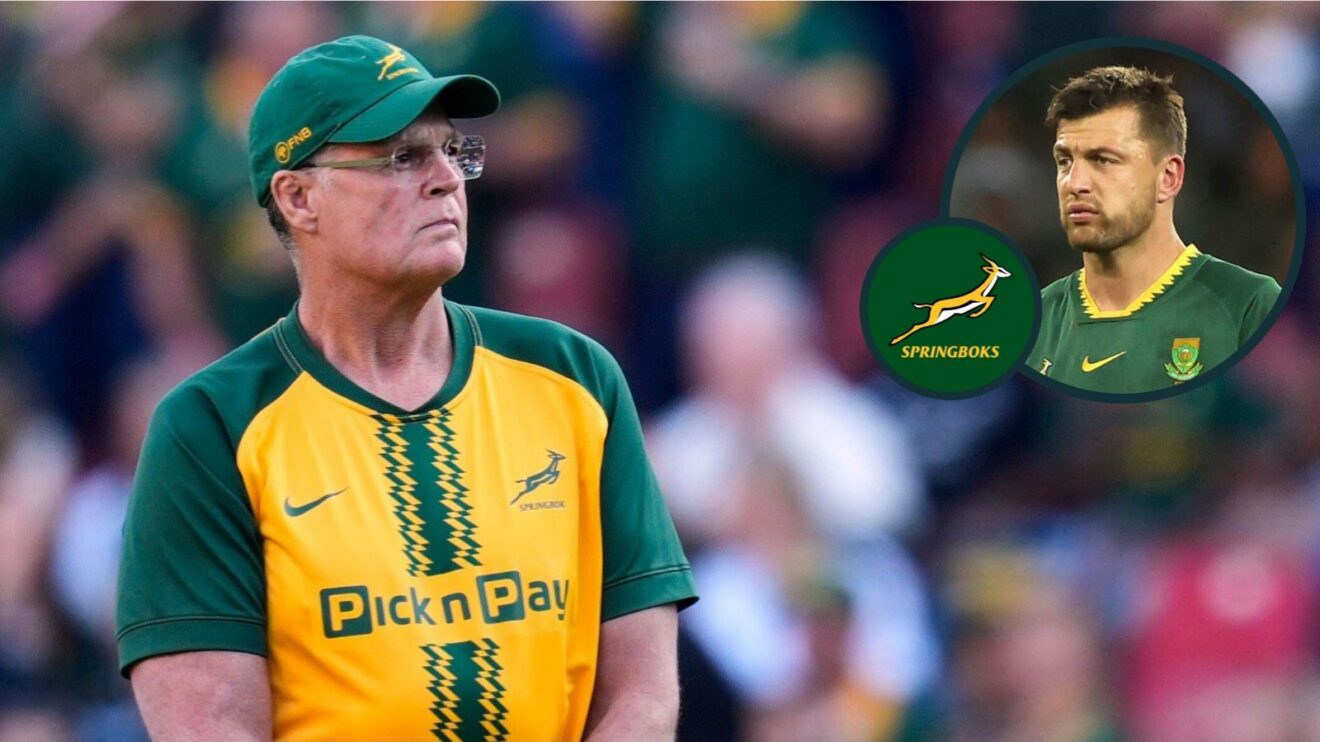
Springboks head coach Rassie Erasmus (left) with an inset of Handre Pollard (right)
By Jared Wright and Louis Chapman-Coombe
Following the announcement of the Springboks team to face Australia, here are our five takeaways from Rassie Erasmus’ selections for the one-off Test in Perth.
The top line
13 out, 13 in as Erasmus returns to type and overhauls his starting XV from the last Test match against the All Black for the meeting with Australia.
With suspension and injury sidelining Eben Etzebeth for much of this year, the most-capped Springbok of all-time starts his sixth Test match in a row as he moves to just three caps shy of 150 while his clubmate Ethan Hooker also survives the axe from the Baltimore victors.
The remainder of the team is a healthy mix of experience and youth, with the head coach offering fresh opportunities to stalwarts, fringe players, and, as per usual, ensuring there is a plan within the matchday 23.
Jan-Hendrik Wessels, Johan Grobbelaar, and Zachary Porthen take over from Ox Nche, Malcolm Marx and Wilco Louw as the starting front-row, with the latter trio dropping to the bench after their heroics in Rugby’s Greatest Rivalry series.
Etzebeth combines with Franco Mostert for the 33rd time in the Bok starting engine room as the latter returns from an injury he sustained earlier this year against the Barbarians. There is an all-new loose trio combination behind the experienced duo as Marco van Staden starts at number and he is flanked by Elrigh Louw and Paul de Villiers.
Handre Pollard also returns from injury to start at fly-half for a record-extending 67th time for the men in Green and Gold, with Herschel Jantjies named as his half-back partner, earning his first Test start since 2021.
In the centres, Andre Esterhuizen dons the number 12 jersey and does so as the 68th Springboks captain. He combines with Canan Moodie for the sixth time in the midfield while Hooker is joined in the back three by Edwill van der Merwe and Aphelele Fassi – a combination well known in Durban.
Esterhuizen’s elevation to the starting line-up means that there is a more traditional 5-3 split on the bench, with Lood de Jager and Jasper Wiese providing forward cover along with the aforementioned trio – Wiese also earns his 50th Test cap in doing so.
The backline replacements include Morne van den Berg, who was named Player of the Match in Baltimore, Sacha Feinberg-Mngomezulu and Quan Horn.
It’s a vastly less experienced team than the one that beat the All Blacks in Baltimore, with the number of Test caps in the starting XV dropping from 927 to just 527. However, there are 342 caps worth of experience this weekend, compared to 277 last time out.
Expanding the leadership group
Much has been made about the ageing profile of the Springboks squad and the over-reliance on the old guard, but it’s obvious that Erasmus is keeping the team on its toes, with the appointment of Esterhuizen as captain being the latest example.
For Esterhuizen personally, it’s a wonderful story of a player who was once deemed surplus to requirements who now gets the opportunity to captain his country, an honour reserved for just 67 players before him.
He gets the nod despite the presence of Pollard and Etzebeth, who make up two of that 67 and would have been straightforward and understandable appointments. Instead, Erasmus is allowing a fresh voice to take centre stage in a match that is far from meaningless.
The appointment is just another reason that Esterhuizen was justified in his decision to return to the Sharks after a successful stint in England with Harlequins. He was a dominant force in PREM Rugby but was repeatedly overlooked by the Boks, who admittedly had world-class operators in Damian de Allende and Frans Steyn, with Jesse Kriel and Lukhanyo Am among the outside centre options.
Since his return to Durban, the 32-year-old has become a regular fixture in the Springboks squad, and his shift from being an out-and-out inside centre to a world-class hybrid player, moonlighting as a back-rower, has only bolstered his stocks.
It certainly feels like a left-field captaincy call from Erasmus but the signs of his ever-growing importance and reputation in SA Rugby circles have been plainly evident since he traded the Famous Quarters for the Black and White of the Sharks.
When JP Pietersen took over as at the helm of the Durban club, one of his first tasks was to get the players pulling in the same direction and his first move to achieve that was to name Esterhuizen as his captain despite more experienced and renowned leaders like Etzebeth, Siya Kolisi and Bongi Mbonambi on the payroll. Planet Rugby understands that Esterhuizen was Pietersen’s clear first choice for the role, and the decision was overwhelmingly well received by the vast majority of the team.
Want more from Planet Rugby? Add us as a preferred source on Google to your favourites list for world-class coverage you can trust.
That kind of thing wouldn’t have escaped the gaze of Erasmus and his coaching staff, particularly with the assistants helping with the transition from John Plumtree to Pietersen.
Furthermore, it’s clear that Erasmus wants to freshen up and build on the leadership group. Mbonambi has fallen down the pecking order, but since the last World Cup, Kriel has also captained the team, as have Salmaan Moerat and Pieter-Steph du Toit.
De Allende has also served as vice-captain during this time, as have Nche and Deon Fourie, and this weekend it will be Etzebeth who supports Esterhuizen.
Front-row litmus test
The Springboks scrum, and more importantly the front-row unit at the heart of it, became one of the main talking points from the Rugby’s Greatest Rivalry series. They were utterly dominant across the four Tests. They positioned themselves as the best unit in the game.
But with Erasmus ripping up the squad and giving Wessels, Grobbelaar and Porthen a go in the run-on group, it’s a chance for those underneath the defacto starting unit to show just what they can do. If they can replicate the efforts of those ahead of them in the pecking order, they could give Erasmus real food for thought. If they cannot, or if they actually lose their own scrum battle, then it’ll simply mean that unit strengthens their grip on the starting shirts.
This is a real litmus test for these men. Can they pass?
Look, there is no doubting their individual qualities; after all, they wouldn’t be near the Springboks squad if they were not outstanding players in their own right. Wessels’ selection at loosehead feels quite pointed, utilising him as an out-and-out prop this time around instead of the prop-hooker cover option on the bench and it allows him to really show what he can do in this position. Is this a sign that Erasmus is starting to view him more as a prop? Grobbelaar has found himself the victim of Marx’s sheer quality and ability to play big minutes, which then allowed Erasmus to deploy a utility forward like Van Staden or Fourie off the bench, in the Greatest Rivalry series. Still, he gets his chance to prove exactly why he is in this squad. Porthen is also quickly emerging as a real Test-quality prop, but he’s at the stage in his progression where he just needs big minutes on the pitch. He will get that in the starting group.
For them, this is a major litmus test. One, you feel, they will need to pass.
Renewed opportunities
Erasmus was always likely to bring some players who missed out on the Rugby’s Greatest Rivalry Tests back in for this one, and he’s done just that.
The front-row might be the big one, given the emphasis on the scrum in recent weeks, but Jantjies, Elrigh Louw, Pollard, De Villiers, Mostert, Moodie, Van der Merwe, Fassi and Horn all come back into the mix.
Again, this just feels like a big chance for them all to really make a point to the head coach and stake a claim for their spots moving forward. Jantjies’ inclusion at scrum-half comes at a time where Van den Berg has propelled himself up the pecking order after his exploits against the All Blacks, Pollard and Mostert return from lengthy injury lay-offs and will be keen to return to the full-gun starting side sooner rather than later, De Villiers was arguably the breakout star from the Nations Championship and will be out to show himself as the long-term option at openside for whenever Kolisi steps away from the squad, Elrigh Louw comes back into the squad amid growing competition in the back-row and with Erasmus also starting to use utility men here more often, while Moodie, Van der Merwe, Fassi and Horn need to show just how they can add to the Tony-ball attack that the Boks have returned to. The latter two also come back at a time where Erasmus is toying with the idea of rotating his playmakers between fly-half and full-back.
Erasmus is certainly open to changes and rotating his team; he’s never hidden that, but he’s also not in the business of giving out sympathy caps. If you are rotated into the side, especially after a big victory or after a successful campaign, it comes with an expectation to perform and carry on from where the previous players left off.
It’s not a handout; it’s a hand up. It’s an opportunity he wants his players to take with both hands and do with it what they please.
Insurance in place
Even with the rotation across the starting XV, of which there have been 13 changes compared to their selection from Baltimore, there is still an insurance policy in place in the form of his bench. Erasmus has simply loaded it with talent, with key generals Marx, Nche, Wilco Louw, De Jager, Wiese, Van den Berg and Feinberg-Mngomezulu picked alongside the aforementioned Horn.
Simply put, that is one of the best bench selections we have seen for some time in Test rugby. Multiple double World Cup-winners, World Rugby Dream Team inclusions and the reigning World Rugby Player of the Year (and the probable favourite to go back-to-back at the time of writing) and, crucially, players who probably lead the discussions for a starting role if the World Cup final was happening tomorrow, based on current form anyway.
Having a unit like that to fall back on is such a blessing for Erasmus, of course, but it also feels like an insurance policy. He has already stated that his side need to be wary of the threat Australia pose them, following their series victory over Argentina, but it also comes amid the back-drop of their meeting at Ellis Park last season. Yes, the Boks won the repeat meeting in round two of the Rugby Championship, but the Wallabies did a number on them in the opening Test of the Championship after previously trailing 22-0 in the early stages. Conceding 38 unanswered points in a 50-minute block would have stung Erasmus, and it seems he is ready for that sort of resurgence once again.
Picking his key men on the bench just gives him something to fall back on if they need to really take things up a gear. That group will do that, and do it in bucketfuls.