World Rugby issues law clarification after New Zealand Rugby request: ‘The contest is clearly over’



All Blacks scrum-half Cam Roigard and an inset of Stormers' halfback Imad Khan.

World Rugby have issued a law clarification after a request from New Zealand Rugby, who sought clarity around a scrum-half’s actions at the ruck.
It is by no means an uncommon occurrence for unions to request clarity on the laws and their application from the governing body, with Italy and France both lodging requests in 2025. The former did so after South Africa’s controversial first action in the Test between the Springboks and Italy when Manie Libbok purposefully didn’t punt the kick-off the required 10 metres.
Andre Esterhuizen was also in front of Libbok when he did so, with the incident resulting in a scrum. The Italian Federation questioned whether this was in the ‘spirit of the law’ and suggested that South Africa’s actions contravened Law 9.7(a), which states: “A player must not intentionally infringe any law of the game.”
New Zealand Rugby’s request to World Rugby
World Rugby subsequently agreed with the Italians, and while that was a high-profile incident that stirred much debate, New Zealand Rugby’s request for clarity concerns an action that happens in every single professional match.
“NZRU have asked: Are the actions of a scrum half moving beyond the back foot of the ruck and moving the ball with their hands consistent with Ruck laws?” A statement from the governing body read.
What NZ Rugby is essentially asking is whether it’s within the laws for a scrum-half to use their hands in a ruck to move the ball to the back of a ruck and play the ball away from the breakdown.
World Rugby confirmed that the relevant Laws are:
Offside at a ruck – 15.4: “Each team has an offside line that runs parallel to the try line through the hindmost point of any ruck participant. If that point is on or behind the try line, the offside line for that team is the try line.”
“During a ruck – 15.11: Once a ruck has formed, no player may handle the ball unless they were able to get their hands on the ball before the ruck formed and stay on their feet.”
World Rugby’s response read: “The laws referenced should be read alongside the Playing Charter which is a part of the Laws of the Game. Together, they seek to establish ‘the essential balance between continuity of play and continuity of possession.’The Charter stresses the equal importance in Rugby Union of both – with nine references to ‘contest’ and eight references to ‘continuity’.
“In the context the request, the rucks defined suggest a contest for possession is over, the ball secured and then the half back (or player fulfilling that role) is then playing the ball away to ensure continuity. The laws highlighted focus on the contest for possession. Match officials must apply the laws in the context of the Charter as well.
Top New Zealand referee claims World Rugby officials are ‘aligned’ despite differing law trials
“While the actions of the scrum half/half back do appear to contravene the pure law wordings, there is no material offence caused and so match officials are ensuring match continuity.”
Want more from Planet Rugby? Add us as a preferred source on Google to your favourites list for world-class coverage you can trust.
Speeding up the game
To break it down simply, when the contest for possession is over, referees should allow the halfback or scrum-half to use their hands to get the ball to the back of the ruck to ensure that the flow of the game is not interrupted.
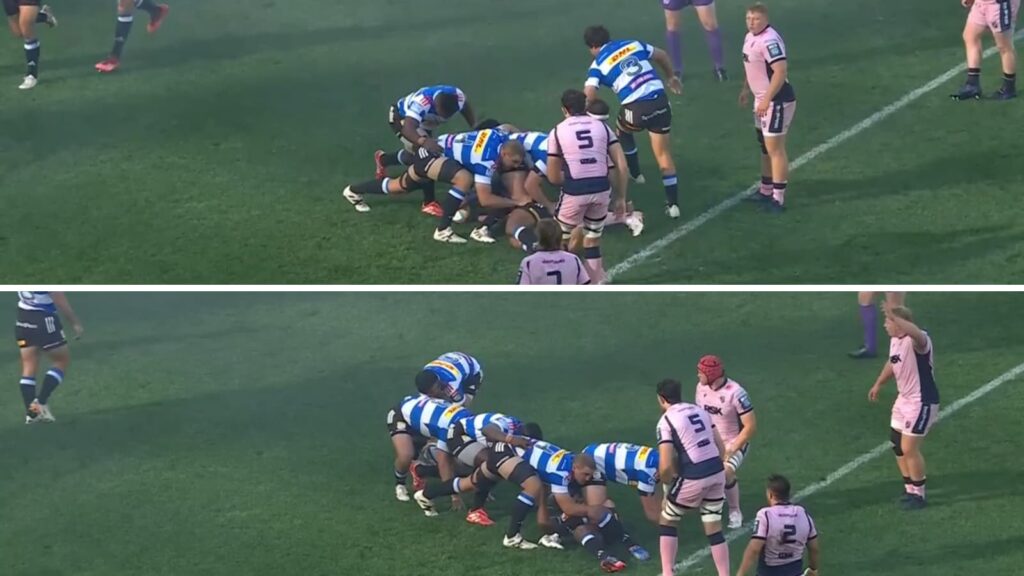
Stormers scrum-half Imad Khan using his hands to get the ball out of a ruck versus Cardiff (VIA URC TV).
Previously, halfbacks were forced to use their feet to rake the ball back and out of the ruck, which slowed the game down and if they weren’t able to, the referee would deem the ball ‘unplayable’ and award a scrum to one of the teams – whichever one was the last to go forward.
“We would remind match officials that this should only be applied when the contest is clearly over; and of the previous Guideline in March 2024 around calling ‘Use it’ as soon as the ball has been ‘clearly won by a team at the ruck and is available to be played.’ This reduces the time for extra players to add themselves to the ruck,” World Rugby further explained.
“We request World Rugby closely monitor this area of the game so objective data can be brought to the next Shape of the Game discussions for wider consideration, and for possible future law change discussions.”
READ MORE: Ben O’Keeffe wants World Rugby to ‘innovate’ by exploring ‘important avenue’ that fans will ‘love’