Saracens v Gloucester: Five takeaways as Tom Willis delivers where England ‘lack’ as Tomos Williams illustrates his ‘sheer brilliance’

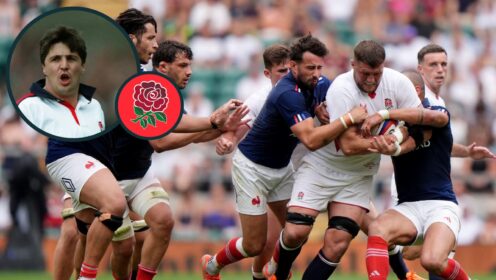
Saracens star Tom Willis and an inset of Gloucester's Tomos Williams.
Following Saracens’ 30-21 victory over Gloucester at Kingsholm Stadium, here are our five takeaways from the Prem Rugby clash.
The Top Line
This was a match that Saracens controlled from the off, through accuracy and rugby intelligence, striking first when Theo Dan finished from close range after Gloucester failed to slow early ball near their line, an issue that plagued them all game, and allowed the visitors to recycle inside the red zone for Dan to crash over.
It was a symptom that persisted all afternoon for the hosts as tackle completion dropped and bodies arrived high and late. Gloucester responded through Freddie Thomas after Josh Hathaway’s immediate involvement forced a quick tap penalty, shifting play back inside the Saracens’ 22 without altering who controlled territory or tempo.
Player of the Match Tom Willis set the standards that Saracens never dropped. He carried 20 times for 53 metres, beat three defenders and crossed the gain line on over 80 per cent of his involvements, repeatedly bending Gloucester’s defensive line without requiring shape or deception.
His work rate through the middle allowed Saracens to play narrow, recycle quickly and return to the same channels without loss of speed, a key shaper of Saracens’ second half control.
A great example was Owen Farrell’s cross-field kick isolating space that had already been conceded, finished by Theo McFarland with the timing and reach of a 6’7” basketballer. Farrell’s control from hand and tee ensured Saracens’ advantage appeared on the scoreboard rather than lingering as pressure, and Mark McCall’s men took full points from the post-Christmas PREM Rugby romp, a fixture that always threatens to undo even the best of teas.
Where the Game Was Won and Lost
The biggest difference was established after contact and via ruck speed as Saracens recycled at an average of 2.9 seconds, maintaining their season tempo and preventing Gloucester from contesting with any consistency. Gloucester’s own ruck speed drifted beyond 4.3 seconds as the match progressed, a consequence of defensive fatigue rather than tactical choice.
The tackle data was rather even; Gloucester were required to make 185 tackles, but missed 18, defending at 90 per cent completion. Saracens attempted 191 tackles, and missed 22, and finished at 88 per cent. What those stats don’t tell you and is highlighted above, is the sustained pressure and need to make tackle after tackle in quick succession as Gloucester were forced into repeat defensive sets, while Saracens were able to recycle and reattach shape without disruption.
Passing accuracy reinforced the same pattern; Saracens completed 93 per cent of their passes, with errors largely confined to advantage situations, whilst Gloucester operated at 85 per cent, losing momentum through basic handling mistakes that arrived without pressure. Saracens were able to reset and return to the same spaces, whilst Gloucester were repeatedly required to restart from static ball.
Territory followed precision of both breakdown work, passing and from the boot. Saracens kicked longer, exited more effectively and forced Gloucester to play from deep for the majority of the second half. To their credit, Gloucester’s set piece functioned in isolation; their scrum succeeded on 92 per cent of their own feed and disrupted Saracens enough to generate possession, as Val Rapava Ruskin dominated Marcus Street, sending him backwards repeatedly. That advantage was blunted by Adam Leal’s inconsistent scrum interpretation, with early engagement and collapses allowed to continue unchecked, turning technical superiority into an unresolved argument.
Daly Key Cog
A key feature of the Saracens’ effort was how Elliot Daly played at full-back and functioned for long periods as a second distributor outside Farrell, operating at a pass completion rate in the mid-to-high nineties and contributing to the Saracens finishing the match at approximately 93 per cent overall accuracy. His repeated presence in the line reduced the need for Farrell to force passes and limited Gloucester’s counterattacking opportunities by closing central space early and forcing longer, lower percentage exits.
The effect was cumulative rather than spectacular. Gloucester held narrow, denied drift and required to tackle more often than they could sustain.
Daly’s positioning also restricted Gloucester’s counterattacking game. By occupying central space early, he removed passing lanes and forced lower percentage kicks, allowing Saracens’ chase to organise rather than scramble. It was influence measured in reduced problems rather than increased highlights.
Tomos Williams and Saracens
Tomos Williams remained a Gloucester player, but the performance illustrated clearly what Saracens have signed. His passing remained flat and accurate under pressure, and his tempo control survived even as Gloucester lost parity at the breakdown.
Williams was most effective when Gloucester attacked quickly rather than attempting to build through extended phase counts their ruck speed could not support. He delivered 41 passes at over 95 per cent accuracy and made 41 metres from the base, including the short side intervention before half time that created Arthur Clark’s try, providing tempo and incision despite Gloucester operating off slower ball for long periods.
The Clark try was Gloucester’s most effective attacking moment and owed nothing to momentum and everything to Williams’ brilliance, who will be sorely missed by the Shed faithful next season. It also explained Saracens’ patience in allowing him to see out his time at Kingholm, a recruitment decision based on the sheer brilliance the Lions nine brings. The StoneX awaits his arrival with anticipation, especially after his impressive display in adversity on Saturday.
Struggling PREM side buck the trend as highly rated England prospect set to return from France
England Watch
Tom Willis’ performance carried an unavoidable subtext. Named Player of the Match, he carried 20 times for 53 metres, crossed the gain line on the vast majority of those involvements and completed his defensive work at over 90 per cent, repeatedly providing momentum without needing space or protection.
It was the kind of output England have lacked in recent seasons, a forward capable of generating metres through contact and resetting quickly enough to do it again. That possibility has now passed. Willis’ move to Bordeaux means he is no longer available to England, turning this display into a reminder of what might have been rather than what could still be selected.
Seb Atkinson continued to build his own case. Operating in a side forced to defend for long periods, he carried intelligently rather than frequently, beat defenders through footwork rather than power and completed his tackles at a rate comfortably above team average, missing only one for a 92% return. His decision-making in tight spaces, willingness to vary his attacking options and accuracy under pressure marked him out as a centre who reduces problems rather than creates new ones. In a Gloucester backline that rarely enjoyed front-foot ball, Atkinson still found ways to influence territory and tempo, a quality that translates cleanly beyond club context.
Val Rapava Ruskin again demonstrated that he remains England’s most destructive scrummaging loosehead should any head coach ever succeed in actually selecting him, achieving dominance through technique, as he gave Marcus Street a torrid time. Despite his age, there’s no overlooking Daly’s effectiveness as a playmaking full-back, stepping into the line to distribute rather than waiting to counter attack, and he remains an international option leading into the 2027 Rugby World Cup, whilst Theo Dan and Hugh Tizard once again showed that modern power only matters when it is paired with mobility and defensive accuracy, as both players enjoyed a romp on the Kingholm 4G.