Opinion: This Ireland era will be remembered not for how high it climbed, but for where it stopped
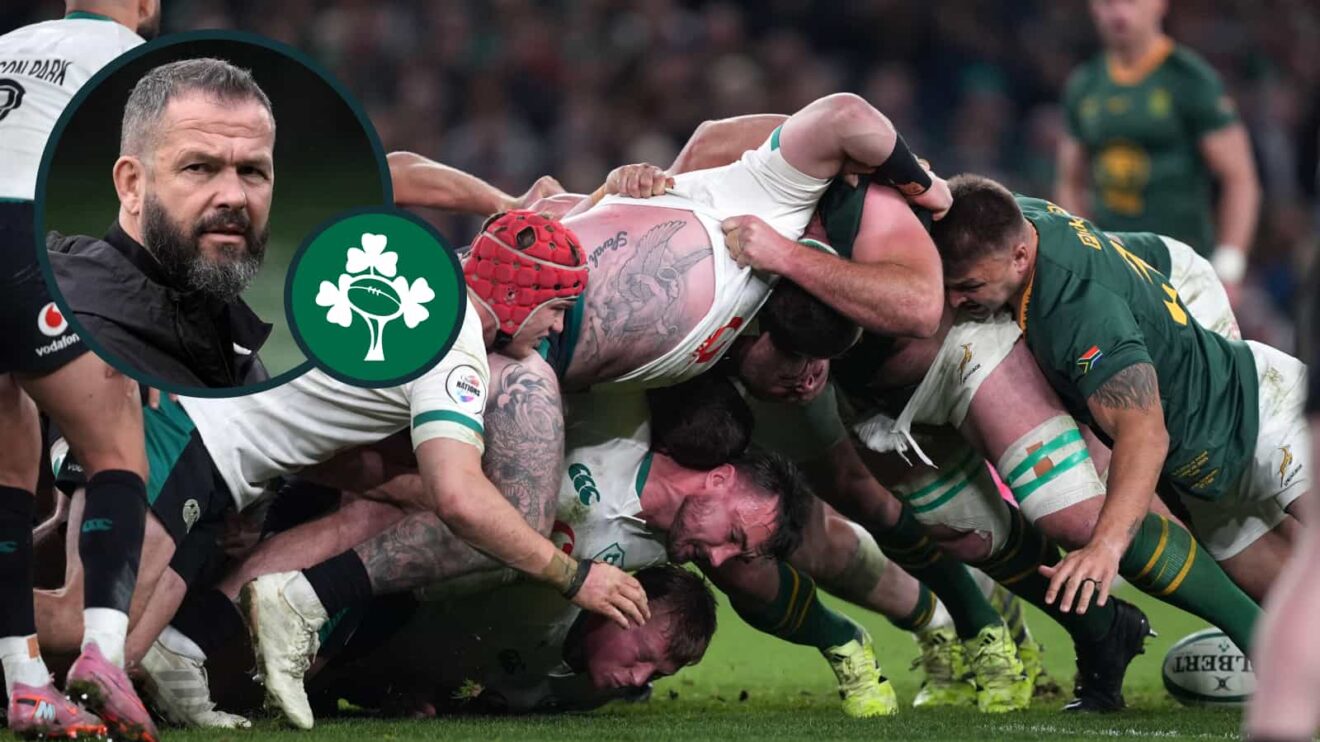
Ireland scrum v South Africa and an inset of head coach Andy Farrell.
Irish rugby has every right to take pride in what it achieved over the past decade, because this was not an era of illusion or empty progress, but one of genuine advancement, historic milestones and sustained excellence that reshaped how the nation was perceived within the global game.
Grand Slams in 2018 and 2023, multiple Six Nations titles, a landmark series victory in New Zealand in 2022, extended spells as the world’s top-ranked side and an unprecedented level of structural coherence all point to a period that stands as the most accomplished in Irish rugby history.
This was Ireland’s strongest generation. And yet, it is precisely because of those achievements that a sense of incompleteness refuses to fade, because when a side reaches this level of sophistication, stability and expectation, success is no longer measured only by accumulation, but by transformation, by moments that redefine what a team is capable of when pressure strips the game back to its essentials. But that moment never arrived, and instead, Ireland reached a level of excellence that should have been transitional and instead became terminal.
When Excellence Became the Ceiling
The rise of modern Irish rugby was built on intelligence, alignment and control, with central contracts, provincial continuity and tactical contiguity combining to produce a side that rarely beat itself and frequently imposed its game on others. Ireland became masters of rhythm and accuracy, squeezing opponents through discipline, cohesion and relentless repeatability, particularly within the familiar cycles of Six Nations campaigns and annual Test windows where structure and preparation were rewarded most reliably.
The system worked, and its success became its own limiting factor. Control, clarity and repetition delivered dominance within known conditions, but when pressure stripped those conditions away, Ireland were left searching for answers that the system had never required them to rehearse. At World Cups, where refereeing interpretations shift, collisions intensify and matches fracture under emotional and physical strain, Ireland repeatedly found themselves operating at the edge of their own framework and that’s where the belief and the preparation collapsed.
The pattern that emerged was tactical rigidity, revealed most clearly when matches moved beyond rehearsal and into confrontation. Quarter-final exits ceased to feel accidental and instead became structural, not because Ireland lacked bravery or belief, but because their game model offered little margin for improvisation when control was contested and emotional surety was challenged.
Leinster as the Mirror
Leinster’s recent European history reflects the same tension, and the comparison matters because it exposes the philosophy at work. For years, Leinster have been the most dominant side in Europe across league seasons and pool stages, controlling possession, territory and tempo with metronomic efficiency while producing depth and continuity that became the envy of the professional game.
Yet finals and semi-finals have exposed a familiar ceiling.
Leinster have regularly arrived as favourites and departed as finalists, their defeats narrow rather than catastrophic, but revealing nonetheless, because they often controlled matches statistically without ever
fully owning them emotionally. When rhythm gave way to confrontation, when structure fractured and momentum became volatile, Leinster’s authority softened rather than sharpened.
Their repeated near-misses were not caused by a shortage of talent, but by an inability to translate seasonal dominance into decisive authority on the biggest days – and worryingly, it kept happening. European Cups are rarely won by the most efficient team over time, but by the side capable of imposing itself when plans unravel, and for all their brilliance, Leinster have not consistently crossed that final threshold.
A Generation Turning Over
This reckoning has been sharpened by transition. The emotional and tactical spine of this generation, players such as Johnny Sexton, Peter O’Mahony and Conor Murray, defined Ireland’s authority as much through their presence as their performance, and their departure has left a void that organisation alone cannot fill.
Leadership at Test level does not emerge on spreadsheets or training pitches alone; it reveals itself under pressure, it is created by shared experience, and Ireland are still discovering where their next centre of gravity lies.
Ryan Baird’s emergence offers a compelling glimpse of what Irish rugby continues to do well. Athletic, confrontational and increasingly authoritative, he looks like a forward capable of thriving when structure dissolves, not just when it holds, and his rise suggests that Ireland’s physical evolution has not stalled entirely.
The situation at fly-half, however, exposes a more uncomfortable truth. Sam Prendergast’s continued exposure at Test level, despite never looking settled or commanding in the role, has become a reflection of pathway comfort rather than international authority, and of a system that too often confuses continuity with inevitability at its most important position. Test fly-halves are forged in uncertainty and pressure, not ushered gently through it, and Ireland’s reluctance to fully confront that reality speaks to a culture that still prioritises optimisation over confrontation.
The Moment the Illusion Broke
If there was a single image that tore through a decade of narrative, it came at scrum time against South Africa, when a front row long regarded as definitive, its status earned through timing, bind accuracy, square hips and control of the hit, was dismantled in full view of the rugby world by a pack that offered no negotiation and no release. This was not a marginal loss, nor a refereeing story, but the collapse of authority itself, where players accustomed to dictating the terms of engagement were forced into reaction and retreat.
That sequence will endure because it carried finality. Ireland’s set piece, the area they believed most resistant to pressure, gave way under aligned power, relentless leg drive and collective intent. The Springboks did not adjust to Ireland or seek leverage within the contest, they imposed themselves, they took one of Ireland’s perceived strengths and left it in a pile of dust on the Aviva turf. In that moment, reputations built over years were stripped of their currency, and once a front row is exposed in that manner on the biggest stage, it does not fade into history, it follows you forever, as Phil Vickery and Dan Cole, both humbled by the Springboks to the point of reputational damage, will tell you.
World Rugby have ‘created their own monster’ as prominent coach hits out at calls to depower scrums
A Golden Generation, Properly Judged
A golden generation does not require a World Cup trophy to justify its existence, and Ireland’s achievements across this era permanently raised standards, strengthened pathways and embedded professionalism that will endure. But a golden generation does invite a higher standard of judgement, and this group were not merely seeking consistency, they were attempting to redefine Ireland’s ceiling.
In that context, repeated quarter-final exits and near-misses remain unavoidable elements of the story, not because they erase what was achieved, but because they ultimately cap it. Ireland became outstanding at being excellent, but never crossed the line into inevitability.
The danger for Irish rugby now is not decline, because the structures remain strong and the talent base deep, but comfort, the temptation to believe that refinement alone will eventually deliver what confrontation has not. The next phase requires a willingness to live in discomfort, to value adaptability as highly as cohesion, and to prepare players not just to execute patterns, but to abandon them decisively when the moment demands.
Leinster face the same reckoning, one that demands fewer rehearsed answers and more authority when control is contested.
Until Ireland learn how to impose themselves when admiration no longer matters, this era will be remembered not for how high it climbed, but for where it stopped.