Opinion: The man who ‘fits’ All Blacks reality and should replace ‘robotic’ Robertson

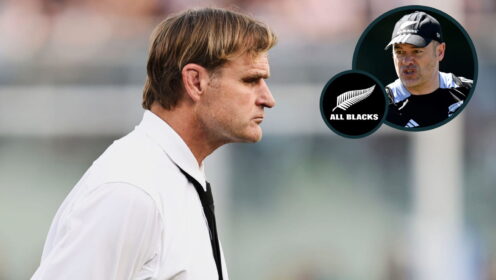
All Blacks head coach Scott Robertson and an inset of Bristol Bears boss Pat Lam.
With Scott Robertson on notice with the All Blacks, New Zealand Rugby should be considering the impact that Bristol Bears boss Pat Lam could make.
Why Pat Lam should be the next All Blacks coach
When the All Blacks stumbled through their November tour of Europe, conceding late tries to sides they should have put away comfortably and looking less like the most feared rugby team on earth and more like a collection of individually brilliant players who’d forgotten how to think collectively, it became impossible to ignore that New Zealand rugby wasn’t just experiencing a rough patch, but had fundamentally disconnected from the very principles that made it untouchable in the first place.
New Zealand rugby works best when it trusts its instincts, when players are given responsibility rather than instruction, when skill is prioritised over control, and when the game belongs to the people on the field rather than the people in the box. The coach who fits that reality is Lam, and this is not about novelty or disruption but about fit, because Lam’s rugby is recognisably New Zealand rugby; educated in the domestic system, shaped by Samoan collectivism, then hardened by years of coaching without safety nets.
As of January 2026, New Zealand Rugby is deep into self-examination following a formal end-of-season review that Robertson himself labelled “an interrogation, right from the top to the bottom,” which tells you everything about how badly things had gone. On paper, 2025 delivered a respectable record: 13 Tests, 10 wins, a win percentage hovering in the mid-70s. In reality, it masked a season defined by inconsistency, defensive leaks, discipline issues, attacking sequences that stalled under pressure, losses that arrived suddenly and heavily, including second-half collapses against direct rivals.
That’s what watching the All Blacks in 2025 felt like; you knew the ingredients were there, you could see flashes of genuine brilliance, and then suddenly they’d ship three tries in 12 minutes whilst you sat there convinced that someone had left the actual game plan in a taxi and replaced it with instructions written in crayon by a bloke who’d once watched a YouTube compilation of defensive errors but had never actually played rugby.
Robertson remains in post, but he is on notice. The 2026 schedule is unforgiving with 13 Tests, South Africa away, the Nations Championship, and no margin for drift. This is the context in which succession and long-term direction are being discussed, even if current speculation focuses on internal adjustments or assistants like Tony Brown, who’s now committed to South Africa.
The coach who gets it
Lam builds teams that think for themselves, an almost heretic quality in modern rugby. Before anyone starts bleating about him being an outsider or not understanding the All Blacks DNA, let’s be absolutely clear; Lam was born in Auckland, played for Samoa because that’s where his heritage sits and because New Zealand didn’t cap him despite bringing him into the squad, and then came back to play provincial rugby in New Zealand, so technically he’s a Kiwi who’s lived the entirety of New Zealand rugby from the inside whilst also understanding what it means to represent Pacific Island rugby at the highest level.
His track record speaks for itself. At Connacht in 2016, Lam took a side with the smallest budget in the PRO12, playing in a shed in Galway, and won the entire competition against Leinster, Munster, and Glasgow, sides with three times the resources. That wasn’t luck; it was systematic development of players who understood their roles so deeply they could execute under any pressure. At Bristol, he’s built a side that competes consistently in the Prem despite operating on a budget that would make the big spenders laugh, producing rugby that’s watchable, effective, and built on exactly the principles New Zealand claims to value but has increasingly abandoned.
The counter-argument writes itself; Lam’s been out of New Zealand for years, he’s never coached at international level, he turned down Wales in 2025, which suggests he’s comfortable at Bristol, where he’s contracted long-term, and the pressure of coaching the All Blacks is exponentially greater than anything he’s faced. All fair points. But the first two cut both ways because his time away has given him perspective without losing the fundamentals, and international inexperience didn’t stop plenty of successful coaches, including Graham Henry, who’d only coached Wales before taking the All Blacks job. As for staying at Bristol, that’s called loyalty and finishing what you started.
Ironically, for a side that normally drips in team culture and self-policing, the All Blacks’ recent struggles have not been about talent but about their own identity; what matters, who decides, where responsibility sits when momentum turns. Lam’s teams answer those questions because he trusts players with clear roles and explicit expectations, and once the match begins decision-making belongs to them and them alone. New Zealand’s greatest sides functioned exactly this way, with leadership moving laterally, standards enforced within the group, and coaches setting the environment and staying out of the way once it was built.
Underlying philosophy
Lam’s rugby is built on understanding of space and ball use rather than robotic execution of patterns, where players are expected to read the game in real time and make decisions based on what they see rather than what they’ve been told to do, which sounds obvious until you realise how many modern coaches have abandoned this in favour of systems that treat players like chess pieces being moved around a board by someone in the coaching box with a laptop and a headset.
Skilled players who understand why they’re doing something will always outperform skilled players who are simply following instructions, and that’s precisely why Lam teaches the principles behind the patterns so players can adapt when the pattern breaks down. In a game as chaotic and fluid as rugby that adaptability is everything, because no amount of rehearsal can prepare you for the infinite variables that emerge when 15 opposition players are actively trying to disrupt your plans.
The high-tempo handling game that Lam coaches is all about manipulating defensive structures through speed of thought and speed of execution, where the ball moves faster than the defence can reorganise, support runners arrive in waves because they’ve read the play early, and offloads happen because players trust that someone will be there rather than because someone definitely will be there.
That sounds like chaos, but it is actually deeply intelligent rugby because it forces defenders to make decisions under pressure, and every decision a defender makes is an opportunity for the attack to exploit. The tempo is underpinned by fitness, but more so, it’s about overloading the opposition where they’re always reacting rather than anticipating, always catching up rather than getting set, and eventually the cracks appear because human beings can only process information at a certain speed.
This comes from Lam’s understanding that Pacific Island rugby has always been about expression within structure, where the structure provides the foundation but the expression provides the edge. The greatest New Zealand sides have always operated in this space where everyone knew the framework, but individuals were trusted to bring their own brilliance within it.
You had Christian Cullen running angles nobody had taught him because he saw space where others saw defenders, you had Tana Umaga offloading in contact because he knew someone would be there even if he couldn’t see them yet, you had Richie McCaw arriving at breakdowns from impossible angles because he’d read the play three phases earlier, and none of that came from a playbook, but from players who understood the game so deeply that they could see it unfolding before it happened.
The cultural thread
New Zealand rugby’s most dominant recent eras have always coincided with strong Pacific Island influence, not just in numbers but in how the game is approached: collective responsibility, emotional investment, playing for each other rather than for systems. Lam carries that naturally because he lives that culture himself with one of his size 11 boots in each camp, so for Māori and Pasifika players, his presence would not be symbolic, but more so familiar, a kinsman, someone who fully understands it all.
The Samoan/Kiwi rugby that shaped Lam is about understanding your role within the collective, whilst being trusted to execute that role in your own way, where structure exists to create opportunity rather than to limit possibility. When Lam coaches high-tempo handling rugby, he’s not imposing a foreign system but drawing on something deeply embedded in Pacific rugby culture, and the fact that he was born in New Zealand, came through New Zealand rugby, but represented Samoa internationally, means he understands both worlds.
That is precisely what the All Blacks need right now because the team is overwhelmingly Māori and Pasifika in composition, but the coaching has increasingly become disconnected from the cultural values that those players bring with them.
Lam has never coached with entitlement, having rebuilt squads, replaced leaders, and operated in competitions where reputation offers no protection, which matters greatly, because New Zealand rugby is adjusting to a world where history no longer guarantees dominance.
Lam’s career has been built on adaptation rather than inheritance, so his teams can adapt to whatever the game throws at them because they understand the game deeply, rather than knowing one way to play it well.
What comes next
The All Blacks don’t really need any form of reinvention as we know just what they’ve achieved and what they represent; what they really need is their culture and tactics back in sync. Lam delivers that because his rugby philosophy looks like New Zealand rugby when it is confident rather than anxious.
This isn’t speculation about what’s happening now because Lam is contracted long-term at Bristol, he’s focused there, and current All Blacks succession talk centres elsewhere, but if New Zealand Rugby is serious about long-term direction rather than short-term fixes, if they genuinely want a coach who understands who they are, how they play, and why they succeed, then the answer is already visible because he is coaching it now. More importantly, he’s coaching the kind of rugby that New Zealand should never have stopped playing; high-tempo, high-skill, high-intelligence rugby where players are trusted to make decisions, where understanding matters more than compliance, and where the ball is moved with purpose and precision because everyone on the field knows not just what they’re doing but why they’re doing it.
Which is exactly the All Black way.
Want more from Planet Rugby? Add us as a preferred source on Google to your favourites list for world-class coverage you can trust.
READ MORE: Murray Mexted: All Blacks have been ‘buggering around’ for two years and it’s ‘tarnished our image’