Nations Championship final: Five ways the Springboks can avenge the Paris defeat against France
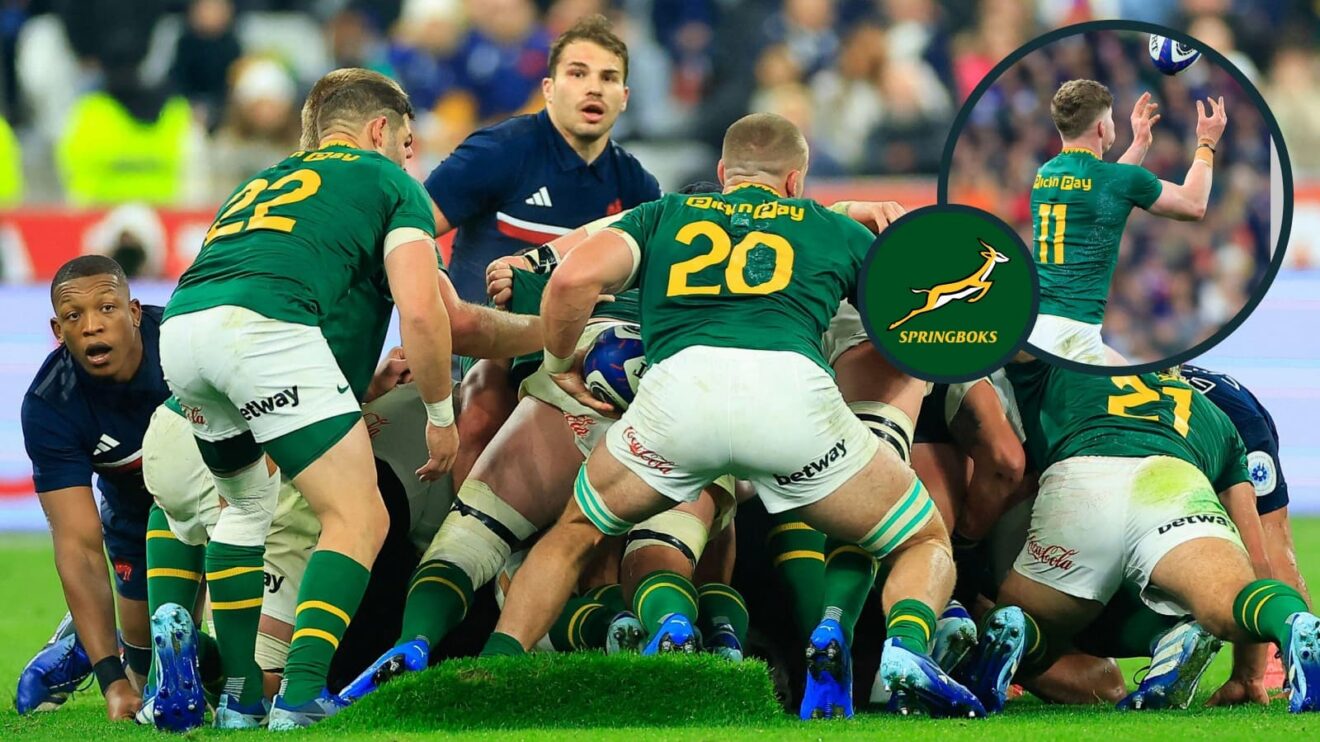
Springboks and France contest a scrum.
South Africa get a second crack at France in the Nations Championship final at Allianz Stadium, Twickenham, on Sunday, and the best way to win it is to shut off every source of the ball Les Bleus score from, which means the most back-to-basics approach the Springboks have ever delivered.
Paris was the perfect storm, yet France still only won by two. South Africa had 55 per cent of the ball and 58 per cent of the territory, but they lost the ball 16 times, lost the aerial battle and ran into the genius of Antoine Dupont, who put in a career-defining performance.
That’s the thing about this French side; they don’t need much ball to hurt you. So the Springbok plan has three aims: take away the loose kicks they run back, starve Dupont of quick ruck ball and stop handing them turnovers, all of which means dragging France into the set piece, where the Boks are strongest and France are weakest.
Scrum, scrum and more scrum
In cricketing terms, you always do what the opposition least want you to do, which means bowling the ball the batter least wants to face. If he doesn’t fancy the short ball, you put two men back on the hook and keep banging it in at his head until he top-edges one. The last thing France want on Sunday is to scrummage, and South Africa should make them scrum from the very first whistle to the last, setting out to break them physically, emotionally and mentally until they want no more.
Paris showed exactly what South Africa can do. The Springboks won all ten of their own scrums, France conceded seven scrum penalties and two more at the maul, and Régis Montagne went to the bin as the scrum penalties kept flowing. Rassie Erasmus had cleverly switched his front-row hours before kick-off, starting Jan-Hendrik Wessels, Gerhard Steenekamp and Thomas du Toit and holding back Ox Nché, Malcolm Marx and Wilco Louw, and once the benches emptied, France’s replacement front-row was battered; the Boks came back from 21-7 down, and the 78th-minute scrum 40 metres out so nearly won it. Eight days later, with Jean-Baptiste Gros missing, Rodrigue Neti was crumpled time and time again against Argentina, and Los Pumas twice turned down shots at goal to make France scrum again, the ultimate humiliation.
Erasmus has gone the same way for the final, but critically, France have Gros back, which makes Du Toit against Gros the contest of the first half. A loosehead scrums against the opposing tighthead, so Du Toit’s job is to get on top of France’s best loosehead early, or at the very least to make him work flat out at every engagement. France will go for weight behind him with Mickaël Guillard and Florian Verhaeghe, the heaviest second-row available, but the locks’ shove has to travel through the props, and two big locks pushing on a beaten prop are simply two big locks getting tired, especially against South Africa’s second shove, which no amount of technique can legislate for because it’s all about timing.
Loose Pass: Nations Championship ‘too much’ as All Blacks and Springboks feel ‘murderous’ squeeze
So the first wave’s job is to take every single scrum on offer, run up the penalty count and drain the French tight five, so that when Nché, Marx and Louw arrive around the 50-minute mark, they’re scrummaging against exhausted locks and replacement props who are already close to a warning. Four or five scrum penalties and you can bet your bottom dollar a yellow card is coming, and the warning sits with the team rather than the player, so once it’s been given, a French replacement prop’s first penalty could easily be the last thing he does for ten minutes. A carded prop costs more than one man, too, because France have to bring on another front-rower at the next scrum and take off a more mobile back-rower or three-quarter to make room.
England’s Karl Dickson referees the final, and he traditionally gives fewer penalties than most elite referees, often free-kicking a messy scrum rather than penalising it, so South Africa will have to show real power, straight and square and going forward, leaving no doubt about who’s going backwards when it collapses. But he’ll reach for the card once the count builds, as New Zealand found against Ireland in 2022, and the fewer penalties he gives, the more scrums South Africa need to get there.
Maul them
France’s maul set-up against Fiji and Argentina was diabolical, because they drive before the catcher has come to ground, so every man binding onto him is too high; because they start high, their drive goes from top to bottom, when it should go from low to high, and there’s nothing driving behind the ball. South Africa should contest Verhaeghe and Esteban Capilla in the air and attack the catcher legally the instant his feet are down, before the maul forms, although that’s a fine line to walk in a final. At the other end, the Boks won all 15 of their own lineouts in Paris, and both Wessels and Marx scored off mauls.
Put the two together and the sequence is almost brutal in its simplicity. Every penalty South Africa win in their own half becomes a scrum, every single one, and I’m not joking; the moment they’re over the halfway line, the next one goes to touch, the lineout goes up, the maul goes on, and the maul either scores or wins another penalty, with France on a warning and running short of front-rowers. It’s that obvious, but the hard part is the discipline, because there’ll be penalties on their own ten-metre line where a kick to touch looks the easy option, and they have to scrum them anyway.
That’s how you break a pack. Every scrum and every reset takes far more out of a tight five than a lineout does; a pack going backwards scrum after scrum stops believing it can hold, and a prop who expects to be penalised starts guessing at the engagement and gets penalised for that instead. The scrum sits at the heart of French rugby’s idea of itself, too, so being marched backwards in a final, with Dupont standing behind it waiting for ball that isn’t coming, hurts a French forward more than any physical tackle. It’s pure Erasmus as well; when I interviewed Schalk Brits during the 2023 World Cup, he described the front-rowers telling Rassie you can’t scrum for a penalty at every scrum, and Rassie raising an eyebrow, smiling and asking, “Well, why not?”
Schalk Burger: Why I’m confident the Springboks will beat France
It isn’t free, mind you; Argentina won the scrums on Saturday and still lost 45-17, scrums eat the clock when you’re chasing, and with both defeats coming by two and three points, there’ll be moments late on when three points in range are worth more than a maul. Until then, the sequence doesn’t change.
Attack them on the floor
France also have no over-the-ball specialist; Argentina won seven turnovers against them, and whilst François Cros is brilliant at sweeping and securing, he isn’t a jackal. Siya Kolisi starts at six, the Springbok openside, with Pieter-Steph du Toit, the standout Springbok in Paris, alongside him, and Marx, who wins breakdown penalties in his sleep, comes off the bench to do it all over again in the 50-70 minute window. Slow French ruck ball means the blitz is set before Dupont’s next pass, and every turnover is a short field for a side that only needs a lineout to score.
Blitz the half-backs
We expect Matthieu Jalibert, the UBB maestro, to start at ten, but he’s only just back from two months out, and on Saturday he was good in parts rather than laser sharp. South Africa should employ a super-powerful blitz on the 9-10 axis, pressing from the 10, 12 and openside channel rather than the normal method of folding in from 13, so the hit arrives on Dupont and Jalibert before they can work their magic, and a French side squeezed narrow can’t kick to grass and chase and will look for touch instead; every kick out is a lineout, and every lineout is a maul South Africa will dominate.
Win the air
South Africa lost the aerial battle in Paris, where France kicked to grass for three tries in 17 minutes and fed off the scraps from tap-backs and the drop zone, so the Boks need their best aerialists in the centres as well as the back three, and Jesse Kriel and Damian de Allende have to stand up and be counted.
Want more from Planet Rugby? Add us as a preferred source on Google to your favourites list for world-class coverage you can trust.
Aaron Grandidier-Nkanang is injured and we expect Thomas Ramos in the back three, but he hasn’t played since September, so the first high ball of the afternoon should go his way with snow on it, and the Boks should keep testing him until he’s shown he’s back up to speed. They don’t need to go anywhere near the wings in the air, though; kicking straight down the middle applies the pressure, and they’ve the physicality to hit the contact and set up from the catch.
A Springbok side with a point to prove
Then there’s the motivation. South Africa arrive at Allianz Stadium with two defeats on the bounce, Erasmus serving a six-match ban, a week of being told they’ve only got a maul and a scrum, and Kolisi with a score to settle, and they want to crush France, plain and simple, in front of a green-and-gold travelling support that will turn the Allianz into something akin to a home fixture.
South Africa don’t need to create a new attacking identity in seven days, but they do need to go back to the most basic Springbok game they’ve ever played, drag France into it, mug them in broad daylight and keep them there for 80 minutes, and if they do, they’ll walk away having avenged Paris.
READ MORE: Andrea Piardi demoted after Rassie rant as World Rugby names Nations Championship Finals officials