Law discussion: Henry Pollock’s try was spot on as Austin Healey unaware of lawbook caveat
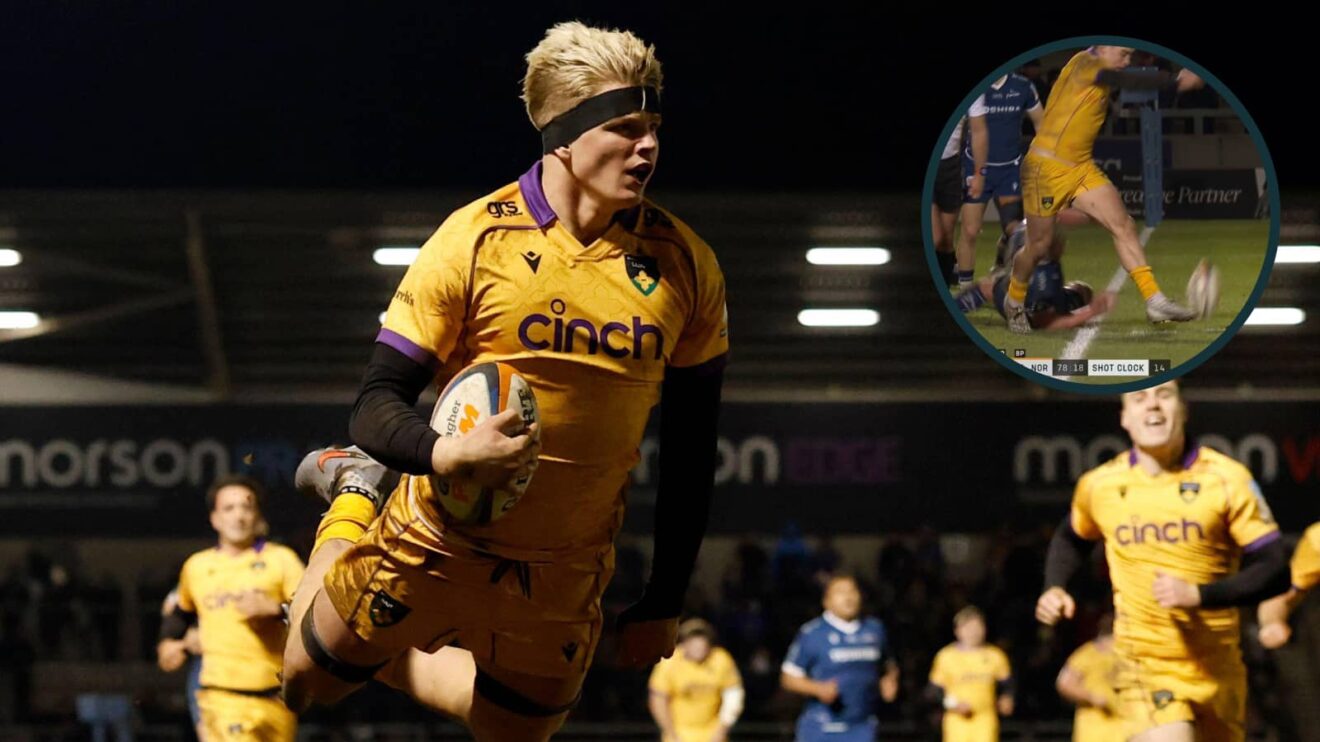
Northampton Saints flanker Henry Pollock and an inset of Tommy Freeman kicking the ball.
Henry Pollock’s 77th try against Sale Sharks on Saturday has caused much confusion and debate, but the match officials got the decision spot on. Here’s why.
The five-pointer from the England flanker was the final nail in Sale’s coffin as Northampton Saints secured a 29-43 bonus victory in Salford to remain on top of the PREM Rugby table ahead of the Six Nations break.
However, many claim that Pollock’s try should not have been awarded, suggesting that referee Anthony Woodthorpe and his assistant reached the incorrect conclusion when reviewing the footage.
Former England utility back Austin Healey added fuel to the flames with his comments on TNT Sports as he was perplexed by the decision.
Commentary stumped, but not the officials
In the 77th minute, Sale winger Arron Reed battered an up-and-under back in the field to avoid a kick out on the full and Saints star Tommy Freeman went charging after the loose ball.
The ball slipped through the grasp of Ernst Van Rhyn and looked to be on its way into touch. But Freeman kicked it diagonally in-field to an on-rushing Pollock, who gathered it in his stride and raced away to the try line, swan diving over for the five-pointer.
The replay of the try showed that Freeman was beyond the touchline, out of the field of play and his right foot was grounded when he kicked the ball with his left.
This led Healey to believe that the try should have been disallowed as Freeman’s actions should have meant that the ball was out of play.
“It’s a really good kick. Is he on the field when he kicks it, though? I’m not sure. Is Freeman’s right foot down when he puts boot to ball? But there is no question about Pollock’s gas and pace,” he said on the broadcast.
“Just take a look at his right foot, before he kicks it with his left. Is he off the pitch? Yes, he is.”
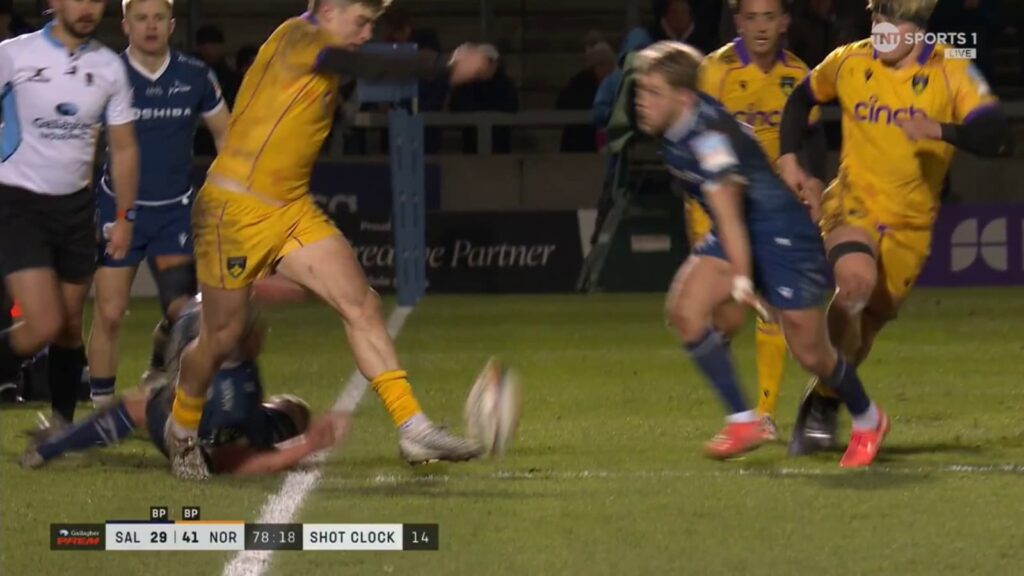
Tommy Freeman kicks the ball while out of the field of play.
That was enough evidence for the 52-year-old to rule out the try, but Woodthorpe disagreed as he discussed the events with his TMO.
“No, it’s play-on. The ball is in the field of play, he is not in possession of the ball… I’m happy, play on,” he said.
“Ah, play-on?” a baffled Healey remarked.
“I think they need to look at this again, his right foot is down. So the ref is happy, so everyone is happy.”
WHO ELSE?! 🙋
Henry Pollock scores again as Saints win on the road at Sale for the first time in EIGHT years.
What a game! 🤝 pic.twitter.com/irXO5GVKSM
— Rugby on TNT Sports (@rugbyontnt) January 24, 2026
Woodthorpe continued, with the former England star speaking over the official, “Yes, his foot is out, but he is not in possession of the ball; he is able to kick the ball there.”
Healey, still perplexed, added: “It’s out! What? He is in possession when he touches it.”
He wasn’t the only one, as former Wales and Lions back-rower Andy Powell replied to a video of the try posted on social media, stating ‘No try’.
Fans piled in, too. “That ref is an absolute joke. Freeman is clearly in touch. Once he touches the ball he’s in possession of it,” one wrote.
Another adding: “No try. Foot in touch.”
The law
To Healey’s credit, he is usually quite sharp on his laws, but ultimately, Woodthorpe and his officials got the decision spot on as per the World Rugby laws around touch or touch-in-goal.
Law 18.1 reads as follows: “The ball is in touch or touch-in-goal when:
a. The ball or ball-carrier touches the touchline, touch-in-goal line or anything beyond.
“b. A player, who is already touching the touchline, touch-in-goal line or anything beyond, catches or holds the ball.
“i. If the ball has reached the plane of touch when it is caught, the catcher is not deemed to have taken the ball into touch.
“ii. If the ball has not reached the plane of touch when it is caught or picked up, the catcher is deemed to have taken the ball into touch, regardless of whether the ball was in motion or stationary.”
And law 18.2 adds: “The ball is not in touch or touch-in-goal if:
a. The ball reaches the plane of touch but is caught, knocked or kicked by a player who is in the playing area.
b. A player jumps, from within or outside the playing area, and catches the ball, and then lands in the playing area, regardless of whether the ball reached the plane of touch.
c. A player jumps from the playing area and knocks (or catches and releases) the ball back into the playing area, before landing in touch or touch-in-goal, regardless of whether the ball reached the plane of touch.
d. A player, who is in touch, kicks or knocks the ball, but does not hold it, provided it has not reached the plane of touch.”
In this case, law 18.2.d is applicable.
At no point does Freeman ever take possession of the ball, as he does not catch or even attempt to catch the ball. He is in touch and provides a perfect example of the law description.
He does not hold the ball, and it does not reach the plane of touch (The vertical space rising immediately above the touch line or touch-in-goal line) before he kicks it.
Additionally, Pollock is comfortably behind Fremaan when the winger kicks the ball, meaning that he is also onside.
It’s a rare occurrence to see law 18.2.d come into play, but fair play to the PREM Rugby officials who were on the button this time around and reached the correct decision.
Saints’ attention now turns to next weekend’s PREM Rugby Cup clash against Leicester Tigers at Franklin’s Gardens, while many of their stars, including Freeman and Pollock, begin their preparations for the upcoming Six Nations campaign.
Planet Rugby reached out to a current elite professional match official to ensure that the technicalities and law interpretations expressed in this article were accurate – which they were.
READ MORE: Henry Pollock on England’s World Cup ‘goal’ and what he ‘loves’ about rugby