Comment: The year the bench took control of rugby and what comes next in 2026
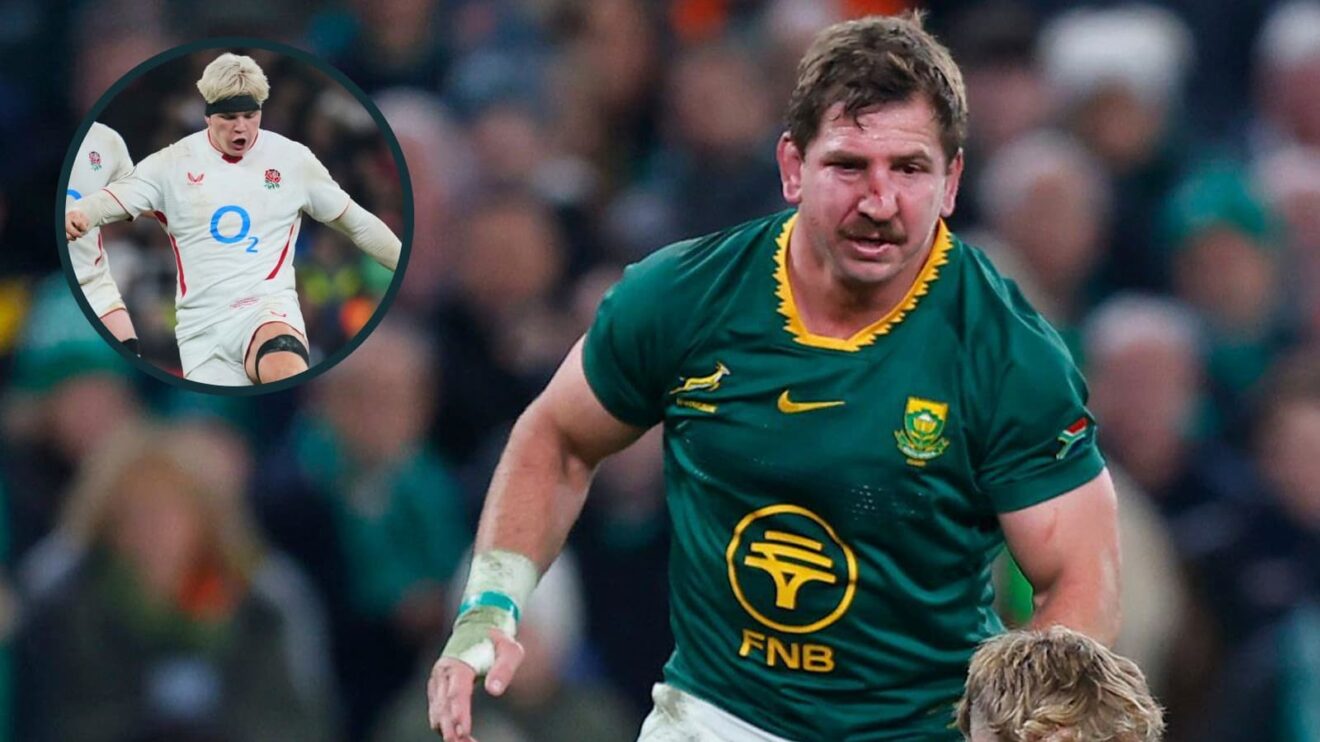
Kwagga Smith and Henry Pollock have become key men for the Springboks and England respectively.
As we stagger towards one final shindig of 2025, it is worth noting that the most significant tactical shift in elite Test rugby has not come from shape, system or some laminated coaching philosophy pinned to a wall. It arrives later, once legs have gone heavy, lungs are on fire and referees have stopped negotiating. The modern bench no longer exists to tidy things up or provide a late burst of enthusiasm; it now governs Test matches with all the subtlety of a sledgehammer and roughly the same regard for feelings.
Eddie Jones understood this before most. His teams selected replacements for the final half-hour rather than the opening exchanges, treating fatigue as a tactical phase rather than a physiological inconvenience. Rassie Erasmus has since stripped away any remaining romance and turned the idea into something colder and more exact. In 2025, replacements are chosen less for energy than for reliability under decay, when technique frays, tolerance tightens and officials begin enforcing rather than absorbing.
This is where Test matches are now decided; not by narrative or momentum swings, but by which side remains technically credible once the referee’s patience expires.
Margin removers
Some replacements alter matches by removing margin altogether. They do not raise tempo or manufacture chaos; their arrival shortens distance to contact, compresses operating space and tightens the breakdown until opponents are forced into infringements they never consciously choose. Penalties arrive without escalation, because the conditions that create them have already been engineered.
South Africa have refined this model more thoroughly than anyone, and André Esterhuizen and Kwagga Smith sit at its centre. Their influence is not positional but structural and it’s all about spatial change. Defensively, they both narrow the inside channel without overfolding, allowing the line to stay connected whilst denying access to soft gainline metres. Offensively, their carrying lines at pace shorten the field, prioritising security over width and forcing defenders to stay low and square across multiple phases. Space does not vanish suddenly; it is removed piece by piece.
That influence was decisive in Paris against France. When South Africa lost Lood de Jager to a red card just before half-time, Erasmus used the bench not to chase dominance but to reconfigure the contest. Esterhuizen operated as a hybrid between centre and flanker, absorbing defensive load inside while allowing the edge to hold shape, and to work as an auxiliary lineout forward. South Africa did not increase force – rather they redistributed it, using one player to do the job of two. Tackle height stayed low, breakdown arrival remained early and legal, and France, despite carrying more and attacking wider, never accessed space cleanly enough to exploit numerical advantage.
Remarkably, the red card did not create South Africa’s control, but it actually revealed it, a quite astonishing feat. Erasmus used the bench to simplify the contest rather than compensate for loss, narrowing roles and reducing decision-load until the game could still be played cleanly at speed. France carried more and played wider, but South Africa stayed legal, onside, low, square and early, which is the combination referees reward when fatigue sets in. The penalty picture that followed was not punishment for ambition but consequence of contrast; one side multiplying actions under stress, the other removing them. Teams who lose shape in that window tend to react with disbelief when the whistle keeps going against them, rather like blaming the breathalyser after emptying the pub, when the reading is simply reporting what has already happened.
Shape holders
Other benches apply pressure by preserving structure rather than accelerating chaos and their value lies in preventing decay. Collision outcomes remain stable, arrival stays early enough to deny momentum and set-piece integrity survives fatigue. The influence is quieter than perhaps the Springboks version but nearly equally as effective, which is why it is often misunderstood.
England’s 2025 meeting with New Zealand at Twickenham illustrates this clearly. New Zealand were already under strain before replacements entered, their phase efficiency dipping and their exits becoming increasingly conservative as England squeezed territory and time. The England bench unload did not reverse the match; it consolidated control, with Tom Curry and Henry Pollock offering two sides of the same coin, one in suffocating defence, one in coruscating attack. When Curry came on around the hour mark, England were defending heavy phase play from New Zealand. The team ultimately posted 179 tackles with only 24 missed; a defensive workload significantly higher than their opponents’ 99 tackles and Curry’s presence helped maintain that pressure when fresh legs were most needed. Pollock’s cameo late in the game was more than energy; he won a turnover penalty and kicked through for the try that ultimately sealed the contest, turning defensive ascendancy into attacking certainty.
From minute 60 onwards England conceded one penalty to New Zealand’s four, gave up no scrum penalties in the final quarter and defended every maul entry without collapse or cynicism. New Zealand were repeatedly forced to exit from deep rather than build pressure through sustained possession. The contest remained tight because England’s shape survived the precise period when it normally fractures, denying New Zealand the late-game leverage they typically rely upon.
Pablo Matera and the temperature of a match
Argentina turned the match at Murrayfield because Pablo Matera entered it and raised the temperature until the contest could no longer be played at Scotland’s pace.
From his first carry he set the physical terms. Contact height dropped, collisions arrived earlier and each phase demanded immediate follow-up. Matera carried with intent to reload rather than to win metres, arriving square, staying on his feet and forcing Scotland into repeat tackles with shrinking recovery time, the rhythm of the match shifting through repetition rather than any single act.
Matera’s work-rate pulled teammates forward with him, forwards following him into contact, backs flooding into the space that appeared as defenders tired. Argentina’s tempo lifted organically; carries accelerated, rucks shortened and reloads sharpened, whilst Scotland’s defensive line, organised and balanced through the first 50 minutes, began to crack terminally under sustained effort.
Revealed: Where Test matches were decided in 2025 as ‘truth’ window emerges
Argentina scored five tries in the final quarter, with Matera repeatedly present in the preceding phases through carries, clean-outs and immediate defensive pressure that kept Scotland retreating and prevented defensive shape from settling.
Matera’s value to Argentina sits in the emotional register of the game. Teammates match his urgency instinctively, the contest speeding up because remaining still feels unacceptable. Opponents are drawn into continuous confrontation, required to respond immediately and repeatedly, with little opportunity to recover composure or structure.
Argentina won because the final quarter became relentless as pace increased, collisions accumulated and effort compounded until resistance gave way, the outcome shaped by sustained physical insistence applied legally and without pause, driven by a player who treats Test rugby as something to be imposed through will as much as execution.
That is how the temperature of a match is changed.
What comes next
The next evolution is already visible and it has less to do with power than selectivity. The arms race has peaked. Everyone understands the final half-hour is decisive; separation now comes from precision. Volume is giving way to specificity, fewer generalists and more players chosen for one narrow job under extreme stress. A loosehead who wins penalties without chasing dominance; a hooker whose maul entry angle never collapses; a back-rower whose arrival is early without appearing hurried. These players are not highlight reels. They are referees’ favourites.
Want more from Planet Rugby? Add us as a preferred source on Google to your favourites list for world-class coverage you can trust.
The advantage will become cognitive as much as physical. The best benches already understand how officials tighten games, not just how bodies tire. Behaviour adjusts accordingly. Clean-out distance shortens, tackle height drops by inches, feet slow just enough to remain square. This is coached behaviour, not instinct.
Depth has always been the wrong word. Depth implies replacement. What matters now is leverage. One player who can reliably shorten a match at minute 60 is worth two who raise tempo and hope. This is why some squads look deep and still lose close Tests; they have energy but no control.
The bench is no longer a safety net or a late flourish. It is the instrument through which modern Test rugby is decided, administered by fatigue and enforced by referees who have seen enough. Teams who understand this do not talk about impact; they talk about survival.
Those who still treat replacements as enthusiasm at the end of a long afternoon will keep staring at the referee in disbelief, convinced they are being hard done by, rather than quietly out-thought, at which point they are not victims of modern rugby at all. They are simply turning up to a Formula One race in a very shiny wheelbarrow and wondering why everyone keeps overtaking them.