Munster v Leinster: Five takeaways as Jacques Nienaber’s defence ‘evolves’ amid ‘fire and brimstone’ derby
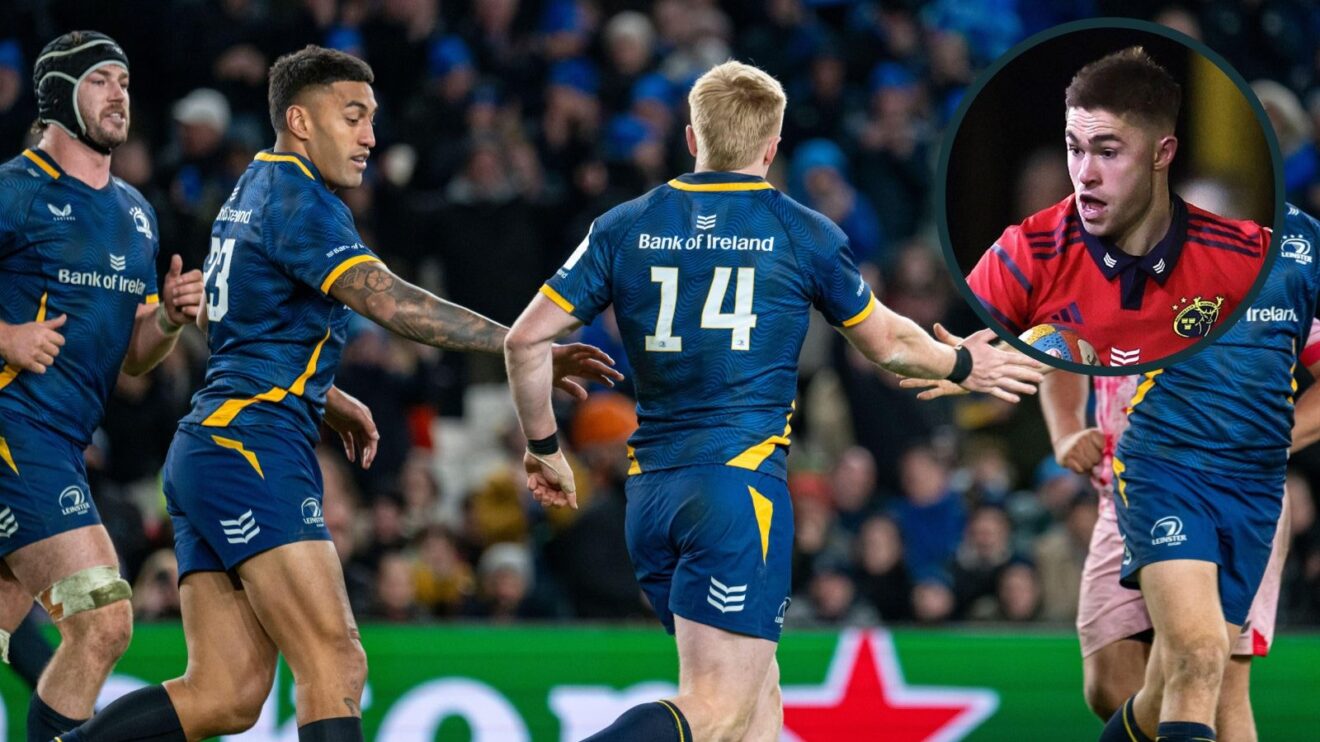
Leinster players celebrating with an inset of Jack Crowley
Following Leinster’s 13-8 win over Munster at Thomond Park, here are our five key takeaways from the URC clash.
The top line
Club games being described as ‘being played at Test match intensity’ is an incredibly overused cliche, but please indulge us for this one. This could easily have been two Test teams going at it.
Right from the get-go, the game felt like it was on a knife-edge, even with Josh van der Flier’s early score giving Munster a 7-0 lead for the entirety of the first half.
It was proper fire and brimstone, with both sides charging into each other with no regard for their body. The battle up front became an increasing part of the game, with Leinster getting the better hand of it in the early exchanges of the second-half and, resulting in two Harry Byrne penalties for their troubles.
Munster soon had their turn to dominate those tight exchanges, led by the impact of their bench, and it resulted in Dan Kelly waltzing over the try line to give the hosts a sniff.
Back to the knife-edge. A penalty late into the second half, coupled with a break from Alex Nankivell, nearly saw Munster sneak it at the death, but a spilt ball saw Leinster come away scot-free and take the spoils back to Dublin.
So close, yet so far
This feels like a case of ‘coulda, shoulda, woulda’ for Munster, who will feel like they could have clinched that at the death. Yes, there was a touch of controversy over the final play, with the hosts feeling it was a deliberate knock-on from a Leinster hand, but that wasn’t what cost them the game.
Munster posted 59% possession and 58% territory across the full 80 minutes, but yet only had eight points to their name to show for it. They also made more metres and carries than their opponents, posting 265 metres and 57 metres compared to Leinster’s 232 metres and 52 carries, and yet couldn’t make it count.
That is not a good enough conversion rate to beat a team like Leinster, and it told in the end. For whatever reason, they just couldn’t get over the whitewash.
It was just small things that cost them. A bad pass here, a knock on or a turnover there, but those add up. Those cost you games against Leinster.
Want more from Planet Rugby? Add us as a preferred source on Google to your favourites list for world-class coverage you can trust.
Their losing bonus point still sees them climb up to second in the URC table, but this was a real opportunity to lay down a marker heading into the New Year. A win would have seen them go top come January 1st, while putting some distance between themselves and the likes of Leinster, Glasgow Warriors and Cardiff in the process, but now they see their rivals climb to within five points of them.
You feel this will linger.
Nienaber’s defence at its best
Leinster’s win was not built on overwhelming Munster ball-in-hand, reflected by the stats mentioned above, but rather it was done on pure defensive grit. It was Jacques Nienaber’s defence at its peak.
The visitors were rock solid across the game, blending their aggressive edge-blitz with more traditional swallow defence to brilliant effect.
Leinster posted a whopping 151 tackles across the full 80 minutes, led by the likes of James Ryan (17), Joe McCarthy (15), Caelan Doris (14) and Josh van der Flier (12), but crucially just missed 10 tackles along the way. This is fairly comparable to Munster, who only missed 11, but they also only made 106 tonight.
This felt like an evolution of the previously ultra-aggressive Nienaber defence, but it could set them up for a much-improved second half of the season. The blitz out wide was still very much there, but around the ruck, they didn’t shoot out. They allowed Munster to get isolated, mainly by forcing them inside and away from support runners, which in turn allowed them to pounce and win a turnover.
It also felt calculated when they would switch between the two differing systems, picking the right time to do it.
It was clever, it was new. Is it what Leinster need to power a title charge?
Battle of the nines
Craig Casey is arguably the next number nine set to control the shirt for Ireland, so the battle between the current holder and the prospective one was fascinating.
Connacht v Ulster: Five takeaways as visitors prove ‘how much things have changed’ in tense win
Both have similar styles. They’re fast around the breakdown, they’re comfortable playing off the cuff, and most importantly, they can both stand up and perform in the most intense pressure cookers.
It’s difficult to say which scrum half came out on top today, but with Jamison Gibson-Park likely set to retire after the next World Cup, Casey’s commanding performance gives a strong indicator as to what is to come.
Reiko Ioane
It was never going to be easy for Reiko Ioane to arrive in Ireland following his history of verbal hostility with Leinster legend Johnny Sexton, but his impact at the age-old club has been incredibly well-received. Against Munster, he proved that he was not just a fair-weather player, but that he could actually make a difference in matches that don’t suit his expansive game.
He went looking for the ball; he went searching for opportunities that would otherwise not present themselves. Whilst his efforts never quite reached the zenith he hoped for, his efforts didn’t go unnoticed.
The crowd responded with eager anticipation each time he received the ball, with an electric atmosphere that threatened – not just to fizzle, but to shock. As noted, the charge never peaked at Thomond Park, but the excitement still made the wait feel worth it.