World Rugby called on to ‘do better’ as referee decisions are deciding Tests ‘not the players’ according to ex-Wallabies boss



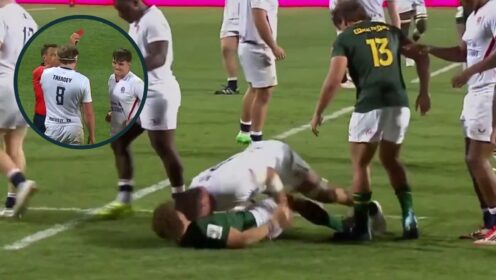
All Blacks fly-half Ruben Love after being sin-binned and an inset of Hollie Davidson issuing a red card.
Ex-Wallabies head coach Ewen McKenzie has called on World Rugby to fix what he believes to be a sanctioning issue in the game.
According to the 61-year-old, referees, TMOs and broadcasters are deciding the outcomes of matches and not the players, with sin-binning periods costing teams far too dearly in the modern game.
There were seven cards issued across the weekend in the Nations Championship: five yellows and two reds, and McKenzie is of the opinion that the numerical disadvantage is now too great.
Yellow cards have too much of an impact
He said as much during an appearance on the Rugby Unity podcast with Sir Steve Hansen, who suggested incidents should go ‘on report’ like in rugby league.
“It definitely has an impact because you look at the games where there were yellow cards and there’s probably an average of two tries at least being scored every time someone’s off,” ex-All Blacks boss Hansen said.
“That’s potentially 14 points, and it’s hard to come back from that, and then you take into account the work ethic that has to go in to nullify that player that’s not there. So that has an effect. Could we put some of those yellow cards just directly on report and see what comes of it maybe?
“I think it’s worthy of having a look at it and seeing if we can do it better because we want the game to be a fair contest. So some of them could be on report.”
The mechanism Hansen is referring to has been widely used in rugby league since the 1990s – essentially it allows referees to penalise foul play without disrupting the flow of the match with an instant dismissal. After a game, a judiciary panel reviews the video footage, assesses the severity of the offence, and issues subsequent penalties, fines, or suspensions.
“We’ve got to do something different”
McKenzie agreed with Hansen that the sanctions are too detrimental to teams right now and has urged World Rugby to look at alternative methods to punish players’ indiscretions. He believes that it not only has a major impact on the scoreboard in rugby union but also the quality of the game during those sin-binning periods.
“Yellow cards in the game we’ve talked about ad nauseam. I was watching Argentina versus Switzerland in soccer with the red card. It didn’t cost them on the scoreboard; it might have cost them physically, but it didn’t cost him on the scoreboard. So, you can’t measure sports; we need to say what impact it has,” the ex-Wallabies head coach said.
Want more from Planet Rugby? Add us as a preferred source on Google to your favourites list for world-class coverage you can trust.
“There’s at least one try, if not two, in that 10-minute period. That’s too costly for the team to suffer. So, we’ve got to do something better.
“I’ve been banging on about it for 18 months now. So, we’ve got to do something better because the game is being determined by the refereeing decisions or the TMO or the TV producer, not by the players themselves, and it’s unfair on the other players because they have to go into a defensive mode, and you can see it. They stop attacking at the breakdown. The game just changes for 10 minutes, and they just defend and try and slow the game down.
“It’s contrary to what we want. We want pace in the game; they’re walking back from kick-offs, and it becomes a tactic to try and burn up 10 minutes. Well, that’s not the objective of the game.
“We’ve got to put him on report, or do something different.”
READ MORE: Sir Steve Hansen’s verdict on Rassie Erasmus’ depth building: ‘It’s that mindset of we don’t care’