Who’s hot and who’s not: ‘Serious acceleration’ whets All Blacks’ Greatest Rivalry appetite, but ‘ugly’ Argentina and TMO ‘fastidiousness’ not a good look


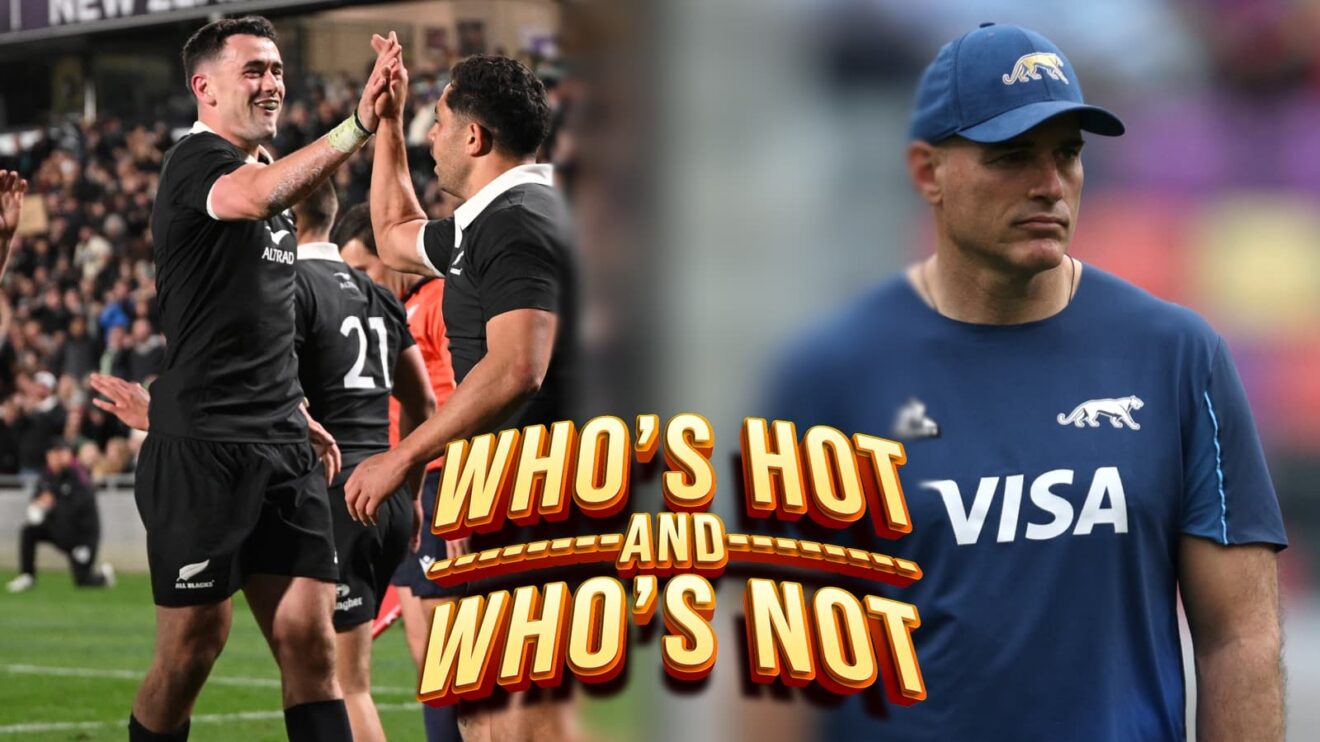
The All Blacks celebrate a try in their convincing win over Ireland and, right, Felipe Contepomi oversees another tempestuous evening in charge of Argentina
It’s time for our Monday wrap of who has their name in lights and who is making the headlines for all the wrong reasons after the weekend.
THEY’RE ON FIRE!
All Blacks: Yes, Dave Rennie’s side were gifted the Will Jordan try by Stuart McCloskey, but there was plenty to admire about how New Zealand went about their first half business in Auckland. They decisively led Ireland 28-7 at the interval, securing the four-try bonus point in the 39th minute, and this 21-point advantage was the winning of a big match they ultimately triumphed in by 19 points.
The gear shift was a serious acceleration from the previous Saturdays under their new boss, as they were just six ahead at the break versus the French (19-13) and only two in front of the Italians (14-10). This slow start issue was eradicated by an inspiring directness in their play where their carriers regularly dominated Ireland in the collisions, something you wouldn’t have expected in a match-up between the second and third best ranked sides in the world. The Rennie All Blacks era is definitely up and running. Bring on the Greatest Rivalry tour!
Springboks: As the saying goes, it takes two to tango and next month’s Test series with the All Blacks should be a thriller. Critics looking for a nibble at Rassie Erasmus’ side might suggest that their at times muted 43-0 win over Wales was a sign of over-confidence in the ranks, but the reality was that a slippery ball mitigated against a higher scoring victory. Instead, the priority takeaway from the seven-tries-to-nil win was that the Springbok machine had further reason to cheer after adding to its squad depth with four more new players capped from the start to round off a month where a whopping 43 players were capped.
The handbrake-off approach by the head coach, in particular testing out the rookies at his disposal, has been refreshing compared to, say, the shackles-firmly-on policy of ultra-conservative England boss Steve Borthwick, whose rookies were only bench selections. Of course, there was an element of luck at the start of the campaign, the late cry-offs of skipper Siya Kolisi and record caps holder Eben Etzebeth forcing a reshuffle, but the Boks have now come out the other side knowing they have a serious player in Paul de Villiers after his three consecutive starts. That’s proper squad building, unlike several other teams who limit their rookies to ‘safe’ 20-minute cameos from the bench.
Rassie Erasmus’ honest ‘pressure’ admission over certain Springboks after Wales win
Wallabies: The team that most needed a win on Saturday was Australia. Last November’s miserable run of four European tour defeats had extended to six with the recent home losses to Ireland and France, but they exploded to life and gave Joe Schmidt his desired winning send-off with the 57-10 hammering of Italy in Perth. This was a potential banana skin fixture, as a loss would have left the passing of the baton to Les Kiss looking like a really depressing, demotivating handover.
However, three tries in the opening 12 minutes was a reminder of how there remains an encouraging attacking threat in the level of the Wallabies’ play. Declan Meredith was an interesting watch in his second Australia appearance at out-half, and it can never be a bad thing to see a second row (Josh Canham), making just his fifth appearance, finish up with a try hat-trick.
Joe Schmidt makes blunt revelation on Wallabies’ ‘progress’ under his guidance
England: We could be brutal and give Jamie George’s a right old kicking here. But whatever about the ebb and flow of a crazy Nations Championship match where they made a terrible mess of defending a 19-3 interval lead, the bottom line is that they somehow clung onto victory over Argentina. While they have been roundly condemned for a second half featuring four overlapping yellow cards and that twice left them playing with 13 players, they must be credited for riding their luck and seeing out the victory in the final minutes while short two players.
Remember, they were hammered a fortnight previously when they imploded in Johannesburg, finishing off their loss to South Africa with a dispiriting all-round collapse when reduced to 13 players. What the last-gasp events in Santiago del Estero showed was that England do have the ability to learn from experience. Yes, it was awful that their card trouble materialised one more – it’s a recurring vulnerability that needs extinguishing – but they showed they can improve on the fly and their commitment to desperate defending on this occasion was a marked improvement on the soft surrender at Ellis Park.
USA and Hong Kong China: World Rugby’s promotion of the new Nations Cup has been dreadful; it’s a terrific example of the governing body paying lip service to the sport as you really do have to be a rugby avid with a curiosity factor to be in the know about this second-tier tournament that has been pitifully lost at sea amid the focus on the top-tier Nations Championship.
Being the rugby nause that we are, bearing in mind next year’s potentially damaging expansion of the Rugby World Cup to 24 teams, we have been keeping an eye. The biggest development was the July segment ending with three wins for the USA and a winless streak for Uruguay, who were decent as minnows at the last World Cup. The Americans, who have for years been struggling for nourishment, were 29-22 home winners over fellow 2027 qualifiers Spain, but the result of the weekend was the 24th-ranked Hong Kong China’s shock 42-40 win over the 17th-ranked Uruguayans in Montevideo. Hopefully, that success is something genuine for them to build on so they are not humiliatingly beaten out the gate next year in Australia by as wide a losing margin as has been feared.
Junior Boks: Hats off to the South African rugby production line for shaking things up and completing back-to-back Junior World Championship title wins on Saturday. Having covered on the ground the two Junior World Championships hosted in Cape Town in 2023 and 2024, it was clear that there was a kink in the system in terms of preparation, leaving them undercooked and then uninspired when it came to playing and trying to win the coveted age-grade trophy they had last grasped in 2012.
The appointment of Kevin Foote as head coach was an electrifying move, though, and with extra resources thrown into the mix, the Junior Boks squads no longer look like they are running in quicksand. Instead, there is a more forensic approach to ensuring everything is ready when they arrive at the all-important annual Championships. Having ended the famine with last year’s success in Italy, they have now doubled-up by winning again in Georgia. The 16-5 scoreline from Tbilisi flattered France, as the Junior Boks were much the better team. It looks like there is going to be more rich pickings for Erasmus when these ‘kids’ progress further up the chain.
Want more from Planet Rugby? Add us as a preferred source on Google to your favourites list for world-class coverage you can trust.
COLD AS ICE!
Argentina: It was only 13 months ago that Los Pumas produced a quality brand of entertaining rugby that swooned the Dublin crowd and gave Andy Farrell’s British and Irish Lions a deserved bloody nose before they headed off on their Australian tour. There was so much to like about the Argentinians that gloriously sunny evening, but their reputation has been considerably sullied since then. Not only have they lost more matches than they have won, but they have come across as overly petulant.
This culminated in the nonsense concocted on Saturday when their seven-point home defeat to England ended with a player touching the referee with his hand at the full-time whistle and then coach Felipe Contepomi prematurely stomping away from his post-game media briefing, claiming a lack of respect from England over their adjacent dressing-room celebrations. Contepomi had the reputation of a hothead as a player – Munster especially used to love winding him up during his Leinster days – and his Argentina team are becoming an ugly reflection of that lack of composure.
TMOs: It was a problematic Saturday for the reputation of referees, who seem to be seeing less and less with their eyes in real time out on the pitch and over-relying on the television match official to help them out. Nic Berry, who completely missed the nasty clear-out by Luke Jacobson on Josh van der Flier even though he couldn’t have been close to it, and the card-happy Angus Gardner were the biggest culprits in this regard, but there were also far too many unprompted interventions by the TMO. This stop-the-game trend even trickled down to the U20s final.
The net effect is that World Rugby’s unabashed desire to speed up the action with his seemingly never-ending law tweaks and interpretations has instead resulted in the opposite: matches that are taking far too long to complete due to the amount of time given over to dithering referees and endless TMO footage reviews. It doesn’t augur well for attracting new fans to the sport when the Rugby World Cup kicks off in 15 months. Instead of clarity, there is too much fastidiousness and it isn’t a good look.
Ireland: When the Irish finished up the Six Nations with a hammering of Scotland and then a March evening where they came within a last-gasp Thomas Ramos kick of France losing to England and leave them champions, the feeling was that head coach Farrell had performed an impressive rescue, rejuvenation a team that look dead when swatted by the French and trailing to the Italians at the interval in the opening rounds. This rejuvenation, though, didn’t kick on in recent weeks, as they were too sluggish for liking in the wins over Australia and Japan and then underwhelming when sunk by the All Blacks in the opening half in Auckland.
The Irish ‘won’ the second half 14-12, showing that a level of fight does still exist with backs to the wall, but they were missing in action in the opening period where they finished trailing by 21 points at the break. That suggests their Six Nations revival was more of a plaster being reapplied to a wound that won’t heal rather than an Ireland team being restored to the rude health it enjoyed until the summer of 2024. Their coach has much to ponder on the weeks and months ahead.
Italy: It’s manic how it has all turned out for the Azzurri. Everyone – bar English fans – was chuffed a few months ago when they defeated England, but it seems as if that breakthrough first win in that fixture has become a noose around the neck rather than a happy reason to propel their game to the next level. Having lost to lowly Wales the following week in March, their hellish, winless July tour has stalled all their early-year momentum.
In losing to Japan, New Zealand and Australia, the general level of their play has gone backwards rather than progressed, a frustration not helped by coach Gonzalo Quesada falling foul of the rugby beak with his refereeing criticisms. World Rugby needs to cop itself on here – clamping down on free speech only lends itself to a dull narrative around the sport. Look at how Irish boss Farrell swerved discussing the Jacobson incident post-game when it needed to be discussed. We digress, though: the Italian escapade finished with the farce seeing Marco Riccioni, the starting Italy tighthead in Perth who had been substituted, getting red carded for becoming embroiled in a touchline fight, rounding off their 47-point defeat. How distressing.
Wales: The best that could be said about Steve Tandy’s side coming away from Durban was that their latest ‘nilling’ by the Springboks was a 30-point improvement on the 73-0 humiliation suffered last November in Cardiff, but was that a genuine sign of progress or just more of the same fug inherited from the disastrous Gatland part two era? We’re inclined to lean towards the latter. It’s all well and good repeatedly savouring massive tackle counts from the likes of the impeccable Jac Morgan and willing lieutenants such as Alex Mann, but they are really struggling to do anything resourceful in attack away from their maul.
An aggregate scoreline of 116-0 across two matches against the Springboks is a desperate situation. Of course, the Boks are the world’s No.1 team but it was just four years ago when a side coached by the soon-to-be-ousted Wayne Pivac won 13-12 in Bloemfontein and only lost the three-match series with a combative 30-14 defeat in the decider. Was unceremoniously shafting Pivac for Gatland all those years ago the biggest misstep in this unpleasant tumble down the rankings?