State of the Nation: England take ‘big step forward’ to shift ‘growing pressure’ off Steve Borthwick but discipline issues ‘becoming an epidemic’


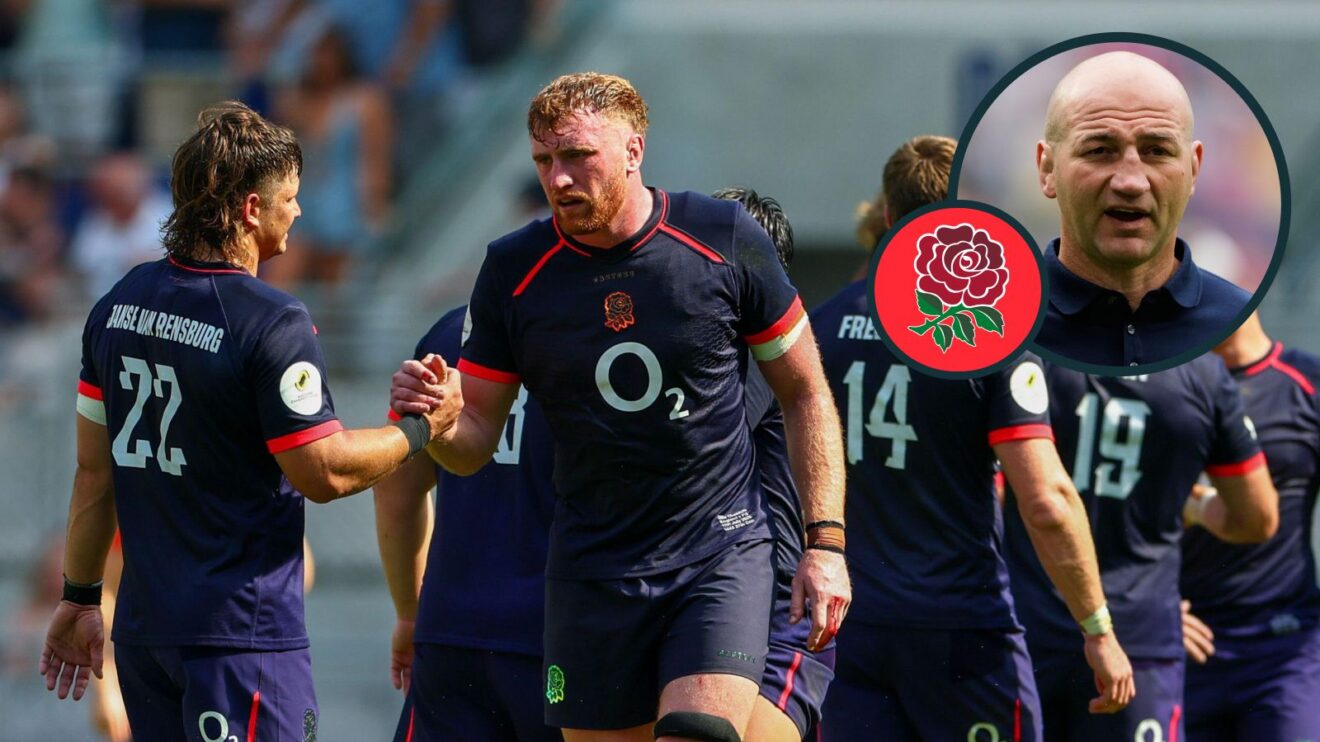
England players Ollie Chessum and Benhard Janse van Rensburg with an inset of Steve Borthwick
Following the conclusion of the Southern Hemisphere leg of the 2026 Nations Championship, we update you on the state of the participating nations. Next up, it’s Steve Borthwick’s England.
After a dismal Six Nations campaign that saw them pick up just one win from five and lose four in a row, England came into the Nations Championship in search of real change. This was only heightened by the growing pressure on head coach Borthwick, despite him receiving the backing of RFU bosses on the eve of the campaign.
But, as ever, it was easier said than done. The Springboks were pencilled in for the opening weekend, arguably the worst Test you can have after losing four in a row, before then facing a Fiji side that ran them close in their last meeting and an Argentina side that nearly completed a famous comeback back in November as well.
England did manage to snap their losing streak, though, and ended the campaign with two wins from three. As a result, Borthwick’s side sit third in the Nations Championship Northern Hemisphere table, just behind second-placed Scotland and two points behind pool-topping France.
Nations Championship summary
With England coming into the campaign off the back of four successive defeats and with looming questions over the direction of the team, their opening Test of the summer could not have come against a worse opponent. The all-conquering Springboks, who were again looking to strengthen their grip at the top of the World Rugby rankings.
It began in the worst way possible for the visitors, too, with Rassie Erasmus’ side racing into a 17-0 lead after just 11 minutes thanks to tries from Thomas du Toit, Cheslin Kolbe and Kurt-Lee Arendse. England did hit back with two tries at the end of the half, with Ellis Genge and George Martin crossing to make it a three-point game after 40 minutes.
The Boks again began the second-half in scoring touch, though, as Grant Williams and Jesse Kriel dotted down within the opening 15 minutes. Alex Coles grabbed England’s third of the night, but it proved mere consolation as Malcolm Marx and Ben-Jason Dixon added their names to the scoresheet to complete a 45-21 victory.
That defeat, which extended England’s losing run to five Tests, only added more pressure onto both the squad and Borthwick ahead of their showdown with Fiji at Everton’s Hill Dickinson Stadium. Fiji themselves were also looking to put an opening round defeat behind them, after falling to a 39-24 defeat to Wales a week previous, and had given England a proper scare in their previous meeting back in November too.
But any thoughts of a repeat were short-lived, as England ran riot in Merseyside. Tries from Marcus Smith, Jamie George, Guy Pepper, debutant Benhard Janse van Rensburg and Seb Atkinson helped push the visitors into a comfortable 35-3 lead at the half-time break, with only Caleb Muntz’s early penalty kick keeping Fiji from the dreaded nought.
Fiji needed a quick response if they stood any chance of an inspired comeback, and they in fact opened the scoring in the second 40 through Tevita Ikanivere, but it proved a mere speed bump for England as Borthwick’s side again waltzed in scores. A Henry Pollock hat-trick was the highlight of the second-half from an England perspective, while Immanuel Feyi-Waboso, Henry Slade and debutant Noah Caluori also added their name to the scoresheet as England secured a resounding 73-8 win.
That victory had certainly shifted the narrative surrounding England, but Argentina in round three would likely prove the true acid test for Borthwick’s men. Los Pumas were in exactly the same position as England heading into the Test in Santiago del Estero, losing to Scotland in weekend one before claiming victory over Wales in round two. The overarching narrative surrounding Argentina v England following the Football World Cup semi-final made this all the more mouthwatering, too.
It was England who began the better of the two sides, with Tommy Freeman opening the scoring inside three minutes. Soon enough, the visitors had a 19-3 lead at half-time, with Ben Earl bagging a brace either side of Tomas Albornoz’s penalty. It seemed plain sailing for England.
But then the second-half erupted into life, for a multitude of reasons. Six yellow cards, Argentina scoring three tries through Mateo Carreras, a penalty try and Justo Piccardo to England’s two through M. Smith and Feyi-Waboso set up a tense ending. In the final play of the Test, Los Pumas thought they’d scored, as Bautista Delguy crossed in the corner, but his effort was chalked off after a TMO review. England had held on, but only just.
Overall, though, England ended the opening Nations Championship block with two wins from three.
Standout players
Borthwick opted not to rotate his match-day 23 as much as expected, especially when factoring in the travel they had to go through, but that is potentially a testament to the performances of his key personnel.
Ollie Chessum is a player who never fully gets the headlines he deserves, but his work gave England a real rock to build from. The lock-turned-flanker is genuinely world-class at the ugly stuff, particularly in and around the breakdown, but his shift into the back-row seemed to free him just a touch and inject himself into things when it mattered most. Within that, he also bossed proceedings at the lineout, all while adding some much-needed balance to the back-row as well.
Ben Earl was again exceptional, as he has been for pretty much the entire Borthwick era, to be honest. The Saracens man just seems to relish his role as England’s primary ball-carrier, be it in the tight as a battering ram or slightly wider like an extra centre, all while adding a threat around the breakdown too. He is probably the first name on the teamsheet right now.
The front-row combination of Ellis Genge, Jamie George and Joe Heyes again come out with serious credit in the bank. You could certainly list all of them individually, given Genge and Heyes’ exploits in the loose and George’s darts at the lineout giving England a good platform, but when you factor in England’s scrummaging too you get a picture of a quality unit.
This felt a big summer for both Jack van Poortvliet and Fin Smith, but they both grabbed it with two hands. Individually, they showed some lovely flashes in attack, but like the front-row, it’s their combination with one another that deserves plaudits. As a unit, they seemed to have full control of England’s entire attack, be it the tempo, the shape they ran, the areas they played in and, importantly, when to pull the trigger. This was probably the sign Borthwick needed that they could run the show moving forward.
Seb Atkinson also enjoyed arguably his best Tests in an England shirt this July, improving along the way. His ability to step in at first receiver allowed him to combine well with F. Smith in attack, giving the fly-half a nice pocket of space to play in, but also backed that up with some steely carries when required and strong defence. You felt 12 was potentially one of the more open spots in the England team ahead of the Nations Championship, but Atkinson looks to be making it his own now.
A word for Marcus Smith, too, who probably had the best run of Tests for a while, especially back in the starting XV. He will be hoping for more starts, or even minutes, at 10, but the way he grew into the campaign as it went along was pleasing.
Stats leaders
As you would expect, England’s gamebreakers dominate the stats charts after the three Nations Championship Tests.
Fly-half F. Smith ended the campaign as England’s top points scorer with 30 to his name, a tally that sees him sit second in the Northern Hemisphere chart. His half-back partner Van Poortvliet also makes an appearance here, after he finished top of the assists charts across the entire month with four to his name.
Want more from Planet Rugby? Add us as a preferred source on Google to your favourites list for world-class coverage you can trust.
Earl was again high up in the stats charts, as we’ve come to expect after some breathtaking displays in recent years, and finished the campaign as England’s top carrier with 43 runs. He was, however, pipped to the post for most metres, with Feyi-Waboso taking that gong thanks to a tally of 255 from his three Tests.
Pollock‘saforementioned hat-trick also saw him finish as England’s, and the Northern Hemisphere’s, top try scorer with three, while Earl, Feyi-Waboso and M. Smith finished on two apiece.
On the defensive side of the ball, Coles finished on a staggering 53 tackles across his three Tests, posting an 83% success rate on the way.
Chessum also finished with an astonishing tally of 240 minutes played across the three Tests, showing just how valued he is within this England starting XV, while Feyi-Waboso, M. Smith and Tommy Freeman all featured for 230 or more minutes.
Success story
England’s overarching success story to come out of the opening block of the Nations Championship campaign is exactly that. Success. Borthwick’s side are back in the winners’ column again, and that should be taken as a positive.
Let’s face it, the Six Nations had taken England right back to square one. The things that had worked so well for them in 2025, and even against Wales in round one of the Championship, had very quickly stopped working. They needed to rip it up and start again, and this Nations Championship proved that they can win in this new style.
Against both Fiji and Los Pumas, the attack was much slicker than before, and even arguably better than it was against France at the end of the Six Nations too. The kicking game remained part of the system, particularly with Freeman back out on the wing, but it wasn’t the entirety of it. It wasn’t the razzle-dazzle sort of system you would see from teams like France or even the Springboks under attack coach Tony Brown, but they looked to play wide, to attack space, and, crucially, to get their game-breakers into the game whenever possible. Feyi-Waboso was given a freer role to pop up in different spaces, Smith likewise when deployed at 15 and Earl was often spotted floating between the tight and the loose. It was clever, well-thought-out attack.
There was also a notable step up in defence from earlier in the year, which will please defence coach Richard Wigglesworth no end, given he is still fairly new to the role.
Was it perfect? No. Was it promising? Absolutely. And it’s only going to get better off the back of victories too.
Overall, it just feels like England have taken a big step forward this campaign and will be planning for better things as a result.
Main regret
While England did take a big jump this July, especially after their Six Nations campaign, discipline issues remain rife. For whatever reason, they just cannot seem to stop themselves giving away penalties.
Borthwick’s side conceded a staggering 34 penalties across the three Tests, an average of 11.3 per fixture, while also receiving six yellow cards. When you factor in the tally of 55 across the Six Nations, an average of 11-per-Test, as well as the seven yellow cards and one red card from that campaign, it just paints an ugly picture.
It’s becoming an epidemic for England, and they need to fix it up if they’re going to properly kick on from this campaign.
Worryingly, England seem to concede penalties in strings, which in turn allows their opposition to gain momentum, field possession or points. Against Los Pumas, it nearly cost them the Test.
This will not be news for Borthwick; after all, it was a clear point to emerge from the Six Nations review. They must fix up their discipline.
Results
South Africa v England (Springboks won 45-21)
Fiji v England (England won 73-8)
Argentina v England (England won 31-24)