URC boss addresses the lack of top South African referees: ‘You have to bide your time’


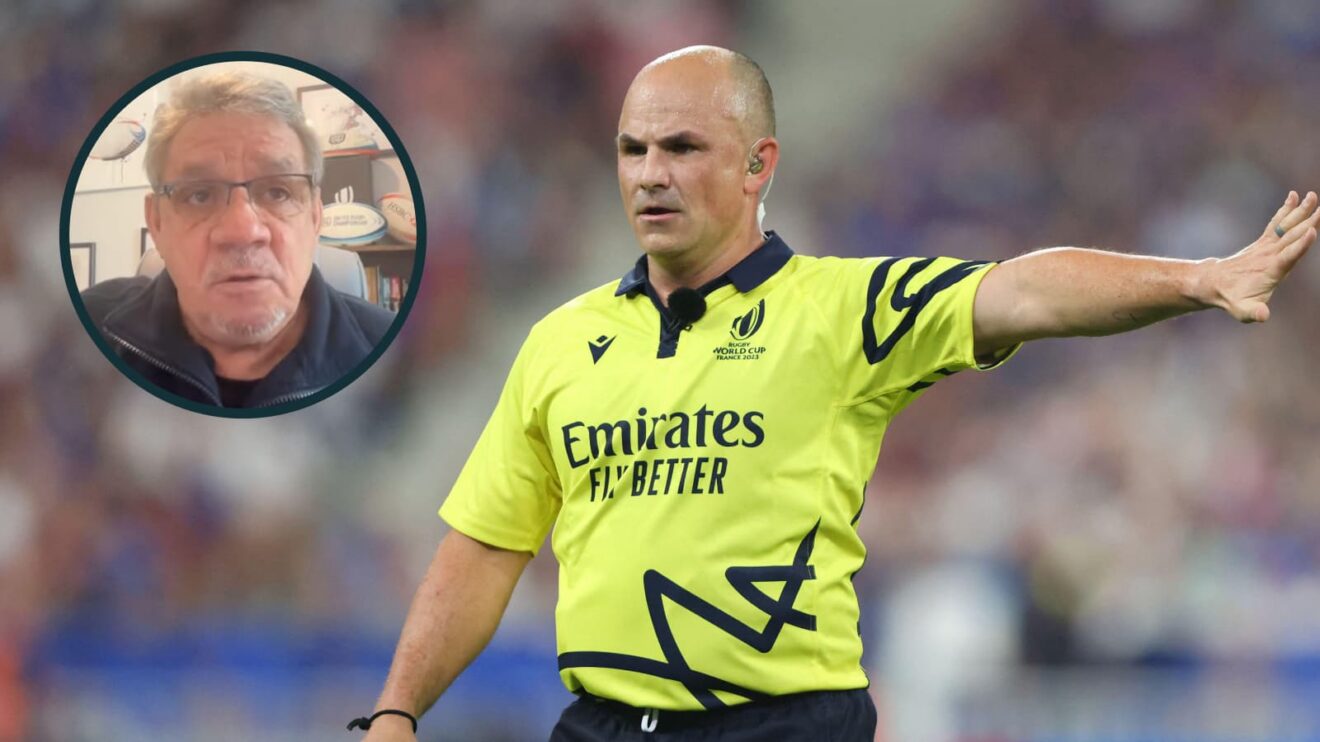
Jaco Peyper retired from refereeing after the 2023 Rugby World Cup and is South Africa's most recent high-profile international ref.
Tappe Henning, the URC’s head of referees, has addressed the reasons for the lack of top South African officials in the game.
While the Springboks have won the last two Rugby World Cups in a row and continue to be a force in the international game, the representation of South African referees at the highest level has declined.
Jaco Peyper was a regular on the international scene before his retirement from refereeing following a nasty injury in the 2023 Rugby World Cup quarter-final between Wales and Argentina. He has since joined Rassie Erasmus’ coaching team as part of his role as SA Rugby’s Law Advisor.
Even before Peyper, South Africa has produced several top international referees over the years, including the likes of Andre Watson and Craig Joubert, who officiated in World Cup finals. Outside of the pair, Mark Lawrence and Jonathan Kaplan were well respected in their heydays, with the latter refereeing 70 Test matches, the third most overall.
Henning himself was a Test referee from the Rainbow Nation and has now been entrusted with overseeing the development of the URC officials.
Despite routinely producing top officials, South Africa currently doesn’t have any who are regularly selected for top-tier Test matches. This was plainly obvious during the Nations Championship in July, with none of the South African referees selected to officiate a Test match.
Why there is a lack of South African referees in Test rugby
Marius van der Westhuizen did operate as a TMO and Foul Play Review Officer while Morné Ferreira was twice handed the assistant referee’s flag, but no South African was handed the top job – with the same being true for the World Rugby Nations Cup.
Henning has now addressed the concerns around the lack of top South African referees and explained that it’s not down to a lack of quality or options; rather, it’s a transition period. He compares the situation to that of a rugby team where they will inevitably go through a dip after a host of experienced players retire in a short period.
Furthermore, he said that a referee needs between five and seven years of professional rugby experience in order to become a top international referee.
“I will talk about the South African referees as a South African referee team from which we select the best to perform in the URC and then move on to EPCR and World Rugby,” the URC referee boss told Brenden Nel on a YouTube podcast.
“It is the same as a team that goes through cycles. If you have a strong team for a long time and then you lose your experienced referees who have occupied the top positions and got the top appointments and exposure all the time, then your next group needs to grow in their own time. That takes five to seven years to develop an international referee.
Top ref boss accuses World Rugby of breaking agreement as they seek ‘clarity’ on new tackle laws
“I’ve been around for a long time in coaching referees, and the reality is that that’s how long it takes. If I may use Hollie Davidson as an example, she is now getting to a point where she’s really getting into some proper consistency in her international appointments. Her process started in 2017, which is nine years ago. That is what it takes, and she’s an exceptional talent as a referee, but that’s how long it takes.
“The South African referees have been dominated by a group of senior referees, Jaco Peyper, who dominated in the last four or five years as the senior referee in South Africa and one of the strongest and one of the best referees in world rugby for quite a while. Before that, you had Craig Joubert, and before that you had Marius Jonker, Mark Lawrence and Jonathan Kaplan, and I can give you numerous names, but if you have strong referees that for a long period of time dominate that scene, they get the top appointments, they get the top exposure, and then when those referees retire from refereeing, you have to bide your time with the next group to build, which takes five to seven years.”
SA Rugby gives full support to milestone brain health symposium in Cape Town
Where the current referees are in their development
Henning says that the current crop of South African referees are in two or three of their development and the URC is working hard to prepare them for what comes next. However, he says that will come with mistakes from the officials as they learn and adapt to the demands of the modern game.
Want more from Planet Rugby? Add us as a preferred source on Google to your favourites list for world-class coverage you can trust.
“We’re probably now in the third year of the cycle with the names that we have: Griffin Colby, Hanru van Rooyen, and Christopher Allison,” he continued.
“That group has now only been around for like two or three years. So we need to work very hard over the next four years to build them into the package that World Rugby wants and that EPCR wants, and ready for the professional game. That is a process of errors, mistakes, and learning. You know, the line with the most scars on the face is the dangerous one. So we want our referees to get those scars and learn from the errors and mistakes, and over the next three to four years, it’s realistic that that will then be the ideal time to put their names in the mix.
“They must learn over the next three or four years as much as they can and grow as much as they can to become that package that’s acceptable.
“Experienced referees make fewer mistakes less often. That makes them the better referee because of their experience, not because they’re smarter or cleverer or know the laws better. They just know the game better. They understand better what the game requires, and their decision-making improves because they’ve been in those situations many times and they understand what the game needs. You have to learn that, and you learn that over a period of five to seven years. You don’t learn that in game one, two, or three.”
READ MORE: Sir Steve Hansen calls for ‘transparency’ from World Rugby as referees are viewed as protected