Sir Steve Hansen calls for ‘transparency’ from World Rugby as referees are viewed as protected



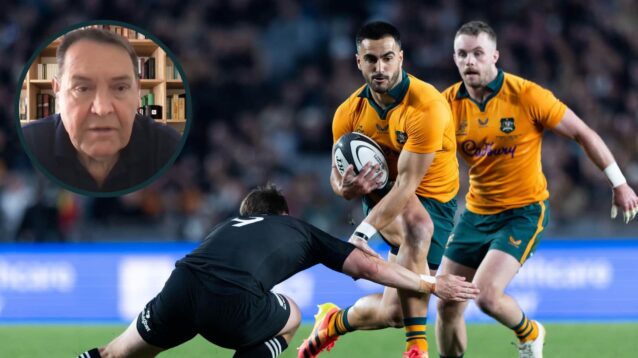
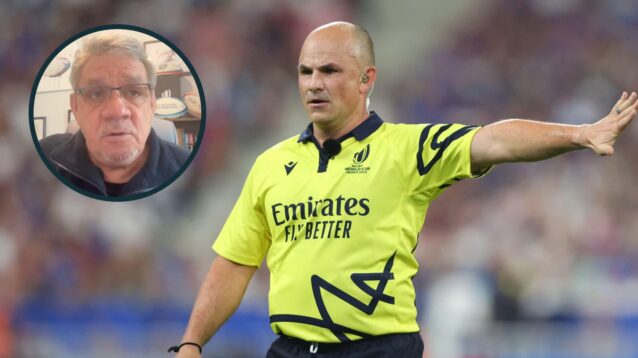
Sir Steve Hansen and an inset of referee Andrea Piardi
Sir Steve Hansen believes that there needs to be more transparency from World Rugby around referee performances.
His call comes amid the backlash of Andrea Piardi’s showing during the clash between the Wallabies and Springboks, with the referee issuing four yellow cards to Australian players.
After the match, ex-Wallabies captain Michael Hooper suggested that Piardi should no longer be allowed to officiate a match involving Australia after previous controversial performances.
Sir Steve Hansen calls for transparency
He argued that it would be in the best interest of the Italian referee if that were a World Rugby directive, something that Hansen agreed with, but the ex-All Blacks boss added the game’s governing body needs to be more transparent.
He says that referees are viewed as ‘protected’ by the public and that World Rugby needs to do a better job at humanising the officials. He also believes that the law book is too complex, which leads to inconsistent referee decisions.
“We need more transparency. More understanding of the why and the how, and more communication. There’s not enough ability to communicate with the referees and build relationships. It’s really hard to bag someone you like – you don’t see too many people doing that,” Hansen said on the Rugby Unity podcast.
“But it’s hard to like someone that you don’t know. That’s my bugbear. We are asking these guys to do probably the hardest thing in the game because the rules have got so much ambiguity around them. They’re so inconsistent; the rules I’m talking about, not the refs.
“So that creates inconsistent referee decision-making within one game from one ref to the next ref. Now that’s not their fault. That’s because of how our game laws are set up. Now we need to fix that. We need to fix the communication.
“I think there is a sense amongst some people that they are protected because of that lack of communication and that lack of transparency, and they’re not. But whether we like it or not, that’s an inconvenient fact. Some people think they’re protected, so we need to be able to be more transparent, more communication, and those things sort themselves out.
“But it starts at the top. It starts with World Rugby, and they have to be held accountable for that, not the referees.”
Michael Hooper hides referee bias accusation behind call for World Rugby to protect Andrea Piardi
Ewen McKenzie’s verdict
Former Wallabies head coach Ewen McKenzie joined Hansen on the podcast and sympathised with referees. He added that World Rugby aren’t doing themselves any favours with their decision to stop referee and coach meetings.
Previously, coaches could request meetings with officials before a match and while that is still possible in the international game, World Rugby have added the requirement that both head coaches are present.
“I don’t want to be a referee. Not at all. I’m sure you guys wouldn’t want to be a referee either,” he said.
“Like, it’s not like it takes a personality type that wants to be in that position. A lot of people wouldn’t want to do it because it looks like a hard job to me, and it’s a thankless task.
“That’s what it looks like to me because of how it is set up. There is a process of assessment, whatever it is, but that’s kept behind closed doors, so that doesn’t help; the transparency is not there.
“Then we have this change in ruling about how coaches could meet with referees that was set up recently. We talked about that. I noticed that Tappe Henning, who runs the URC refereeing, has now opened that process up more to allow coaches to meet more than what World Rugby has offered.
“He has said we are going to actually be more transparent, or at least more transparent with the coaching community. So at least there’s some understanding, so that’s good. World Rugby has done something, and the URC has already gone and changed that and made it more transparent, so good on Tappe for doing that. That’s all pointing in the right direction, so closing it down and boxing it in, I don’t think, helps. I think we’ve got to try and be more transparent and find little ways to do that.”