Tony Brown’s ‘three key things’ for attacking success as Springboks coach reveals ‘mindset challenge’ for South African stars


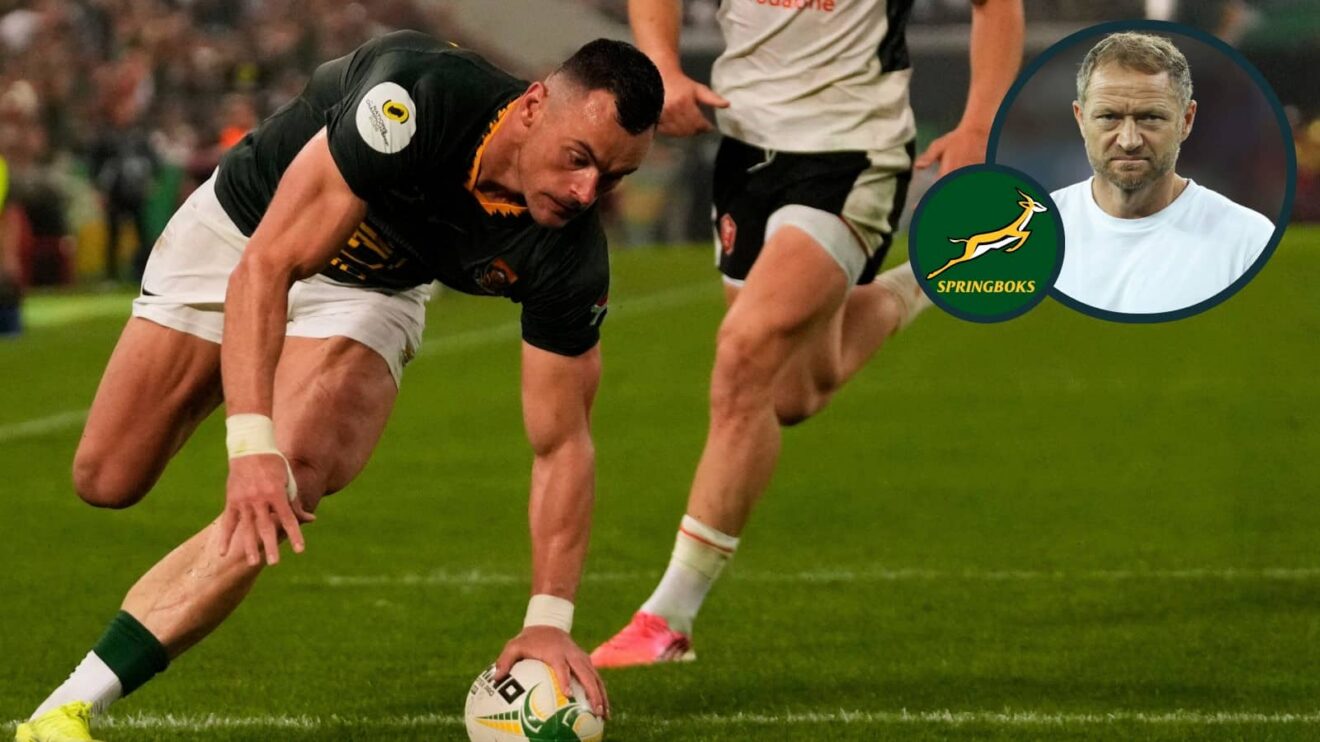
Jesse Kriel scoring a try for the Springboks and attack guru Tony Brown.
Tony Brown has provided insight into his coaching philosophy after playing an influential role in expanding the Springboks’ game since the back-to-back Rugby World Cup success.
The New Zealander joined Rassie Erasmus’ backroom team following their triumph in the 2023 global tournament.
That triumph, as well as the one in 2019, were very much based on the fundamentals of defence, physicality, set-piece and kicking.
South Africa have still held onto those core principles but Erasmus realised a need to be more adventurous given World Rugby’s desire to see more attacking ambition.
Brown’s influence
That is where Brown comes in with the 51-year-old regarded as having one of the most innovative minds in the sport.
“I think you have to be adaptable. If I have to boil it down to three key things, it’s momentum, speed and space. If you can achieve those three things on the rugby field, you’re always going to be quite a dominant rugby team,” he told the Plumtree Uncut Podcast with former All Blacks coach John Plumtree.
“On the defensive side, you’ve obviously got to stop momentum, you’ve got to stop speed and then you’ve got to shut down space, that’s the challenge.
“For me, not losing the gain line is massive, being able to always dominate the gain line that then creates space for the players to attack.
“Then if you’ve obviously got speed and skill, you can do some pretty good things on the rugby field.”
While Brown has key principles, he also has to change things based on the type of players he is working with.
“It’s always been about trying to find a way to win and you’ve got to look at the personnel you’ve got and work out where your strengths and weaknesses are, and then work out a style of game from an attacking point of view that’s going to work for those players and that team,” he said.
“It’s always a challenge depending on how good the athletes are, how good the team is. Around trying to find ways to win and trying to inspire the players to play a certain way that’s going to allow us to win more games than we lose is always what excites me about being a coach.
“Obviously, the attack side, you can get a little bit more adventurous on attack than you can on defence, but ultimately it just comes down to seeing the players you’ve got, what sort of team you’ve got and then finding a way to win and to perform, especially at the highest level.”
How the Boks differ
Brown’s other high profile jobs saw him coach at Japan and Highlanders which presented different challenges to South Africa.
“They’re definitely a different type of player and I knew I could create a certain style of game that would be successful for the Springboks,” he said.
“Coaching Japan, you’ve obviously got to attack space more to create momentum because the Japanese players couldn’t create enough momentum to then shorten the line and create space.
“They’re very good at using their skill and having that challenge to try and get them to understand how we’re going to win was really good as well.
“The Highlanders were probably a mix of both. Definitely in the early days, the Highlanders and Otago didn’t have strong forward packs, so it was always built around speed, skill and moving the ball.”
Brown stated that the Boks players were less inclined to seek space when he joined the set-up and has therefore had to alter their mentality slightly.
“A lot of it is getting them to buy into the mindset around playing a little bit more, trying to get them a little bit fitter so they can position a little bit quicker,” he added.
“Obviously, South Africans get brought up and coached to run over the top of people which doesn’t always work at international level, so being able to use your skills a little bit more, use your footwork a bit more and attack space a bit more is always going to be the challenge.”
READ MORE: Dave Rennie: ‘Springboks are beatable but you’ve got to be at your best’