Ben Smith: Springboks ‘manipulated’ the All Blacks in a part of the game that has become a lot harder than when I was playing


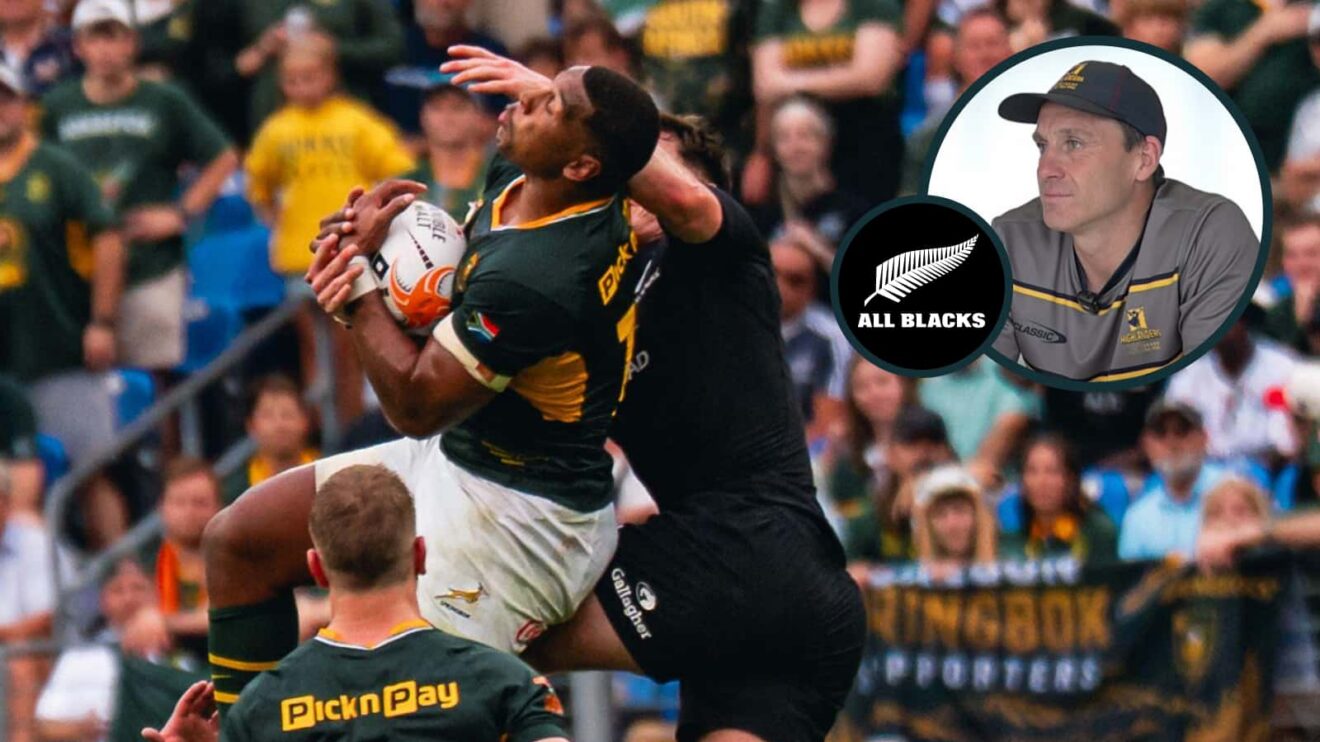
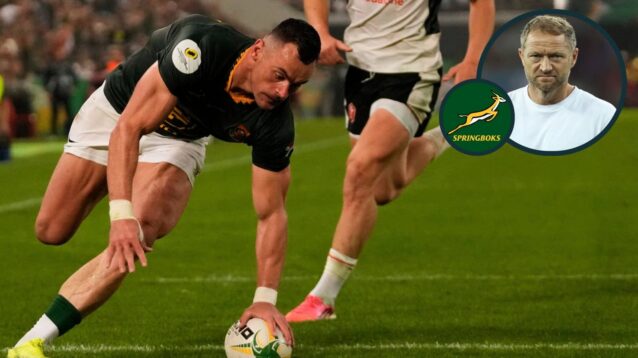
An aerial contest between the Springboks and All Blacks with an inset of Ben Smith.
Legendary All Blacks full-back Ben Smith has hailed the tactical impact of Tony Brown during Rugby’s Greatest Rivalry series.
After going down 1-0 in the Test series opener, South Africa rallied to win the next three matches against New Zealand, with their set-piece and superior aerial game playing a pivotal role in Rassie Erasmus side’s success.
In his heyday, Smith was one of the best full-backs in the world and was renowned for his ability under the high ball, and now is an assistant coach at the Highlanders, where he has worked alongside Brown.
Tony Brown’s fingerprints
The 84-Test cap former outside back has weighed in on Rugby’s Greatest Rivalry series, revealing where he thinks the Springboks got the upper hand.
“I thought it was awesome just as a spectator watching,” he told the Highlanders’ YouTube channel.
“Everyone knows how tough it is to play over there [in South Africa], but I just thought the games were really epic, great contest. Obviously, we did really well on the first one. South Africa came back, and the set-pieces are where they do really well, and then in the aerial game they were pretty good, and then they sort of fed off that.
“So, it was impressive to watch both teams going at it.”
While South Africa played quite conservatively in the opening three games of the series, they changed tack in the finale, adding more width to their attack.
Baltimore shift
Smith says that Brown’s influence was clear to see in Baltimore. He added that the four Tests against the Springboks has prepared the All Blacks well for next year’s Rugby World Cup in Australia, where they are likely to meet South Africa in the quarter-finals.
“Definitely had Brown’s fingerprints on there. I think they’ve got a really good balance to the game at the moment,” Smith said.
“Around being able to use their set-pieces, but also use their skill out to the edge, through the middle, and they’ve got some pretty handy players at the moment.
“They have got a lot of experience, which has shown through at key times for them, and they’ve been able to squeeze us. But I think it’ll be good for us going into the World Cup next year, to be able to go over to South Africa, play some really good Tests, and hopefully it’ll set us up for next year to be able to beat them in what will hopefully be the quarter-final.”
Commenting on New Zealand’s attack under Dave Rennie, Smith added: “I thought they had a real intent to move the ball and want to play. Then they’ve obviously got the players to be able to do that, so that was pretty impressive to watch.
“It’s a tough place to play, so just a couple of key moments and those other Tests that I just thought South Africa sort of squeezed us, but we did manage to play some really good footy.”
Dave Rennie: ‘Springboks are beatable but you’ve got to be at your best’
South Africa’s point of difference
The All Blacks managed to outscore the Springboks in the try-scoring stakes, crossing for 17 tries to South Africa’s 14, and Smith believes that their ability under the high ball was a huge contributing factor.
Much has been made about the All Blacks’ struggles under the high ball, even under Scott Robertson. Rennie’s side has trialled a new tactic of wingers running backwards to catch the high ball instead of running onto the ball.
While it was effective in the opening Test match, the Springboks adjusted their tactics thereafter with Smith crediting Brown for the tactical switch.
“I think it’s always been a point of difference for South Africa about going after that high ball, and I’ve heard that they train it a lot,” he said.
“It’s a real point of difference, sort of like their set piece in a way, for South Africa to be able to go after that. So, I thought that showed in the series.
Want more from Planet Rugby? Add us as a preferred source on Google to your favourites list for world-class coverage you can trust.
“Then the All Blacks, I just found it pretty interesting to watch. They were trying to combat it, obviously, with the winger trying to get back and catch it. Brownie, being a smart operator, moved the point of contact where they kicked it, and it became a real battle of manipulating that whole battle in the air. I thought it was interesting as it played out as it went through the series and how both teams sort of approached that.
“I think at times the All Blacks tried to move the ball a little bit more and go away from the box-kicking and try to shift the point of contact a little bit more. Whereas South Africa were, you know, that’s a real point of difference for them. So, they keep going there, and they got pretty good gains, to be fair.”
Improving under the high ball
Asked if it is a difficult skill to train, Smith said: “The hardest thing is to train it under pressure where you’ve got contact, and there’s a lot going on in the air around that. That’s the tough one.
“At times it’s probably easier to be the team that’s kicked it and chasing it than the team that’s actually trying to defuse it and defend it because those guys have got all the momentum going forward.
“The way that the South Africans were able to manipulate space and put it in the right areas to actually make it hard for the All Blacks to catch it, I thought they did that really well. But I’m sure the All Blacks will have looked at that and have a few more plans going forward. So, I’m interested to see how it all sort of plays out because it will obviously affect Super Rugby next year in terms of how everyone approaches that part of the game.”