Starting Leicester Fainga’anuku at flank in a Test would be ‘unfair’, claims ex-All Black as he pales in comparison to proven international



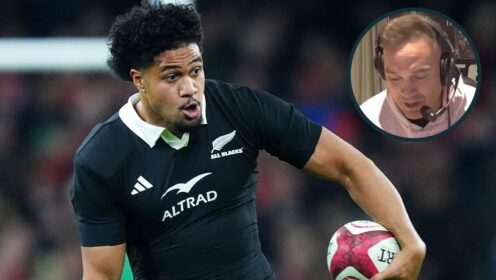
Crusaders' star Leicester Fainga'anuku and an inset of Queensland Reds forward Fraser McReight.
James Parsons says that it would be ‘unfair’ to expect Leicester Fainga’anuku to start in the loose forwards for the All Blacks.
The Crusaders‘ star put in a man-of-the-match performance in the 35-20 victory over the NSW Waratahs, which was his first start in the number seven jersey for the Christchurch-based club.
While the centre/wing-cum-flanker has received glowing reviews from many fans and pundits for shift against the ‘Tahs, Parsons has taken a close look at his performance and weighed it up against fellow openside flankers from the weekend.
Leicester Fainga’anuku pales in comparison to Fraser McReight
The former All Blacks hooker believes that the Crusaders didn’t help him out enough and probably should have played him at number eight or blindside flanker instead.
But was the experiment a success? “I can’t give you an answer because I don’t know what the success is,” Parsons said on the Aotearoa Rugby Podcast.
“If Rob Penney wanted all the focus to be on creating opportunities, then yes. Whether you can do that against another team, I’m not sure.
“If you come up against the Chiefs or Canes, who defensively will be more physically dominant, I still think you can look at the way Jordie plays in the pod system, and Quinn Tupaea plays in the pod system. I still think you can get as much benefit in your game plan with him at 13. Probably not winger – wing would be hard for him to play in that pod role. He’d probably have to be in the midfield and then not lose that ability around the breakdown and in your defensive patterns.”
Parsons used stats to detail where Fainga’anuku paled in comparison to the likes of Fraser McReight and Du’Plessis Kirifi over the weekend. Stating that while there is potential for the Crusaders’ star to be a force in the back-row, he has a lot to learn when it comes to loose forward play.
“From what he’s done, like to go from midfield to wing to actually put on that 80-minute shift at seven is a big job – even for actual sevens, it is huge,” he said.
“His numbers stack, but there are some intricacies around the gain-line, lightning-quick ball, the balance between carry and pass, and also in terms of the attacking breakdown.
“He hit 30 attacking breakdowns, which is pretty impressive, but 23 of them involved three or more players. So you’re coming in fourth or fifth player. Someone didn’t do their job, and he had to come do a job, which is fine, but if it’s one of those, then that’s sweet; you’ve done your job. But if you’re coming in and just hovering around the breakdown and the job has been done, then it’s an attacking player missing that could draw the defence.”
‘It was like Jonah Lomu’ – Ex-All Black’s verdict on Leicester Fainga’anuku experiment
Unfair comparison
Adding further context, he revealed the same statistics that Wallaby McReight produced in the Queensland Reds’ 36-33 defeat to the Blues.
“In comparison with Fraser McReight, who’s an international seven, he hit 45 rucks, which is ridiculous; he’s a busy man, but only two of them were plus three (players at the breakdown), and you’d have to think with a man of his skill set and the way he played against the Blues, you’d think those two were probably needed.
“It’s just unfair to even judge Leicester on it. It’s a thing you learn over time, and you almost need to learn this away from the bright lights, like everyone’s eyes were on this game. Everyone was looking at how Leicester went, and from just a visual point of view, watching the game, everyone’s left going, ‘Man, he’s a seven’. But you look at Fraser McReight’s numbers, who’s a proven international seven, there are still parts of that role that needs to grow.”
While the former hooker wasn’t overly convinced that Fainga’anuku fulfilled the positional requirements of an openside flanker well, he does think that Dave Rennie could utilise him as a back-rower in the latter stages of Test matches.
“But could he do it in a hybrid role late in the game, tiring defences off the bench? Yeah, I think he could at the international level. I think starting at seven at the international level would be unfair to him,” he concluded.
Want more from Planet Rugby? Add us as a preferred source on Google to your favourites list for world-class coverage you can trust.
Benefit for the All Blacks
Ex-Crusaders scrum-half Bryn Hall agreed with his fellow pundit and said that his former club should continue to trial Fainga’anuku in the position for the betterment of the All Blacks.
“The utility role and with what we have seen with Esterhuizen at the Springboks, it’s a massive bow that Leicester can have,” he said.
“We talk about the 12 and 13 when it comes to Jordie Barrett at Quinn Tupaea, who’s played really well, and Billy Proctor. If he can cover wing, the midfield, and whatever it may be in the loose forward, if you’re looking for the bigger picture for Leicester and the All Blacks, I think it’s a great role.
“I find it a little bit unfair to be able to expect him to be able to get everything right as a seven like McReight, who’s played almost 10 years and his junior rugby in that position. For Leicester and what his role is, I’m not privy to what his role was from Rob Penny in that coaching group, but I can only imagine it was being able to get over the ball, get as many touches as you can, and being able to influence the game like that.
“And then if they do continue this, then the things that Jippa [Parsons] is touching on, they can maybe get little bits of gold from that week-to-week if they continue to have them in that position.”