Springboks v All Blacks: The five drills behind what you’ll watch in Rugby’s Greatest Rivalry opener


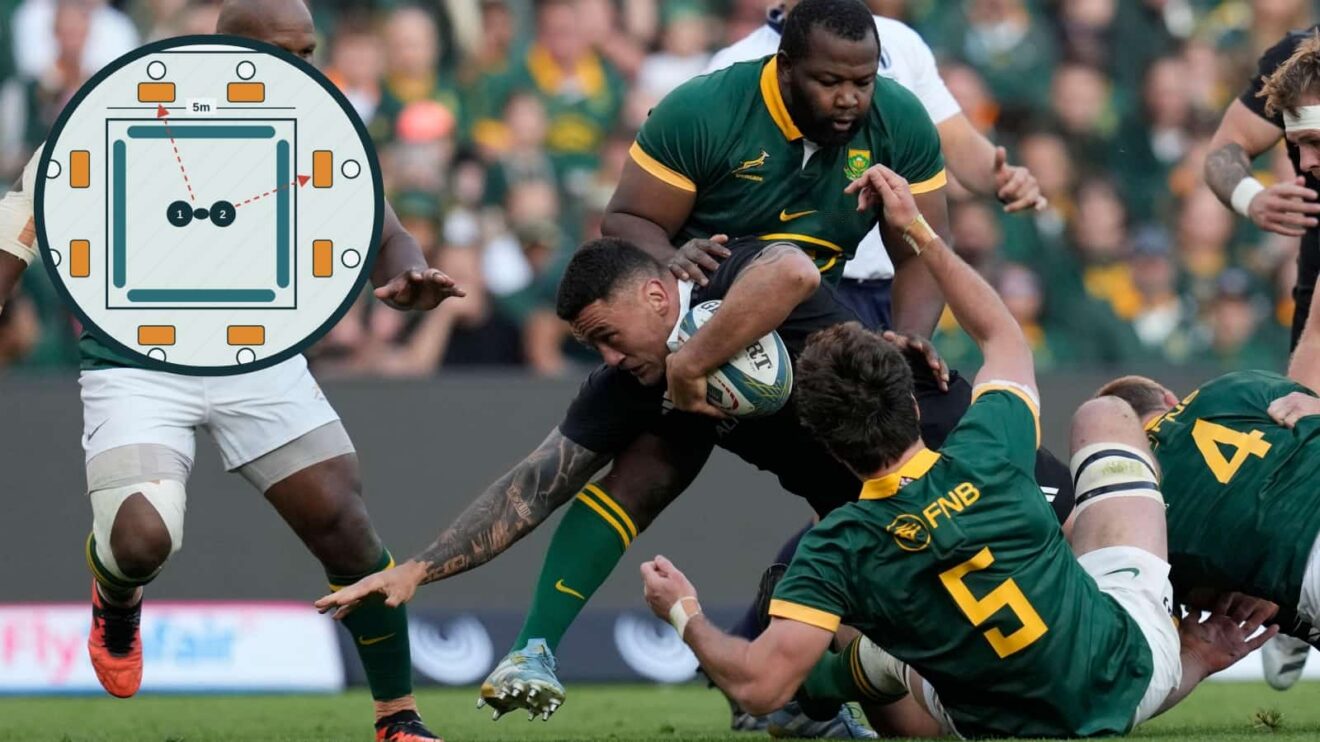
A breakdown during the 2024 clash between the Springboks and All Blacks.
Both packs have spent this week working on the part of the breakdown that alludes fans and pundits, and the drills they’ll have used have their own bloodlines: one out of the Chiefs, one out of Paris, one that arrived in the Springbok camp inside Felix Jones’s laptop.
Few drills in a modern contact session is designed to teach the jackal, because the jackal is, in some ways, the easy bit and every seven in the world thinks he’s already world class at it; the difficult second either side of it is what actually decides your afternoon- ruck speed, accuracy and intensity in a 15 man context- and that’s what these five are built for.
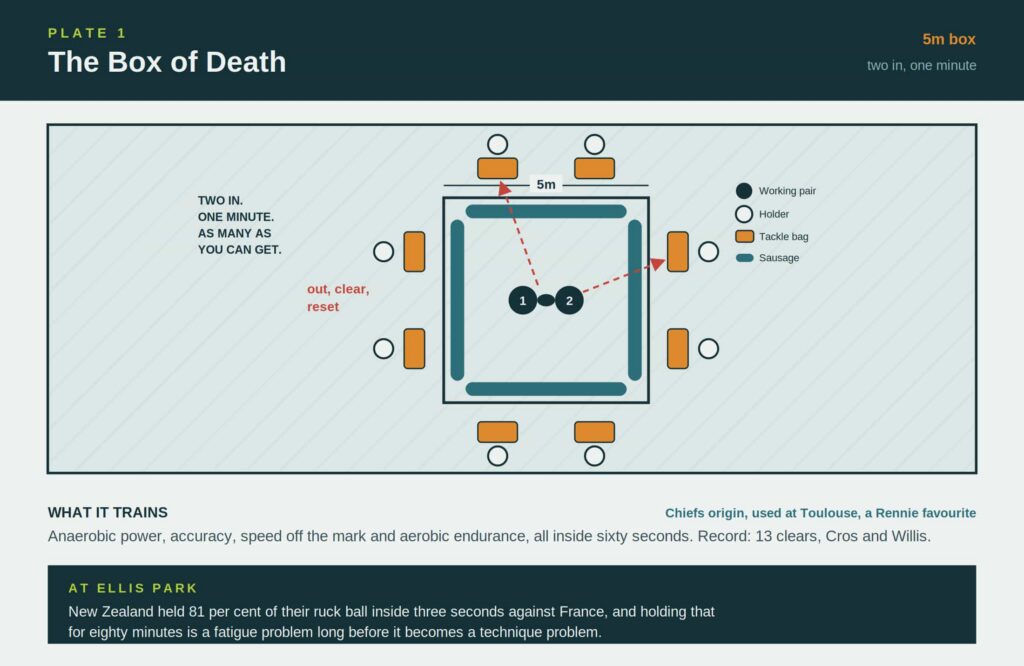
The box of death
This beauty started at the Chiefs, went as far as Toulouse, and it’s a Dave Rennie favourite, which is worth knowing before Saturday. I’ve run it for years and no player has ever once thanked me for it. In fact, I’m sure I’ve received idle death threats to me and my family after a particularly brutal session.
In fact, at recreational level, I well remember running this drill with our very own Jared Wright as part of the player group; Jared immediately threatened us with an employment tribunal claim once he’d got his breath back and sent me sinister GIFS of Tendai Mtawarira destroying England and Lions for three weeks as revenge.
Five-metre box, a tackle sausage laid inside each edge, two bag holders on all four sides, and a pair in the middle who clear whichever bag you call, reset to the centre, and go again for a minute, coach placing ball to make players work. Call the bag late, because if they can see it coming they’ll set off early, and you’ll have spent sixty seconds watching two men jog somewhere they’d already decided to go to use up the clock. In short, you’re trying to replicate game situations, where thinking time is a premium.
The first half-dozen reps look wonderful, everybody square and low and you start wondering whether you’ve made it too soft; then somewhere around forty seconds the legs go, the body height creeps up, shoulders start arriving ahead of feet, and you find out what you came to find out, which is usually that your loosehead has decided, rather tactically, a controlled collapse onto the bag counts as a clear-out.
It’s lung-busting, and that’s the whole point, because you’re getting anaerobic power, accuracy, speed off the mark and aerobic endurance out of the same sixty seconds instead of four separate sessions; best I’ve seen is thirteen in the minute, and rather predictably, it was Francois Cros and Jack Willis, which won’t shock anyone who watches Toulouse.
It came out of a Chiefs environment for obvious reasons, since tempo means ruck volume, ruck volume is a fitness problem dressed up as a technical one, and Rennie’s All Blacks are producing 55 more rucks a game than Scott Robertson’s did, so somebody has to establish who’s still arriving square on rep fourteen. They held 81 per cent of their ruck ball inside three seconds against France, which is a lovely number in August and a considerably harder one at altitude in the seventy-second minute.
The race
Five stations in lanes off one start line, everybody goes on the same whistle, and the first man through his own station and over the line takes it. (which is the only piece of scoring most tightheads will manage all season, unless your name is Thomas du Toit.)
Ball carry into a tackle pattern; a sausage held high to be stepped and driven under; a contact load onto a shield the holder swings at you; a prop-sized hula hoop; and a man lying over a sausage with a pad who has to be shifted off the top. The hoop is a Stade Français idea that France took into the Test set-up, aimed at a problem every big French pack has, which is that large men get tall in contact and tall men lose to smaller men underneath them; it’s the station players moan about most, which usually means leave it in- and the hoop builds technical accuracy.
Rotate the lanes every single round, because otherwise they’ll all quietly drift towards whichever one suits them, and you’ll notice that the bloke who most needs the hoop has somehow never once been in that lane, whilst your back three have colonised the ball-carry station where the only real requirement is running fast in a straight line, which they were going to do anyway.
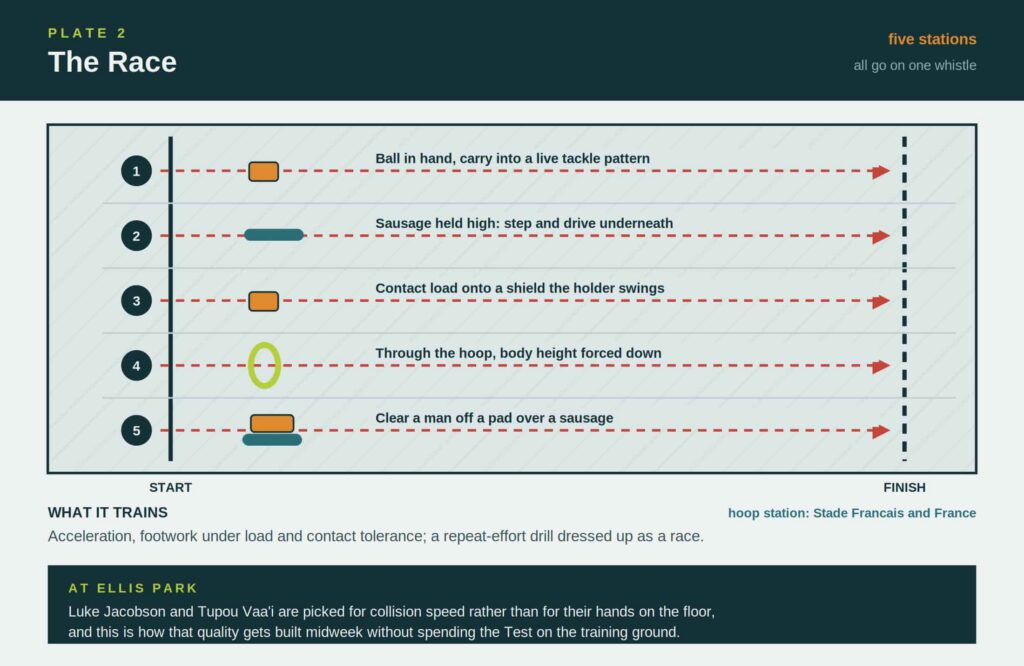
The intensity comes off the clock and off the man alongside you rather than out of another body, so you buy the competitive edge without the collision bill, and every Test conditioning department on earth is now making that trade; what you get for it is acceleration, footwork under load and a tolerance for contact, with the aerobic cost arriving through the rounds rather than the reps. It’s also how you build what Rennie has picked for, because Jacobson and Vaa’i are in that back row for collision speed rather than for anything they’ll do with their hands on the floor.
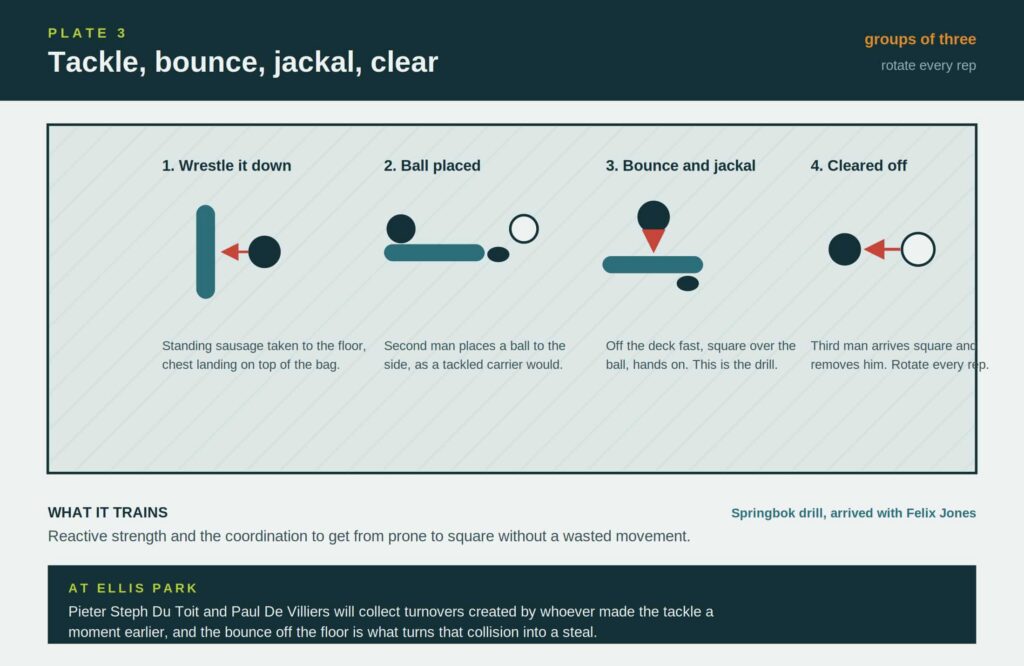
Tackle, bounce, jackal, clear
A Springbok drill, and it came in with Felix Jones, which is worth a moment given how much of this week Jones has spent on other people’s technique at the breakdown.
In groups of threes: one man wrestles a standing sausage to the floor and lands chest on the bag, the second puts a ball down beside it exactly as a tackled carrier would, the first is up and square over that ball, and the third comes to shift him.
This one is all about accuracy and timing. Everything sits on the bounce, because half a second slower off the deck and you arrive alongside the cleaners rather than in front of them, which is the entire distance between a turnover and a penalty for holding on; tiredness shows up here as scruffiness long before it shows up as slowness, so watch the hands rather than the feet, and watch the props, who will lie on that bag like a man who has found somewhere comfortable and intends to stay.
It fits the system Jones coaches into, where you win the collision and then let a very few licensed men profit from it, so that half-second bridge has to be trained rather than assumed. It’s also why the wide channels behave differently from the middle, since out there it tends to be one against one, the tackler’s up quickly and the support is a long way off, and when Pieter-Steph du Toit or Paul de Villiers wins one on Saturday you want to be looking at whoever made the tackle immediately before, because he’s the man aiding and abetting theft and robbery.
The gauntlet
Another South African one, and it’s travelled a good deal further than its origins get credited for.
Three gates, each a pair of pads squeezed together by holders with a ball trapped between them, and one runner taking each ball in turn in a legal position before going straight on to the next. The holders are the ones you’re really coaching here, since squeezing hard enough to make it difficult but never impossible is a finer judgement than it sounds and you’ll need a couple of rounds to calibrate it; too hard and he starts hauling with his back, too soft and you’ve built a jog with pads.
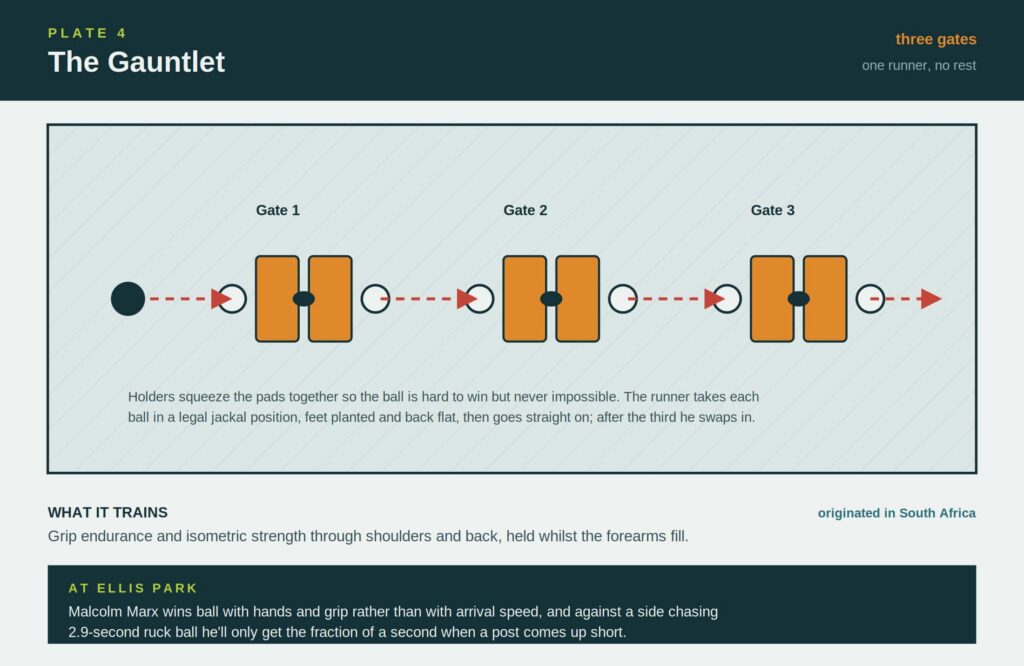
By the third gate the arms have gone, which is the intention, because what you’re after is grip that survives a full afternoon and a back that stays flat when the forearms are full; it’s the least glamorous thing on this list, brutal to upper body, but a lot of fun, not least because it’s the one drill where the front row are entirely at home and your stripling winger discovers at gate two that being able to run 10.7 is no use whatsoever when a ball won’t come out.
Marx is the reason to bother with it. He wins the ball with hands rather than with speed to the contest, and against a side chasing sub-three-second ruck ball he’ll get a fraction of a second whenever a New Zealand placement comes up short.
Want more from Planet Rugby? Add us as a preferred source on Google to your favourites list for world-class coverage you can trust.
Round the corner
Everybody runs this one, north and south, which is rare in a game where the good ideas normally sit inside the building for a season before they leak.
Nine feeds a pod of three; they run at passive defenders and set a clean ruck, carrier down on being touched, two men clearing, and the nine plays away to the next pod arriving round the corner, who do the same in the opposite corridor; start with touch and uncontested rucks, then build to live, and let the nine run if he sees something.
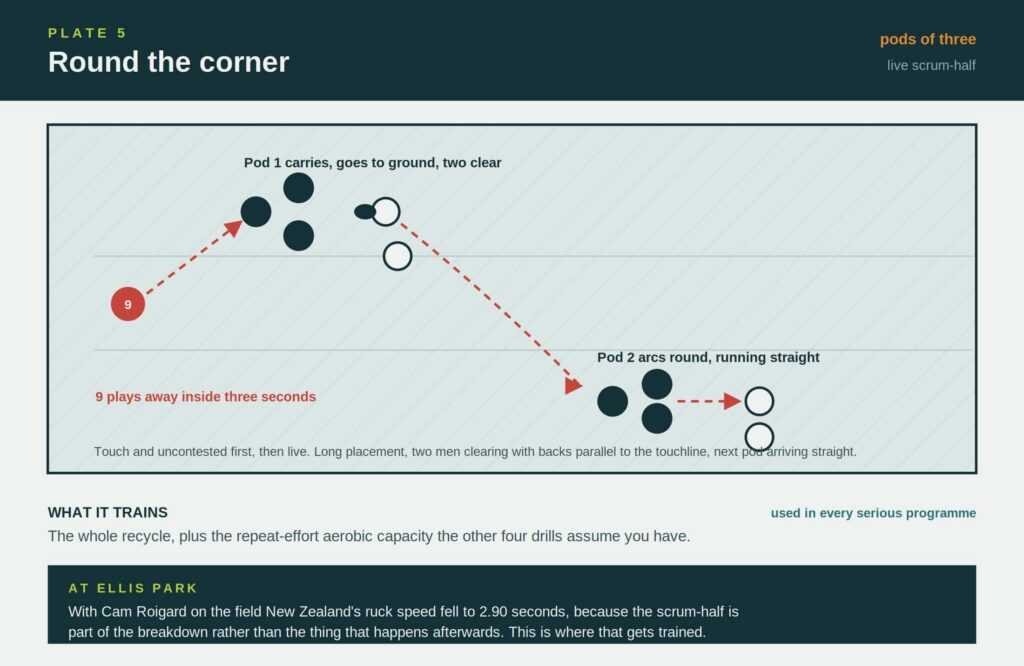
Three coaching points, in this order. The carrier presents long, arms extended back towards his own side, because everything after that depends on the separation; the clearers arrive with backs parallel to the touchline rather than square to the posts; and the next pod runs an arc so that it arrives straight instead of drifting, which is the difference between recycling the ball and shovelling it sideways whilst everyone admires the scenery.
Most sessions put it at the end, partly because it’s the only genuinely aerobic drill in the set and partly because of the fourth man, since a pod can clear beautifully and still leave the nine a two-movement pick-up, at which point the previous three seconds have been wasted. With Roigard on the field, New Zealand’s ruck speed fell to 2.90 seconds, and no amount of forward work gets you there on its own.
South Africa need a handful of short New Zealand placements across eighty minutes to justify the way they’re built, whilst New Zealand need four rucks in five inside three seconds simply to play their game at all, and both of those things get settled on a Tuesday every bit as much as on a Saturday.