Sir Steve Hansen: The ‘inconvenient fact’ is that the All Blacks are ‘not good enough’


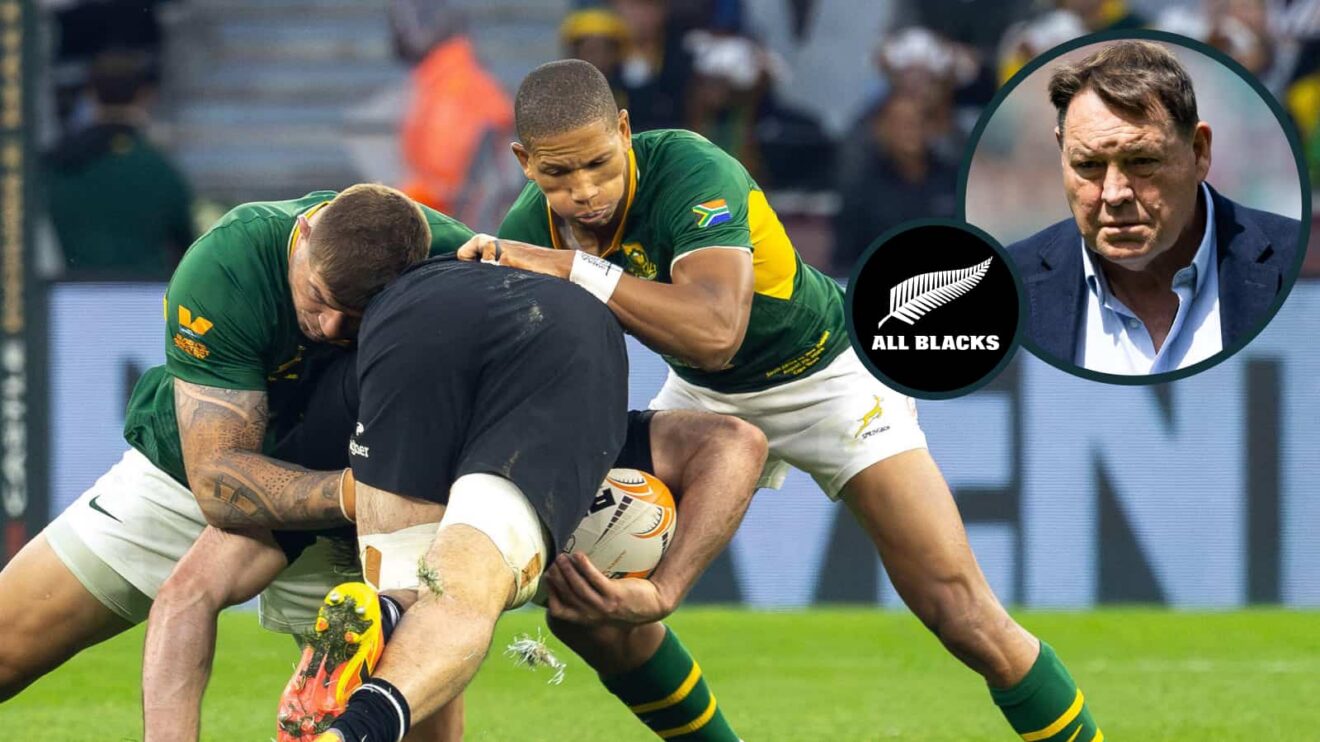
Springboks Malcolm Marx and Manie Libbok make a double tackle against the All Blacks an inset of Sir Steve Hansen.
Sir Steve Hansen says that the All Blacks weren’t ‘good enough’ in some areas of their game to beat the Springboks, but believes those issues are all fixable.
The 2015 World Cup-winning coach admits that New Zealand are behind South Africa in several departments but feels that the players will feel the pressure to improve from the public.
Sir Steve Hansen: New Zealand will be driven to improve
According to Hansen, the Springboks won these battlegrounds across the last three Tests of Rugby’s Greatest Rivalry Series, and going forward, it has to be improved.
He adds that the players and coaching team will be driven to make those improvements, as it has always been a driver for New Zealand.
“If you look at the New Zealand psyche, we want to win. We don’t want to just make up the numbers, and that’s what a lot of New Zealand fans will be feeling like – we didn’t win enough, and we lost the series,” Hansen said on the Rugby Unity podcast.
“That’s always been a driver for the All Blacks; the external pressure of having to win all the time is only superseded by the internal pressure of having to perform well and win these contests.
“That’ll drive them to a higher level of performance every day; that’ll sit in their gut, and they’ll know that they have to be better because at the moment they’re not good enough.”
Where the All Blacks are falling short
Delving into the All Blacks’ weakness that the Springboks exposed, Hansen pointed to New Zealand’s pre-breakdown work, their scrum performance, their ability under the high ball and their ability to stop the Springboks’ maul.
“That’s an inconvenient fact [that the All Blacks weren’t good enough], but there are probably three areas I think that we really got to challenge ourselves,” he explained.
“Ball into contact, I thought we went to ground too early and didn’t give the first arriving player enough time to cope with their guys over the ball, like Marx. South Africa are very good at that; they’re very good at getting over the ball.
“I thought our scrum on our ball was okay, but on their ball we didn’t challenge them enough, and there were a lot of penalties in that area that allowed them to get into that lineout and maul situations where they eventually scored tries.
“So, we’ve got to find some more power on their ball, but we’ve also got to find ways to stop their maul better. Whether it’s getting up and competing [in the lineout], whether it’s staying on the ground, we’ve got to do that better and it’s the initial first hit in that maul that we’ve got to get sharper on. We still haven’t mastered the high ball as well as they have, and they’re trying new things there. So that’s just going to take time.”
They are fixable problems
The ex-head coach did see some improvement in Baltimore already, pointing to New Zealand’s own lineouts but added that all of the issues that Rennie’s team had during Rugby’s Greatest Rivalry series were fixable.
Want more from Planet Rugby? Add us as a preferred source on Google to your favourites list for world-class coverage you can trust.
“Our own lineout ball, I thought we were better on the weekend. We have moved the lineout around a little bit, made their big fellas have to move and chase us, and when we did that, we got good clean ball, but we were still too slow off the ground when going in a tempo race with them. So, that’s just some work individually on players and combinations,” he added.
“Everything that we need to work on is very fixable and very quickly. So, it’s exciting because we’re not that far away, and when we get those things right, then we’re going to be challenging to the point where the game becomes different for both teams.”