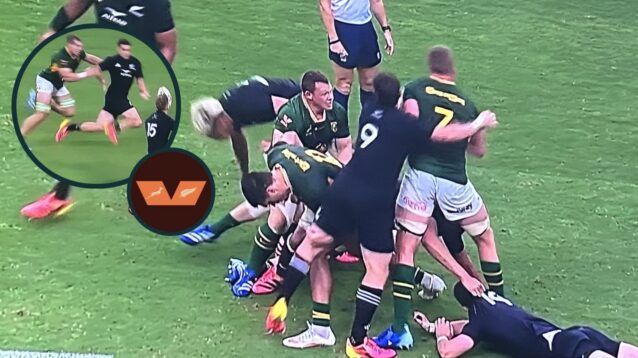
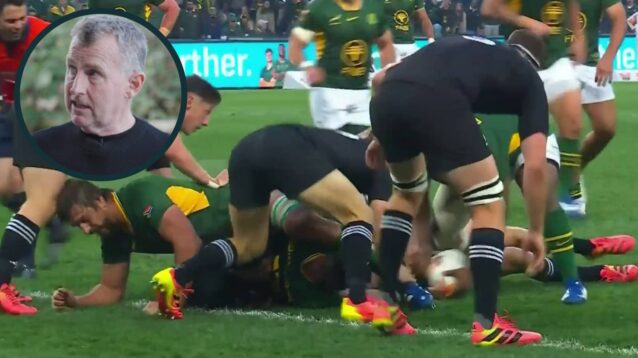
Nigel Owens: World Rugby ‘should be applauded’ for law amendment as controversial timing explained


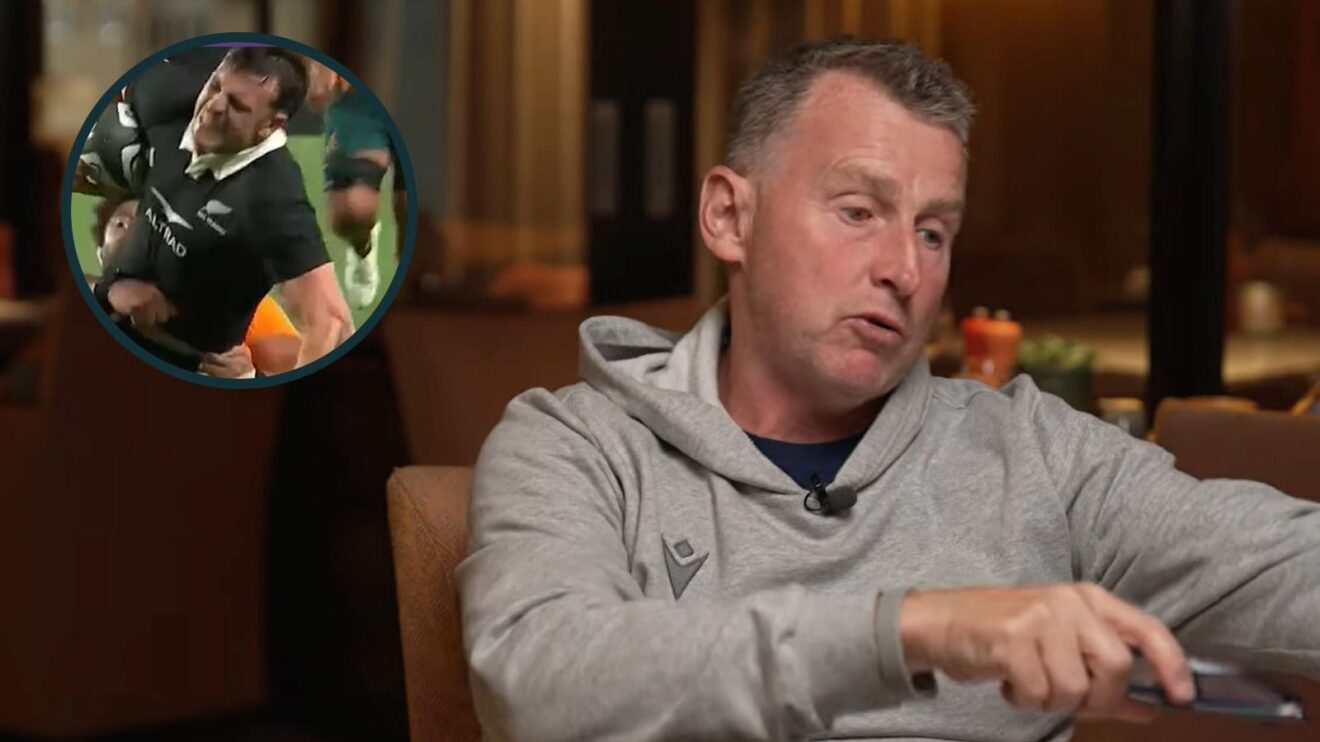
Former Test referee Nigel Owens and the hip drop tackle on All Black Leroy Carter.
Former Test referee Nigel Owens believes that the sport’s bigwigs “should be applauded” for getting rid of the hip drop tackle despite criticism of World Rugby.
From November 1, it will now be illegal for tacklers to put their bodyweight onto the lower limbs of their opponents after grabbing them from the side or behind.
There has been criticism in some quarters, however, with All Blacks legend Jeff Wilson claiming that the governing body are entering “dangerous territory” with the law change.
France’s criticism of World Rugby
The timing has also been criticised with it announced partway through the northern hemisphere season with France’s head of referees Mathieu Raynal taking aim at World Rugby.
Raynal is supportive of the decision to outlaw the tackle, though, and that is the view of many observers.
Leroy Carter suffered a nasty injury after being the victim of a hip drop when Wallabies back-rower Rob Valetini desperately tried to stop the New Zealand wing from scoring.
That sort of incident will now be penalised in the Nations Championship, as Owens explained on World Rugby’s Whistle Watch show why it has been brought in now.
“You tend to see law changes happen every four-year World Cup cycles because they’ll trial other laws and they’ll look at it and if it works they’ll bring it in,” the Welshman said.
“They don’t just drop a law in but, when it comes to player safety, if there is a concern there’s something that could be dangerous, then they will bring that in pretty quickly and quite rightly so.
“What you will see from November 1 – this (Valetini’s tackle on Carter) is a perfect example of what it is – will be illegal.
“There’s no malicious intent when you’re chasing somebody and they’re going to dive for the try, you tackle them and do as much as you can to bring them back and stop them.
“That’s what happens here, but in doing that you then drop your weight down then, which is not malicious but it’s on the lower limb.
“What we saw then was a serious injury. There’s no sort of recklessness or maliciousness around this law but that action we have seen can cause a serious injury.
“It’s a correct law to bring in and this is the perfect example of why we [have]. I do have empathy as a defender because if all they’ve got to do is fall over the line and I’m tackling from behind, there’s no way I’m going to stop you unless I’m able to grab you and pull you back.
“The evidence is there on this one on why I think this is a move that should be applauded.”
The knee drop tackle
World Rugby have also told referees to clamp down on the knee drop, where the defender drops to either one or both knees before making a tackle.
It is more of a clarification than an amendment, with players considered out of the game when off their feet, but it is something officials will be looking at properly from now on.
“It’s not a law change because it’s always been in law, there’s probably been a clarification now around it and a directive to referees, Owens said.
“Basically, you drop your knees to the ground and then you make a tackle. What’s always been in law since the beginning of rugby is on the ground, out of the game, but it’s never been refereed like that.
“Where you’re seeing a lot of this, because of how things have changed in rugby, since you’ve had a lot of the pick and gos, particularly around the goal line, you are seeing players already down targeting quite low and another one targeting quite high.
“Basically on the goal line, you’ve got players on the ground waiting for the ball carrier. That is now illegal.”
One caveat is that it will not be deemed illegal if the defender drops to his knee or knees at the same time as making the tackle.
“It will be interesting to see how it’s refereed on the goal line because it’s a bit more tricky and quite simultaneous. It’s always been in law that you have to be on your feet to make a tackle,” Owens added.
“What was starting to happen was players dropping the knee to the ground and then the ball carrier comes into them.
“If a player is making the tackle and as he’s making that tackle his knees are on the ground, that’s fine, that’s simultaneous, that’s not illegal.
“What we want out of the game is the knee drop and then the tackle afterwards.
“There’s a lot of that around the goal line so this is going to be a bit of a shift around the goal line in particular for players who have to make sure they are off the ground.”